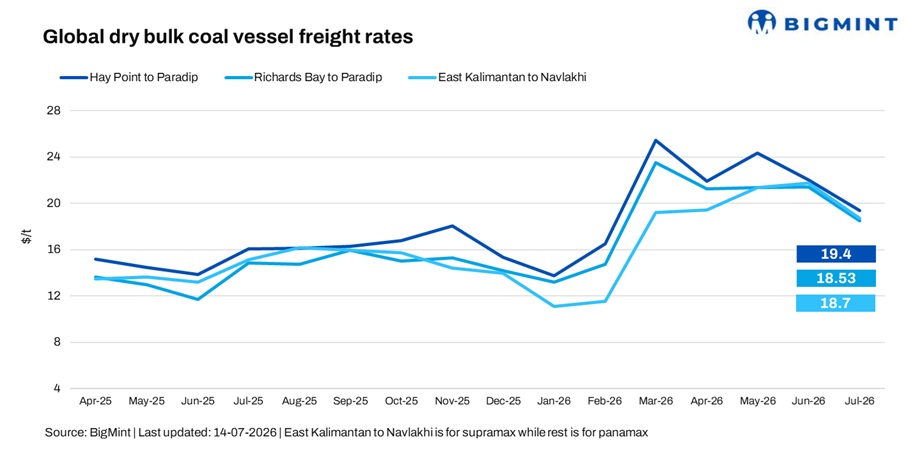
- Australian route supported by firm bunker prices
- Limited RBCT cargoes and softer Indonesia demand weigh on sentiment
India’s dry bulk coal freight market witnessed mixed trends in the week ended 14 July 2026, as firmer bunker prices supported freight rates while uneven cargo availability across key loading regions limited broader market momentum. The Australian route remained resilient, whereas softer demand from South Africa and Indonesia capped gains on other routes.
The Panamax market maintained a firmer tone during the week, supported by higher bunker prices and steady Australian cargo enquiries, although overall fixing activity remained measured.
Singapore’s Very Low Sulphur Fuel Oil (VLSFO) bunker prices surged to $741/tonne (t) on 14 July, up sharply by $87/t from $654/t on 11 July. The increase was primarily driven by a rally in crude oil prices amid renewed geopolitical tensions and supply disruption concerns. Firmer refining margins, stronger marine fuel demand, and tighter prompt availability in Singapore further supported bunker prices.
A shipbroker told BigMint, “The market is showing a firmer tone as rising bunker prices have provided support to freight rates, although overall fixing activity remains largely unchanged.”
Another broker added, “The strength was largely confined to larger vessels. The Capesize segment remained firmer on stronger cargo demand, while Panamax, Supramax, and Handysize markets traded broadly flat amid limited fresh fixtures and modest cargo demand.”
Route-wise update

The South Africa-India route remained subdued as limited cargo availability from RBCT continued to restrict fresh fixtures. A shipbroker mentioned, “Cargo availability from RBCT remains limited, resulting in subdued fixing activity and little movement in freight levels on the route.”
Meanwhile, the Indonesia-India Supramax route remained under pressure as softer coal demand and improved vessel availability weighed on freight sentiment. Market participants also remained cautious over geopolitical developments, which could quickly alter freight dynamics if tensions escalate.
“Freight levels have not seen any major changes so far. However, any escalation in geopolitical tensions could impact freight rates in the coming weeks”, a source told BigMint.
Outlook
India-bound coal freight rates are expected to remain broadly firm in the near term, supported by elevated bunker prices and stable cargo demand from Australia. However, market direction will continue to depend on cargo emergence from South Africa and Indonesia, vessel availability, and the pace of fresh fixtures.
While firm bunker prices and owners’ resistance are likely to provide a floor to freight rates, subdued activity in the Atlantic basin and any weather- or geopolitics-related disruptions could limit upside and keep sentiment mixed across routes.

Leave a Reply