- Weak finished steel demand restricted sponge iron market recovery.
- Trade volumes softened as buyers limit bookings at higher prices.
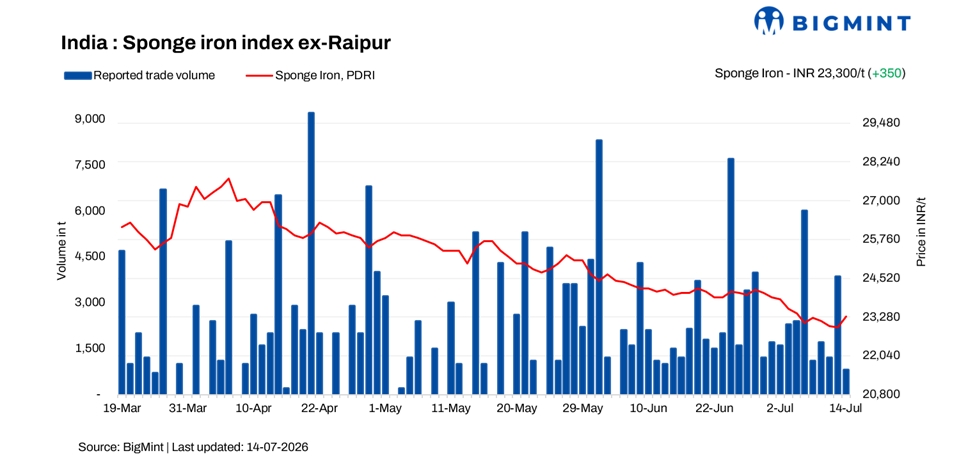
The Indian sponge iron market witnessed a slightly positive trend, with prices increasing by around INR 50-400/t across major regions, supported by buying activity seen in the previous trading session. This improved market sentiment to some extent. BigMint’s assessment for Raipur pellet-based sponge iron increased by INR 400/t to around INR 23,400/t. However, trading activity remained average, with buyers showing limited interest at the higher price levels.
Despite the upward price movement, the sponge iron market continued to face marginal pressure. Sellers raised offers only in a limited manner as weak downstream demand restricted aggressive price hikes. While the improved sentiment has slightly boosted seller confidence, muted consumption and cautious buying continue to cap market momentum, resulting in softer trade volumes at elevated prices.
Raw material
On the raw material front, Raipur pellet prices increased by around INR 200/t due to maintenance shutdowns at major central region pellet plants and ongoing export orders, tightening supply. Higher pellet prices have increased production costs for sponge iron manufacturers. Meanwhile, coal prices eased slightly, offering only marginal relief to input costs, which was insufficient to offset the impact of expensive raw materials.
Trade volume
Buyers continued to procure only need-based volumes, with no significant bulk deals reported. BigMint recorded sponge iron trade volume of around 9,000 t, nearly 10,000 t lower than the previous trading session. The sharp decline in volumes reflects buyers’ reluctance to book material at higher prices and indicates that overall market momentum remains subdued despite the recent price improvement.
Rationale
Prices have been derived based on transactions, offers, bids, and indicative price data sets. Transactions are considered as T1 and given a weightage of 50%, whereas other data sets are considered as T2 and given a weightage of the balance 50%.
Click here for detailed methodology


Leave a Reply