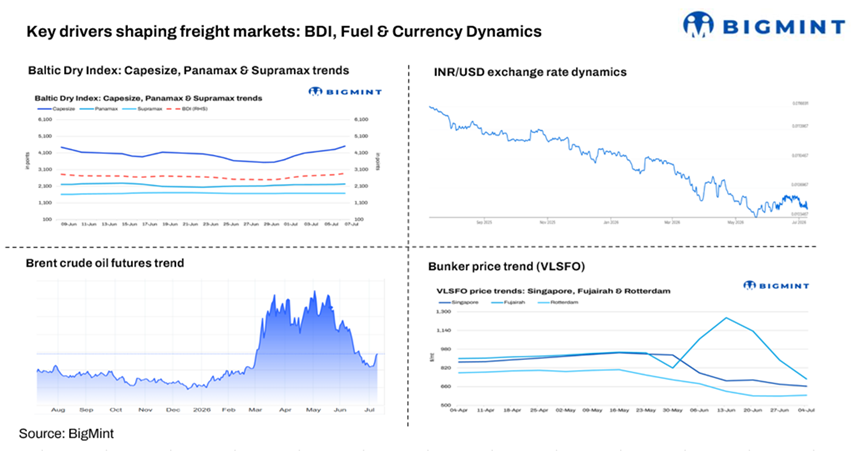
- Shipping shifting from volume-driven to tonne-mile-driven market amid geopolitical disruptions
- Commodity buyers increasingly opting for long-term contracts to secure stable logistics costs
Global freight markets are no longer driven solely by supply and demand fundamentals. Geopolitical conflicts, evolving trade corridors, decarbonisation policies, and shifting sourcing strategies are redefining the economics of global shipping, making freight an increasingly strategic indicator for commodity markets.
These themes took centre stage during BigMint’s webinar, “Freight in Flux: Geopolitics, Energy Transition & Supply Chain Realignment,” where industry experts discussed how changing trade dynamics are influencing freight markets, vessel deployment, commercial contracts and long-term investment decisions.
The panel featured Captain Sanjiv Bhargava, CEO, Bulk Marine Ltd.; Manish Gulati, Director-Commercial, Interocean; and Aishwarye Dubey, Maritime Lawyer & Advisor at A.P. Moller-Maersk.
Global trade realignment shifts shipping economics
Discussing the long-term impact of geopolitics, Captain Sanjiv Bhargava said shipping has shifted from a volume-driven to a tonne-mile-driven market, with disruptions in the Red Sea and Strait of Hormuz extending voyage distances, tightening vessel availability, and supporting freight rates.
He added that the industry’s focus has moved from securing the lowest freight costs to ensuring reliable supply chains amid persistent geopolitical uncertainty.
Supply security becomes new commercial priority
Captain Bhargava highlighted that supply chain resilience is becoming a key priority, with commodity buyers increasingly opting for long-term Contracts of Affreightment (COAs) to secure stable logistics costs and reliable cargo movement.
Meanwhile, shipowners are focusing on greater operational flexibility and route optimisation to navigate geopolitical and logistical disruptions.
Charter parties evolving to address geopolitical risks
Maritime lawyer Aishwarye Dubey noted that shipping contracts are evolving beyond traditional commercial risks to address sanctions, armed conflicts, cyber threats and political instability. He highlighted the growing use of broader war-risk and sanctions clauses, allowing greater contractual flexibility amid geopolitical disruptions such as those in the Red Sea and the Strait of Hormuz.
BIMCO clauses gaining greater importance
The webinar also highlighted the increasing adoption of the Baltic and International Maritime Council (BIMCO) standard contractual clauses across the shipping industry.
As geopolitical events continue to evolve rapidly, shipowners and charterers are relying more heavily on internationally recognised frameworks to allocate risks relating to sanctions, force majeure, cybersecurity, and war-risk premiums.
Shipping contracts are no longer merely commercial agreements — they have evolved into comprehensive risk management instruments designed to address an increasingly uncertain operating environment.
Decarbonisation influencing freight dynamics
Beyond geopolitics, the discussion also highlighted the growing impact of environmental regulations on shipping. Captain Sanjiv Bhargava noted that while large-scale investments in decarbonisation have progressed gradually, operational measures such as slow steaming have already reduced effective vessel supply, lending support to freight rates.
He added that the industry must strike a balance between meeting sustainability goals and maintaining commercial viability in an increasingly complex operating environment.
India, China continue to shape dry bulk demand
Turning to demand fundamentals, the discussion highlighted diverging trends between the world’s two largest commodity-consuming nations.
While India’s steel demand remains robust, China’s economic growth has moderated from previous highs. However, panellists cautioned against interpreting China’s slower growth as a weakening of freight demand.
Instead, cargo flows are evolving rather than disappearing, with China continuing to dominate long-haul Capesize trade while India’s growing industrialisation creates additional opportunities across regional dry bulk routes.
The panel agreed that freight markets are increasingly being shaped not merely by cargo volumes, but by changing trade patterns, sourcing strategies and shifting voyage distances.
West Africa emerging as a key iron ore trade route
The panel highlighted the emergence of West Africa-China as a significant iron ore trade corridor, driven by the development of new mining projects in the region. The longer sailing distance compared to traditional Australia-China routes is expected to increase ton-mile demand, providing structural support to Capesize freight markets. As West African exports gain momentum, the route could play an increasingly important role in reshaping global dry bulk trade flows and vessel deployment.
Coal expected to remain the key freight driver
The panellists identified coal as the “commodity of the year” for dry bulk shipping, supported by sustained seaborne trade despite the global energy transition. While India’s thermal coal imports may gradually decline over the longer term with rising domestic production and renewable energy capacity, the impact is unlikely to be immediate.
Coking coal imports are expected to remain robust, as India continues to rely heavily on overseas supplies to meet the requirements of its expanding steel industry, ensuring continued support for dry bulk freight demand.
The road ahead
The discussion reinforced that global freight markets are entering a new phase where geopolitical developments, supply chain resilience and environmental regulations are becoming as influential as traditional supply-demand fundamentals. Longer voyage distances, evolving contractual frameworks, greater emphasis on supply security and changing commodity flows are collectively redefining the dry bulk shipping landscape.
As one of the panellists remarked, freight markets are becoming increasingly event-driven rather than fundamentally driven, making agility, risk management and strategic planning essential for all participants across the global maritime supply chain.
The conversation will continue at BigMint India Ferrous Week 2026, scheduled from 19-21 August at JW Marriott, Kolkata, where industry leaders will delve deeper into the challenges and opportunities shaping the ferrous value chain. The conference will feature a dedicated logistics session, “Shipping at a Crossroads: Rate Swings, IMO Decarbonisation and Geopolitical Shifts,” alongside discussions on India’s Port Efficiency, Logistics and Trade Competitiveness, providing stakeholders with deeper insights into the evolving dynamics of freight, shipping and global trade.

Leave a Reply