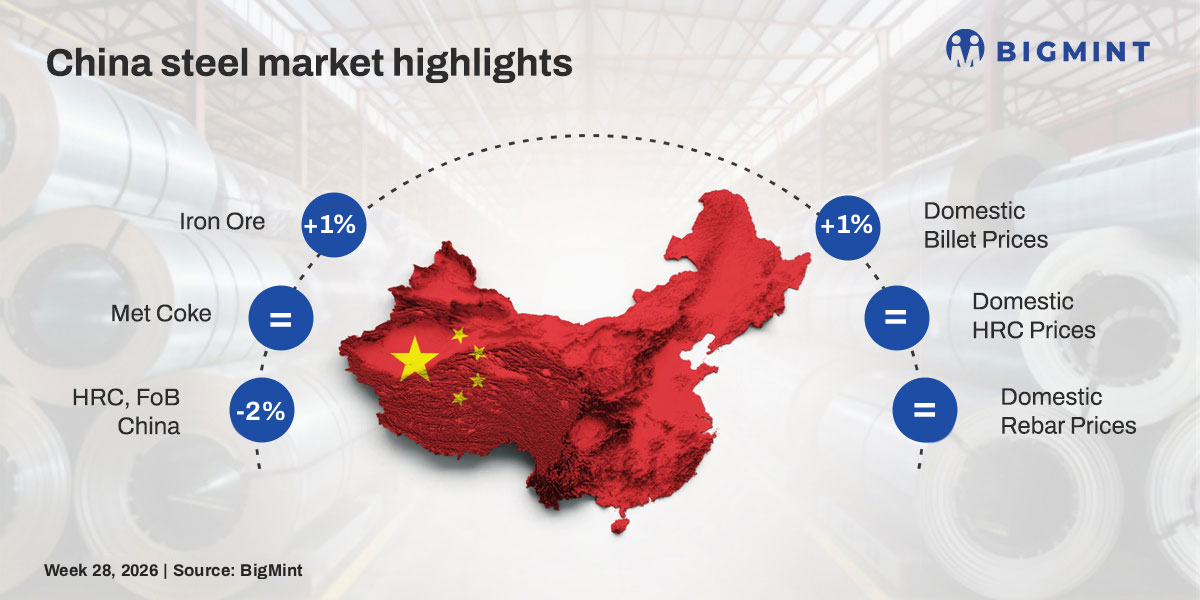
- Raw materials support prices despite weak seasonal demand.
- HRC export offers weaken amid global competition.
The China Iron and Steel Association (CISA) reported that total steel inventories at key CISA-affiliated industries stood at around 16.28 million tonnes (mnt) during late-June (21-30 June 2026), marked a decrease of 1.62 mnt or 9.1% from 17.9 mnt in mid-June.
However, inventories inched up by 450,000 t or 2.8% m-o-m from 15.83 mnt in late-May.
Moreover, inventory levels rose by 830,000 tonnes (t) or 5.4% y-o-y from 15.45 mnt recorded in the same period last year.
The decline was primarily driven by steel mills scaling back production amid mounting inventory pressure, weak seasonal demand, and compressed margins. Persistently subdued construction activity due to the rainy season and high temperatures reduced steel demand and prompted mills to reduce output to prevent further inventory accumulation.
Raw materials front
Iron ore spot prices edge up w-o-w: Iron ore fines benchmark prices for Fe 61% rose w-o-w by $1/t w-o-w to $99/dmt CFR China on 10 Jul’26.
Prices rose tracking gains in Dalian iron ore futures as renewed geopolitical tensions in the Middle East and concerns over potential supply disruptions from Australia lifted market sentiment. However, subdued physical trading and lower steel output in China continued to cap further gains.
a) Spot pellet premium rises w-o-w: Spot pellet premium for Fe 65% grade pellet gained by $0.85/t to $23.5/t CFR China on 8 July.
b) Spot lump premium edged up w-o-w: Spot lump premium edged up w-o-w by $0.045/t to $0.2045/t CFR China on 10 July.
China’s supply constraints support coke, but seaborne coal softens: China’s coking coal and met coke markets remained broadly stable during the week, supported by tight coking coal supply due to slow mine production recovery and stringent safety inspections. However, weaker steel prices, narrowing mill margins and planned maintenance are expected to soften coke demand, while resistance from steel mills has delayed the proposed tenth round of coke price hikes.
Reflecting the weaker sentiment in the seaborne market, Australian PHCC prices declined sharply by $7/t w-o-w to $237/t FOB Australia, driven by falling steel prices, subdued buying interest and lower bid levels. Consequently, BigMint’s PHCC index also softened by $9/t w-o-w to $254/t CNF Paradip, India, as buyers adopted a cautious procurement approach amid weakening downstream steel market fundamentals.
Billet, rebar prices firm w-o-w on stronger raw material costs: Chinese billet prices edged higher during the week ended 10 July, supported by firmer raw material prices, power-related supply concerns, and resilient production costs, although seasonal demand remained subdued. BigMint assessed domestic billet at RMB 2,970/t ($438/t), up RMB 30/t ($4/t) from RMB 2,940/t ($434/t) a week earlier.
However, physical demand remained weak as heavy rainfall, flooding in southern China, and the traditional summer slowdown continued to curb construction activity. Market participants noted that rising inventories and slower spot trading limited further gains in finished steel prices.
The gains were primarily driven by stronger raw material costs, with iron ore rebounding to $98-100/t and coke prices rising for the tenth consecutive round. At the same time, lower EAF operating rates and power-related supply disruptions provided additional support to prices.
In the export market, Chinese billet offers at $460/t FOB, slightly higher than $455-458/t FOB a week earlier. However, fresh bookings remained limited as seasonal demand weakness, higher freight costs, and continued geopolitical uncertainty in the Middle East kept overseas buyers cautious despite firmer domestic pricing.
Weekly steel price trend
Domestic hot- rolled coil (HRC) prices increase w-o-w: Chinese HRC prices inched up by RMB 10/t ($1/t) w-o-w to around RMB 3,110/t ($456/t) on 10 July from RMB 3,100/t ($455/t) from the previous week. Furthermore, SHFE HRC futures (October 2026 contract) marginally down by RMB 2/t ($0.2/t) w-o-w to RMB 3,289/t ($483/t) from RMB 3,291/t ($483/t) a week earlier. However, Chinese HRC export offers dropped by $10/t w-o-w to $500/t FOB Rizhao from the $510/t in the previous week.
China’s domestic HRC market began the week on a firmer note as improving macro sentiment and positive expectations ahead of upcoming policy meetings boosted market confidence. However, the optimism faded as weak seasonal demand, cautious downstream procurement, and ample supply re-emerged as the dominant factors, while rising inventories kept prices range-bound despite cost support from steel mills.
Baosteel, the world’s leading steel producer, has raised its domestic HRC and hot-dip galvanised iron (HDGI) prices by RMB 50/t ($7/t) m-o-m for August 2026 sales. The price hike is likely to have been driven by higher raw material costs, primarily due to a sharp increase in metallurgical coke prices.
Meanwhile, Chinese HRC export offers softened as mills lowered prices to improve competitiveness amid weak overseas demand, cautious buyer interest and increasing competition in the global market.
Rebar prices marginally up w-o-w: Rebar prices in China were increased by RMB 10/t ($1/t) w-o-w to around RMB 3,190/t ($466/t) as on 10 July, compared with RMB 3,180/t ($465/t) in the previous week. However, SHFE rebar futures (October 2026 contract) remain range bound by RMB 1/t ($0.1/t) w-o-w to RMB 3,278/t ($481/t) as on 10 July from RMB 3,277/t ($481/t) a week earlier.
China’s rebar market remained subdued as seasonal demand weakness continued to outweigh supportive policy signals. Although the government’s focus on industrial upgrading and low-carbon transformation strengthened long-term confidence, sluggish construction activity due to heavy rainfall, ample steel supply, and rising inventories kept buyers cautious. As a result, rebar prices fluctuated within a narrow range, with sentiment remaining weak.

Outlook
China’s steel market is expected to fluctuate next week. Cost support from firm raw material prices and policy expectations may limit downside, but weak seasonal demand, rising inventories, cautious procurement, and ample supply will continue to weigh on sentiment. Export prices are likely to stay under pressure amid subdued overseas demand and intense competition.
Leave a Reply