- Iron ore exports decline 3.5% m-o-m, pellet shipments fall one-third
- Softer Chinese buying weighs on June volumes despite favourable export parity
- H1 iron ore exports rise 24% y-o-y on weaker rupee, healthy overseas demand
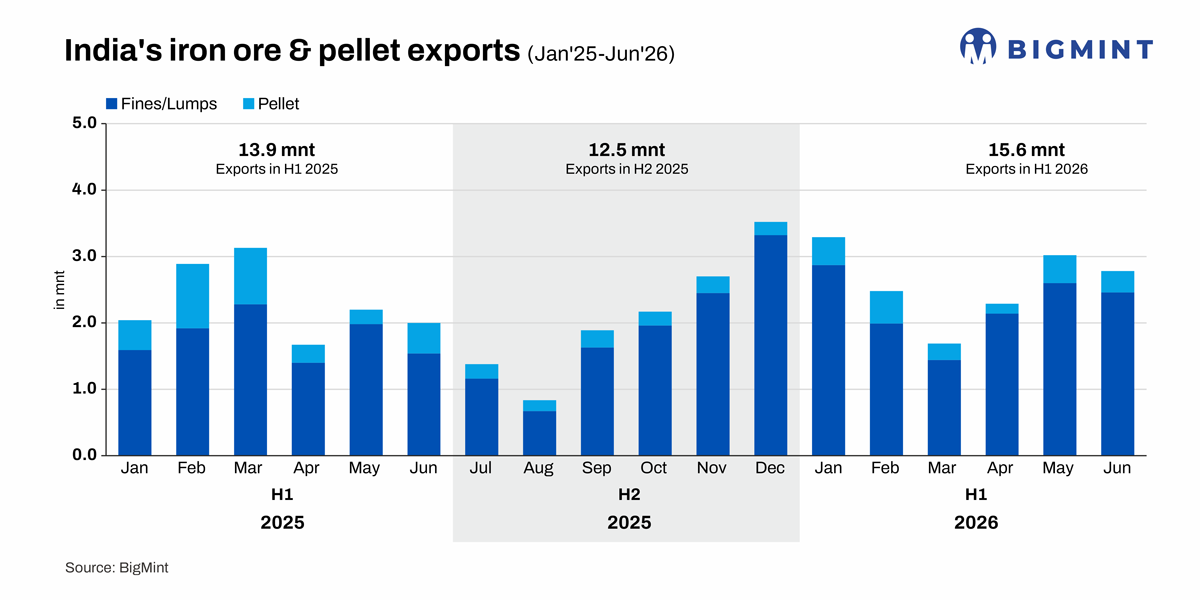
Morning Brief: India’s iron ore exports moderated in June after surging to a five-month high in May, as shipments to China eased and pellet exports corrected sharply amid weaker overseas demand. Iron ore exports declined 3.5% m-o-m to 2.46 mnt in Jun’26 from 2.55 mnt in May, while pellet shipments dropped 33.3% to 0.32 mnt from 0.48 mnt. Consequently, total exports eased to 2.78 mnt from 3.02 mnt in May, although volumes remained well above the monthly average recorded during the first quarter. Export economics nevertheless remained supportive, underpinned by a weaker rupee and healthy demand for Indian fines, helping cumulative iron ore exports during H1 CY26 rise 23.9% y-o-y to 13.28 mnt. Pellet exports, meanwhile, continued to lag, declining 32.8% y-o-y to 2.17 mnt.
Chinese demand continues to anchor export volumes
China remained the principal destination for Indian iron ore despite the moderation in June shipments, importing 13.57 mnt during H1 CY26 compared with 13.12 mnt a year earlier. Demand continued to be supported by lower domestic mine output, with China’s run-of-mine production declining to 397 mnt during the first five months of CY26 from 412 mnt a year earlier. Although daily crude steel production at CISA member mills declined 3.6% during the final 10 days of June, finished steel inventories fell an even sharper 9.1%, indicating that underlying steel consumption remained resilient.
Healthy demand for single-mine cargoes, particularly from Rungta Mines, and stronger shipments of Karnataka-origin material also supported export volumes during the first half. Rungta remained India’s largest exporter with 5.47 mnt, while Lloyds Metals & Energy recorded a notable increase in shipments following the ramp-up of production after its capacity expansion.

Export parity continues to favour fines
Iron ore exports remained commercially attractive despite the moderation in June. The rupee averaged around INR 93 against the US dollar during H1 CY26 compared with INR 86 a year earlier, improving export competitiveness and lifting overseas realisations. Export parity for fines also remained broadly favourable, with export realisations assessed at around INR 3,500/t against domestic prices of approximately INR 3,800/t, allowing miners to maintain healthy overseas dispatches. Stronger cargo movement through east coast ports and improved exporter participation further supported shipment volumes.
Pellet exports remain under pressure
Overseas pellet demand continued to weaken during the first half, with buyers increasingly preferring direct iron ore cargoes over pellets. The differential between export and domestic pellet realisations narrowed to around INR 900/t during H1 CY26 from INR 1,300/t a year earlier, reducing the incentive to export. Captive consumption also remained a priority for several integrated steelmakers in eastern India, while higher freight costs arising from geopolitical disruptions eroded export competitiveness. Market participants indicated that several pellet cargoes booked during the latter part of the first half are expected to load during late July and early August, suggesting part of the H1 decline reflects shipment timing rather than a structural deterioration in overseas demand.

Outlook
We expect iron ore exports to remain supported through the third quarter as long as Chinese demand remains firm and export parity continues to favour overseas sales. Lower Chinese domestic mine production, a weaker rupee and healthy demand for Indian fines are likely to underpin shipments, although monthly volumes may fluctuate after May’s exceptionally strong performance. The principal downside risk remains China’s proposed crude steel production curbs during the second half of CY26 amid shrinking mill margins, which could moderate iron ore procurement and weigh on Indian export volumes if implemented. Pellet exports are expected to recover more gradually as deferred cargoes are loaded during July and August, though stronger domestic consumption and relatively weaker overseas demand are likely to continue limiting export growth.
Leave a Reply