- Hydro secures 85,000 t low-carbon aluminium supply deal
- Weak China demand offsets renewed oil supply concerns
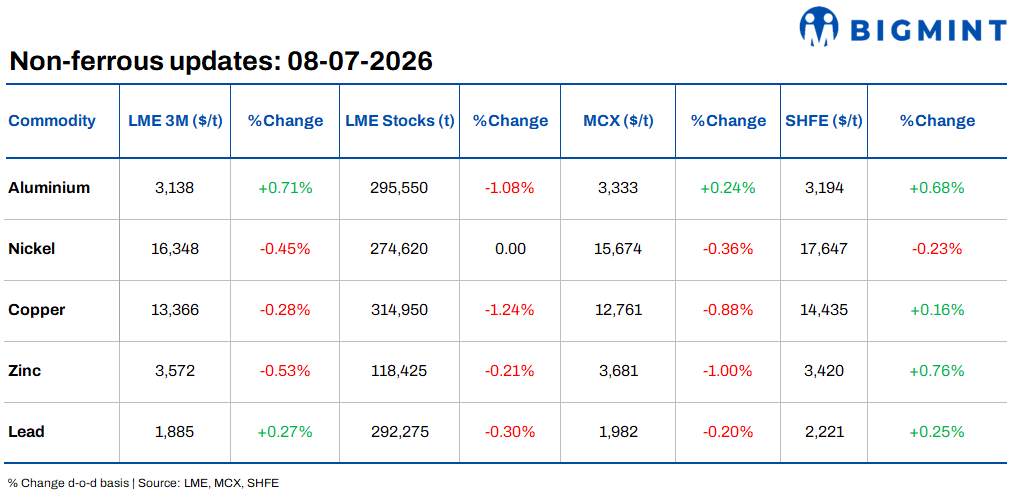
Base metals on the London Metal Exchange (LME) traded mixed on 7 July 2026, as aluminium rose 0.71% d-o-d to $3,138/t, followed by lead, which gained 0.27% to $1,885/t. Copper and zinc declined 0.28% and 0.53% to $13,366/t and $3,572/t, respectively, while nickel edged lower by 0.45% to $16,348/t. Prices remained largely range-bound as continued inventory drawdowns across LME warehouses helped offset pressure from a firmer US dollar.
LME inventories continued to decline across all major base metals. Copper stocks recorded the steepest drop, falling 1.24% d-o-d to 314,950 t, followed by aluminium inventories, which declined 1.08% to 295,550 t. Lead and zinc stocks fell 0.30% and 0.21% to 292,275 t and 118,425 t, respectively, while nickel inventories remained unchanged at 274,620 t.
Domestic market overview
India’s non-ferrous scrap market remained weak on 7 July amid subdued buying activity. Aluminium tense scrap (loose), ex-Delhi, remained unchanged at INR 270,000/t, while ex-Chennai prices declined by INR 1,000/t, or 0.39% d-o-d, to INR 255,000/t.
Meanwhile, copper armature scrap (Cu 99%), ex-Delhi, fell by INR 13,000/t, or 1.08% d-o-d, to INR 1,190,000/t, tracking softer domestic demand despite continued tightening in LME copper inventories.

Oil rebounds on renewed Middle East supply concerns
Global crude oil prices strengthened on 8 July 2026, with WTI crude rising 5.36% d-o-d to $72.69/bbl and Brent crude advancing 5.59% to $76.54/bbl. Natural gas increased 1.64% to $3.28/MMBtu, while the US dollar index edged up 0.18% to 101.07.
Oil prices rallied after renewed geopolitical tensions in the Middle East reignited concerns over supply disruptions. The gains followed US airstrikes on Iranian targets and the reimposition of sanctions on Iranian crude sales, raising fears that the fragile ceasefire could unravel and disrupt tanker traffic through the Strait of Hormuz, which normally carries around one-fifth of global oil supplies. The renewed tensions prompted traders to rebuild geopolitical risk premiums into crude prices, while concerns over shipping security further supported the market.
Market participants also remained focused on China’s oil demand outlook. Analysts noted that stronger Chinese crude imports and inventory replenishment could provide additional upside to prices, while weaker buying would reinforce expectations of a well-supplied market. Despite recent gains, uncertainty over the durability of the US-Iran truce and the pace of shipping through the Strait of Hormuz is expected to keep oil markets volatile in the near term.
Other updates
Hydro strengthens Europe’s low-carbon aluminium supply chain
Hydro has signed two long-term agreements to strengthen Europe’s low-carbon aluminium and renewable energy supply chain. The company entered a five-year agreement with Nexans to supply around 85,000 t of low-carbon aluminium wire rod between 2026 and 2030 for power grids, overhead transmission lines and subsea cables.
The aluminium, produced under the Hydro REDUXA brand, has a carbon footprint of less than 4 kg CO₂/kg, less than one-third of the global average.
Separately, Hydro signed a long-term power purchase agreement (PPA) with Eviny, securing 0.5 TWh of renewable electricity annually (5 TWh in total) during 2031-2040.
The agreements reinforce Hydro’s strategy to expand low-carbon aluminium production in Norway, where its metal is produced with a carbon footprint around 75% lower than the global average, supporting Europe’s growing demand for sustainable electricity infrastructure.
Codelco faces output and debt challenges amid rising AI demand
Chile’s state-owned Codelco is under pressure to increase copper production as demand from artificial intelligence, data centres and electrification accelerates, while also managing a heavy debt burden. The miner is working to restore output after years of operational setbacks, targeting a recovery through major expansion projects including Chuquicamata Underground and El Teniente.
However, rising capital expenditure and debt levels continue to weigh on its financial position, even as long-term copper demand remains robust. As the world’s largest copper producer, Codelco’s ability to ramp up production is viewed as critical to addressing the structural supply deficit expected to emerge over the coming decade.

Leave a Reply