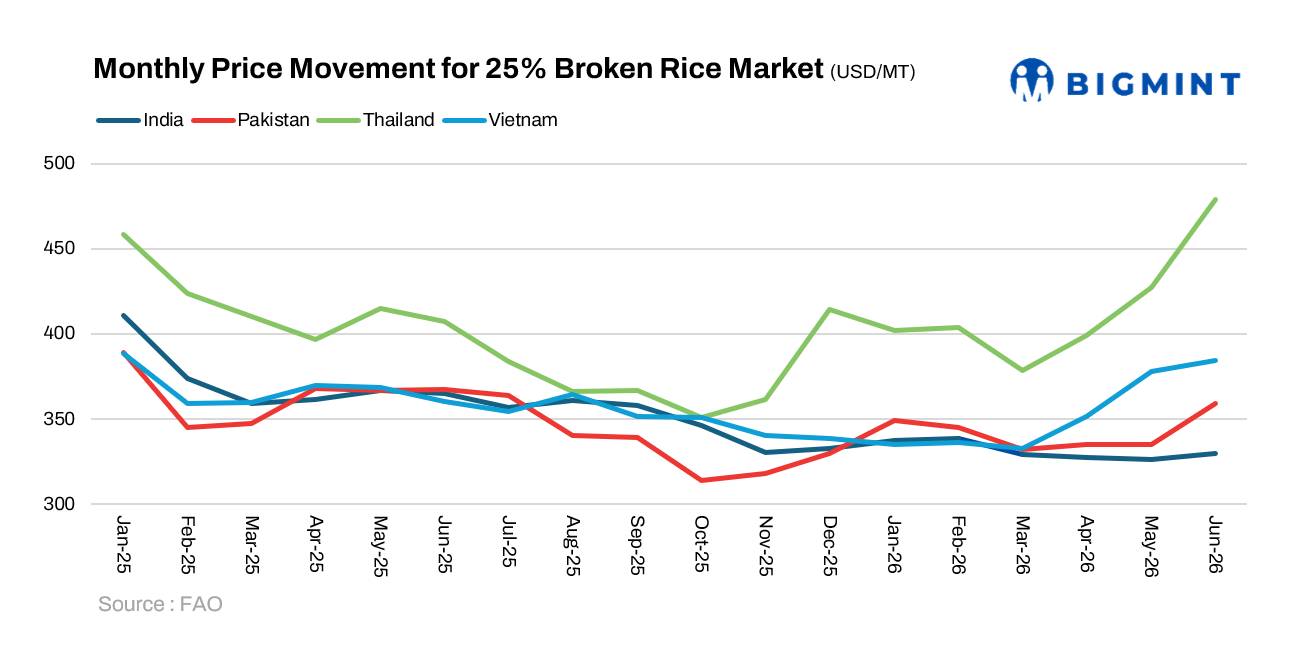
- Global 25% broken rice prices strengthened in June, led by Thailand and Vietnam.
- Demand recovery and supply concerns supported the uptrend
Global export prices for 25% broken white rice extended their recovery in June 2026, marking a sharp turnaround from the subdued market witnessed through much of 2025. FAO export quotations indicate that prices strengthened across all four major Asian exporters, with Thailand leading the rally, followed by Vietnam and Pakistan. India, despite a marginal increase, continued to offer the most competitive prices due to abundant domestic supplies.
The June rally reflects a shift in global market sentiment as buyers returned to the market amid growing concerns over future supply rather than immediate shortages.
Thailand leads the price rally
Thailand recorded the strongest increase in export quotations, with 25% broken rice prices rising to nearly USD 480/MT in June from around USD 425/MT in May.
The sharp increase was driven by growing concerns over El Niño, which is expected to reduce rainfall across Southeast Asia during the upcoming growing season. Traders also expressed concerns over water availability for the July-August crop, prompting exporters to maintain firm offers.
At the same time, demand from importers such as the Philippines and Iraq, along with continued purchases from African buyers, supported Thai export prices. Appreciation of the Thai baht further increased FOB quotations, while higher fertiliser, fuel and logistics costs also contributed to the rise.
Vietnam prices rise on supply concerns
Vietnam’s 25% broken rice quotations also strengthened in June, reaching around USD 385/MT.
Unlike Thailand, the price increase was primarily driven by tight domestic availability after strong export shipments during the first half of the year. At the same time, concerns that El Niño could affect the upcoming crop encouraged buyers to secure supplies earlier, resulting in additional stockpiling demand.
Although some importers temporarily slowed purchases during June, expectations of tighter supplies later in the year kept export quotations firm.
Pakistan follows regional uptrend
Pakistan’s 25% broken rice prices recovered to nearly USD 360/MT during June after remaining weak for much of 2025.
The increase reflected stronger buying from Asian and African destinations alongside firmer regional market sentiment. However, Pakistan’s gains remained relatively limited as exporters continued to compete with significantly cheaper Indian rice in several price-sensitive markets.
India remains the most competitive exporter
India continued to remain the world’s lowest-priced supplier, with 25% broken rice quotations largely stable at around USD 330/MT.
Despite improving export enquiries, India’s abundant rice production, record government stocks and comfortable export availability prevented any significant price increase. Buyers seeking economical supplies increasingly shifted towards Indian rice as prices in Thailand and Vietnam climbed.
The availability of large carryover stocks also reassured the market that India would remain well supplied despite concerns over the progress of the southwest monsoon.
Key Factors Influencing Prices
The increase in international 25% broken rice prices during June was supported by a combination of market fundamentals. Weather-related concerns associated with a potential El Niño raised uncertainty over upcoming rice production in Thailand and Vietnam, while improving import demand from Asian and African buyers boosted export activity. Strong shipments from Southeast Asian exporters tightened near-term export availability, and higher fertiliser, fuel and freight costs pushed up export offers. Additionally, the appreciation of the Thai baht supported higher FOB quotations. However, abundant rice supplies and competitive export prices from India continued to moderate the overall increase in global rice prices.
Outlook
Global 25% broken rice prices are expected to remain firm over the coming months as markets closely monitor weather developments across Southeast Asia. If El Niño affects crop yields in Thailand and Vietnam, export quotations could strengthen further. However, India’s record inventories and continued export competitiveness are expected to cushion the global market, preventing a sharp surge in prices unless weather-related production losses become more severe.
Leave a Reply