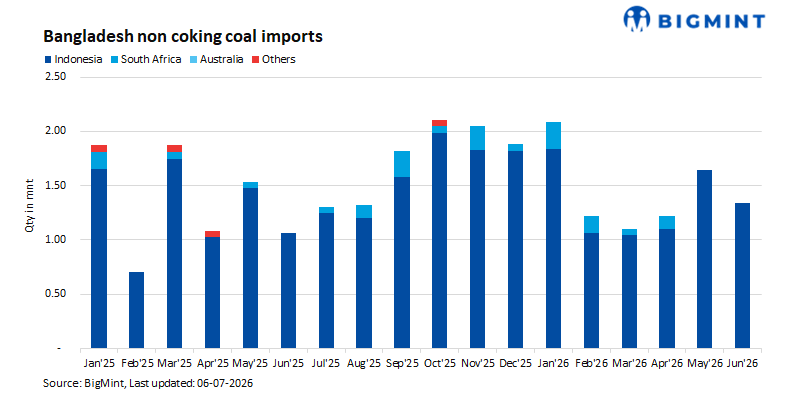
- Indonesia dominates Bangladesh’s coal imports
- H1 imports rise despite June dip
Bangladesh’s coal imports declined 18.29% m-o-m to 1.34 mnt in Jun’26, primarily due to softer procurement following higher arrivals in May and adequate inventory levels. However, imports remained 25.52% higher y-o-y, reflecting stronger coal demand compared with the same period last year. During H1’26 (Jan-Jun), imports increased 5.9% y-o-y to 8.61 mnt, supported by higher power sector consumption, although Q2 imports declined 4.8% q-o-q to 4.2 mnt amid moderated buying activity.
Indonesia retains dominant market share
Indonesia remained Bangladesh’s largest coal supplier, accounting for the majority of total imports. Shipments declined 18.29% m-o-m to 1.34 mnt in Jun’26, mirroring the overall slowdown in import demand, but were 25.52% higher y-o-y on sustained reliance on competitively priced Indonesian coal. During H1’26, imports from Indonesia increased 4.42% to 8.03 mnt, while Q2 volumes eased 3.3% q-o-q as buyers adopted a more cautious procurement strategy.
South African imports ease after strong Q1 performance
Imports from South Africa remained limited at 0.05 mnt in Jun’26, declining from 0.16 mnt in May due to reduced spot purchases. Nevertheless, H1’26 imports more than doubled (+115.76% y-o-y) to 0.58 mnt, reflecting stronger procurement earlier in the year. Q2 imports fell 73.9% q-o-q to 0.12 mnt, indicating a sharp moderation in buying following robust arrivals in the first quarter.
Market sentiments
Bangladesh’s coal market remained stable, with utilities largely following requirement-based procurement after building comfortable inventories earlier in the year. Although coal imports moderated in June, demand from coal-fired power plants remained steady.
The country’s heavy dependence on imported fuel continues to expose it to global price volatility and supply disruptions, prompting authorities to focus on improving energy security and procurement efficiency. At the same time, uneven power distribution and periodic load-shedding, particularly in rural areas, highlight the need for a more resilient and efficient power system.
Outlook
Bangladesh’s coal imports are expected to remain stable in the near term, supported by continuous fuel requirements from coal-based power plants.
However, buyers are likely to continue purchasing cautiously, depending on inventory levels and international coal prices. In the medium term, the government is expected to strengthen its energy security by improving fuel procurement, diversifying energy sources and gradually increasing renewable power capacity to reduce dependence on imported fuels and minimise exposure to global market disruptions

Leave a Reply