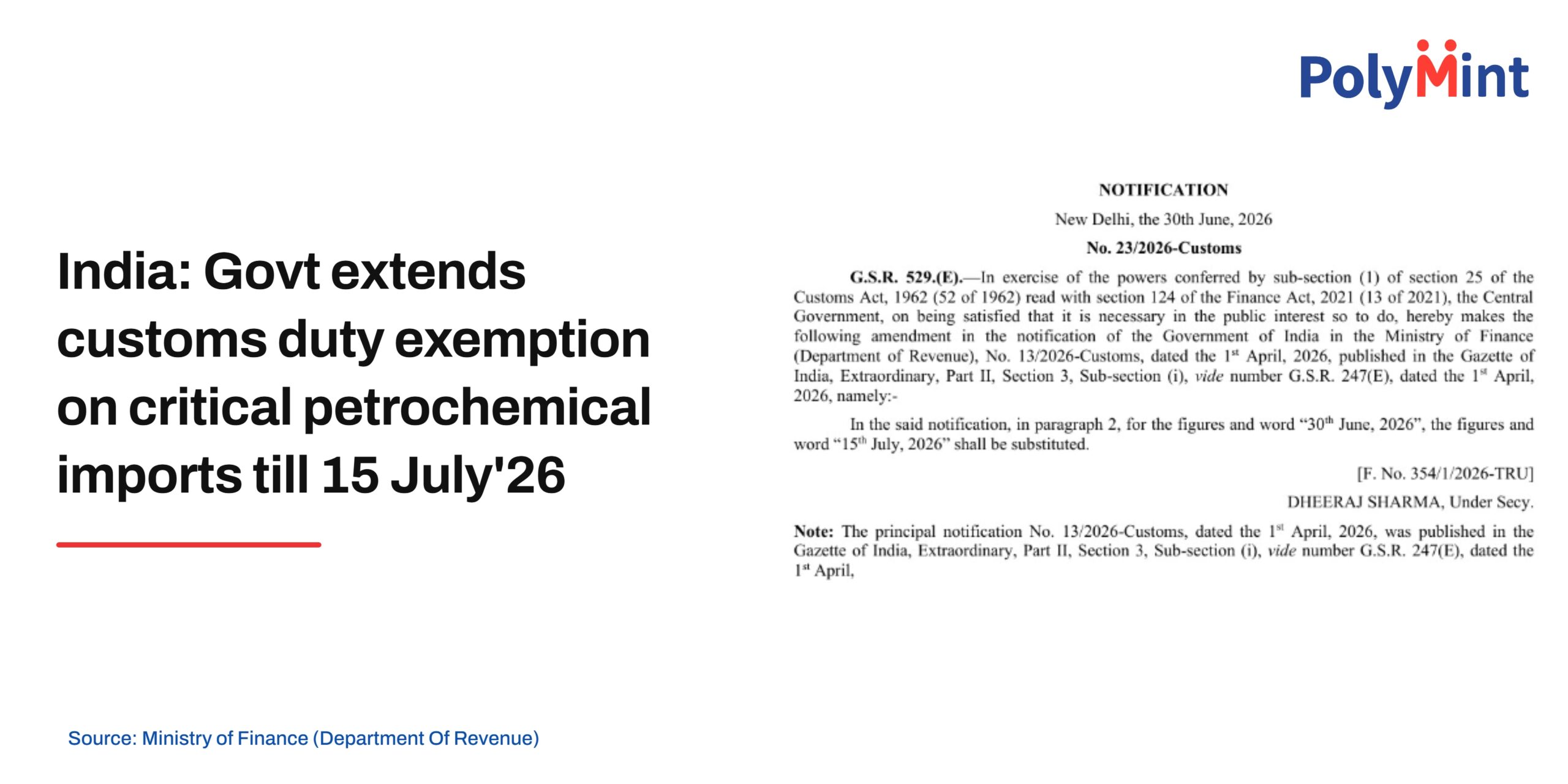
- Duty waiver extended by 15 days to ensure uninterrupted supplies
- Exemption to support downstream industries amid West Asia disruption
The government has extended the full customs duty exemption on imports of critical petrochemical products by another 15 days, pushing the validity of the relief measure from 30 June to 15 July 2026. The extension, notified by the Ministry of Finance through Notification No. 22/2026-Customs dated 30 June 2026, amends the earlier notification issued on 1 April 2026 and retains the existing list of eligible products without any changes.
The exemption was originally introduced on 1 April 2026 as a temporary measure in response to the ongoing conflict in West Asia, which disrupted global petrochemical supply chains and raised concerns over the availability of critical feedstocks in India. At the time, Indian petroleum companies had been directed to prioritise LPG production, increasing the country’s dependence on imported petrochemicals to meet downstream industrial demand.
According to the government, although the supply situation is gradually normalising, extending the exemption for another 15 days is intended to facilitate a smooth transition for domestic industries while avoiding supply disruptions. The measure is expected to maintain the availability of essential petrochemical feedstocks and intermediates until normal trade flows are fully restored.
The exemption continues to cover a broad range of petrochemical feedstocks, intermediates and polymers, including Monoethylene Glycol (MEG), methanol, toluene, styrene, isopropyl alcohol (IPA), purified terephthalic acid (PTA), vinyl chloride monomer (VCM), polyvinyl chloride (PVC), polypropylene (PP), polyethylene (PE), acrylonitrile butadiene styrene (ABS), styrene acrylonitrile (SAN), epoxy resins, polycarbonates, PET chips, polyurethanes, polyols, formaldehyde resins and several other engineering plastics and specialty chemicals. The list of products remains unchanged from the notification issued in April.
The continued duty relief is expected to benefit a wide range of downstream manufacturing sectors that rely on imported petrochemical feedstocks. These include plastics and packaging, textiles, pharmaceuticals, chemicals, automotive components, consumer goods and other manufacturing industries, where raw material costs represent a significant share of production expenses. By keeping import duties at zero during the extension period, the government aims to cushion manufacturers against elevated logistics costs and supply uncertainties arising from geopolitical tensions.
From a market perspective, the extension is likely to provide short-term procurement flexibility for importers and converters. Buyers who had accelerated purchases ahead of the 30 June expiry now have additional time to replenish inventories without incurring customs duty, reducing immediate cost pressures. Importers may also use the extension period to optimise cargo scheduling and secure shipments while international freight routes through the Middle East continue to stabilise.
The policy could also help moderate price volatility in the domestic petrochemical market. Maintaining duty-free imports on key feedstocks is expected to improve product availability and reduce the risk of supply shortages, particularly for polymers and intermediates used across multiple industrial value chains. However, the extension is limited to 15 days, indicating that the government continues to view the measure as temporary rather than a structural change to India’s customs duty framework.
The notification does not introduce any new products or modify the scope of the existing exemption. Instead, it simply extends the validity period of the earlier notification, underscoring the government’s intent to provide continuity until market conditions improve further.
Market implications
The extension offers temporary cost relief to import-dependent industries and helps ensure uninterrupted access to essential petrochemical feedstocks during a period of continued geopolitical uncertainty. While domestic producers may continue to face competition from duty-free imports over the next two weeks, downstream manufacturers stand to benefit from improved raw material availability and lower input costs. Market participants will now closely monitor whether the government allows the exemption to lapse after 15 July or opts for a further extension depending on developments in West Asia and the pace of supply chain normalisation.
Leave a Reply