- Tariff rate doubled to 50% on 18 categories; duty-free quota reduced by 51%
- Industry members believe revised quotas not aligned with market conditions
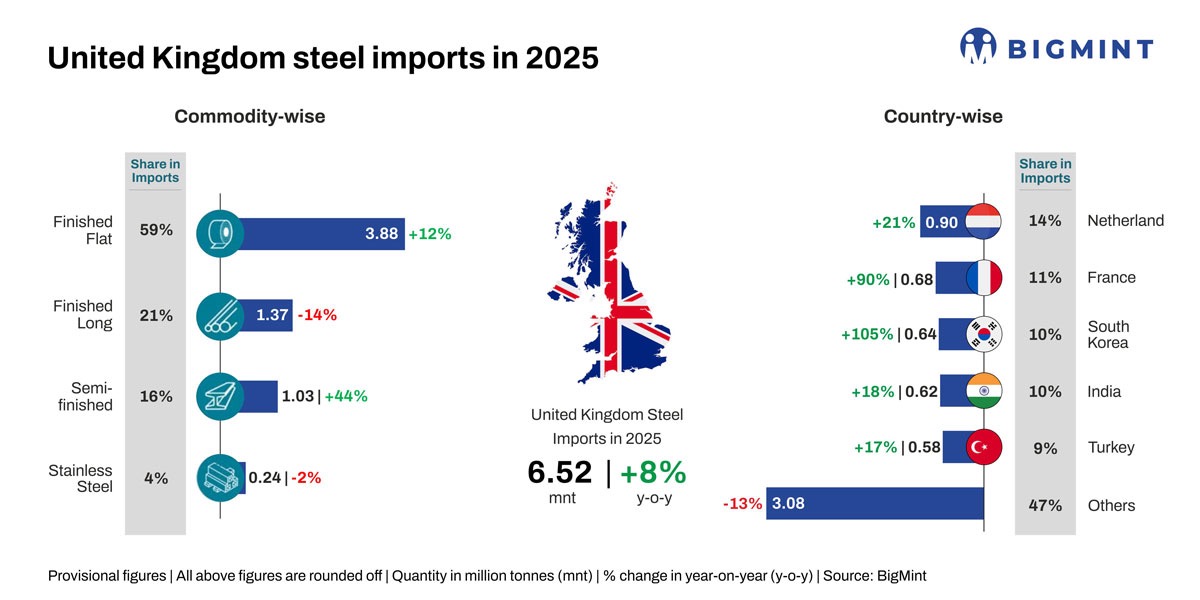
Japan Metal Daily: The UK Department for Business and Trade announced additional tariffs on steel imports on 25 June, which are set to take effect on 1 July. These measures succeed the safeguard measures (emergency import restrictions), which, like those in the EU, expire at the end of June. The tariff rate will be doubled to 50%, and the duty-free quota will be reduced by 51%.
While the EU’s new measures cover 28 product categories, the UK has limited the scope to 18 categories due to constraints on domestic steel production capacity and product variety. The measures apply broadly to steel sheet products, including hot-rolled coils (HRCs), surface-treated steel sheets, tinplate, and heavy plates, but exclude cold-rolled steel sheets.
Country-specific quota allocations in flat steel
The UK government also announced details regarding the implementation of the quotas, specifying that for the most recent July-September period, the quota for HRCs for re-rolling was approximately 596,000 t, with a maximum of 40% available to specific countries and regions. Quotas by other product categories and countries were also outlined.
For HRCs other than those for re-rolling, the EU was allocated approximately 94,000 t per quarter (375,000 t annually), while the “Other” category, which includes Japan, was set at 49,800 t annually. For heavy plates, the EU was allocated 200,000 t annually and South Korea 34,000 t, while the “Other” category was set at 14,000 t annually.
On the other hand, for surface-treated steel sheets, quotas have been allocated to the EU, which has a strong track record of imports, at 510,000 t per year, Vietnam at 174,000 t, India at 126,000 t, and South Korea at 101,000 t. As cold-rolled steel is excluded for all countries, trade officials view these provisions as relatively disadvantageous to Japan.
Impact on Japan’s exports to UK
Japan’s steel exports to the UK in 2025 totalled approximately 170,000 tonnes (t). Of this total, cold-rolled steel sheets were the largest category, accounting for just over 60,000 t. While cold-rolled alloy steel, which has been exported steadily to the UK, is exempt from the measures, approximately 60,000 t of hot-rolled coils and just over 20,000 t of heavy plate are subject to them.
In terms of country-specific quotas, Japan was allocated only three product categories: tinplate, large-diameter welded steel pipes, and non-alloy steel wire rod; however, as the annual export volumes of each are only a few hundred tonnes, their practical value is low. For the majority of product categories, the “Other Category”, which has low allocation volumes to begin with, applies.
Industry expresses dissatisfaction
Opinions on these measures are divided even within the UK. Opponents from downstream industries argue that domestic steel production cannot meet demand, and the UK government has taken this into account. The quotas announced this time were relaxed from the “60% reduction” proposed in March to a “51% reduction.”
Nevertheless, Tata Steel UK, a thin sheet manufacturer, expressed dissatisfaction in a statement by CEO Rajesh Neer regarding the new measures: “The final quotas do not reflect the challenges facing the UK steel industry. For some product categories, the quotas allow for large-scale imports into the UK market.” Tata Steel UK is currently proceeding with a major investment to permanently shut down a blast furnace and install two new electric arc furnaces at its Port Talbot steelworks, but the company cautioned that it has “serious concerns about the impact on future investment.” The British Steel Association also raised concerns, noting that “ultimately, the quota for galvanised steel sheets from Vietnam has tripled.”
The UK, once the world’s leading steel producer, has seen its decline accelerate in recent years due to pressure from imported steel. In 2025, crude steel production fell 35% y-o-y to 2.6 million tonnes (mnt), partly due to Tata’s blast furnace shutdown, causing the UK to slip to 41st place globally, behind Iraq and Oman.
British Steel, the only company in the UK still operating a blast furnace, was placed under government administration last year after its parent company, the Chinese Jingye Group, moved to shut down the furnace; its nationalisation is currently being debated in Parliament. Although the nationalisation bill has passed the House of Commons and been sent to the House of Lords, the task of reviving the UK steel industry through policy measures remains challenging.
Note: This article has been published in accordance with a content exchange agreement between BigMint and Japan Metal Daily.
Leave a Reply