- EU safeguard transition keeps HRC buyers in wait-and-watch mode
- Middle East sentiment cautious as ship owners still remain hesitant
Indian HRC export activity remained subdued during the assessment week ended 30 June 2026, as weak demand and cautious buying sentiment across key destinations continued to weigh on trading activity, with market participants largely adopting a wait-and-watch approach.
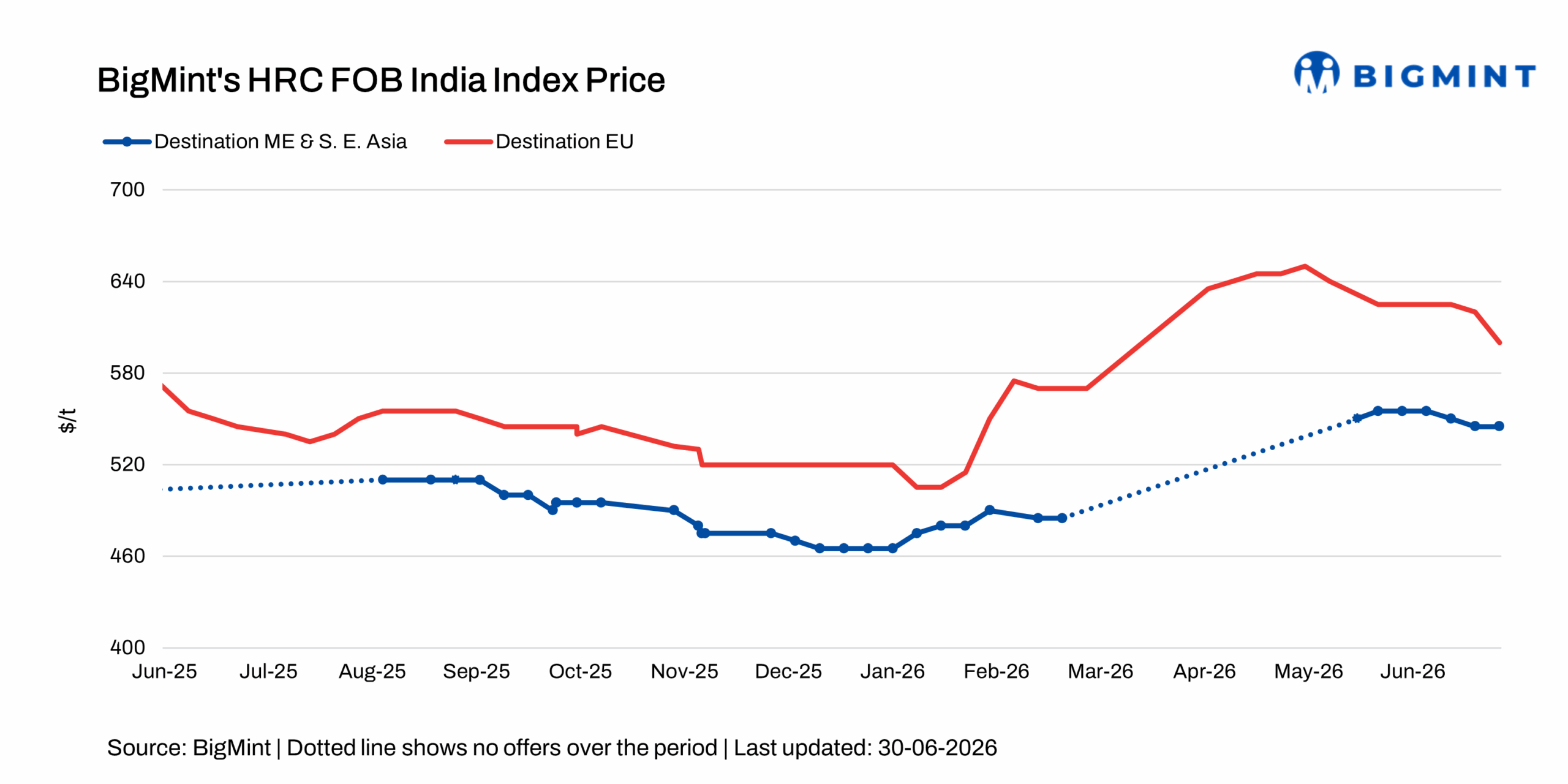
Indian HRC export offers to the EU decline w-o-w: Indian HRC export offers to the EU declined by $20/t w-o-w to around $600/t FOB, compared with $620/t a week earlier, amid muted buying interest from European buyers, with no fresh bookings reported during the assessment period.
The European Union has formally adopted a new steel trade framework, which will take effect on 1 July 2026, replacing the existing steel safeguard measures that expire on 30 June. Under the revised regime, annual tariff rate quota (TRQ) volumes totalling 18.35 million tonnes (mnt) have been allocated across various steel product categories. Imports within the allocated quotas will continue to enter the EU duty-free, while volumes exceeding the quota limits will be subject to a 50% out-of-quota duty, up from the previous 25%.
Among product categories, hot-rolled coil (HRC) received the largest allocation of nearly 5.2 million tonnes (mnt), with around 0.59 mnt allocated to Indian exporters under the country-wise quota allocations announced by the EU on 30 June.
HRC export offers to the Middle East, Southeast Asia remain stable w-o-w: Indian HRC export index to the Middle East and Southeast Asia remained stable w-o-w at around $545/t FOB, as export offers to both the Middle East and Vietnam remained unchanged w-o-w.
Indian HRC offers to the Middle East were heard at around $550/t FOB, with freight to Fujairah estimated at approximately $50/t. Meanwhile, Chinese HRC export offers to the region declined by $5/t w-o-w to approximately $575/t CFR Jeddah from $580/t in the previous week.
Indian HRC export offers to Vietnam remained stable w-o-w at around $550/t CFR Ho Chi Minh City, amid weak demand and subdued buying interest in the region.
A Middle East-based source indicated, “An HRC-carrying vessel is reported to have reached Dammam via the Strait of Hormuz, though the exact transit conditions remain unclear. There are also reports of one or two oil and gas vessels moving through the route, suggesting limited but gradual activity. However, ship owners continue to remain cautious, with confidence yet to return to the market.”
Outlook
Indian HRC export activity is expected to witness a gradual recovery across key markets in the coming weeks, supported by expectations of improved sentiment in the EU following the announcement of country-specific quota allocations. This is likely to provide buyers with greater clarity on quota availability and trading conditions under the revised framework.
In the Middle East, buying activity is also expected to recover as vessel movements through the Strait of Hormuz normalise and logistical disruptions ease.
Overall, export sentiment is expected to strengthen gradually, with the pace of recovery dependent on the revival of demand in Europe, full normalisation of shipping conditions in the Middle East, and evolving Iran–US geopolitical dynamics.
Leave a Reply