- India’s copper recycling sector seeks GST reduction for formalisation
- Premium-grade copper scrap availability remains tight in Indian market
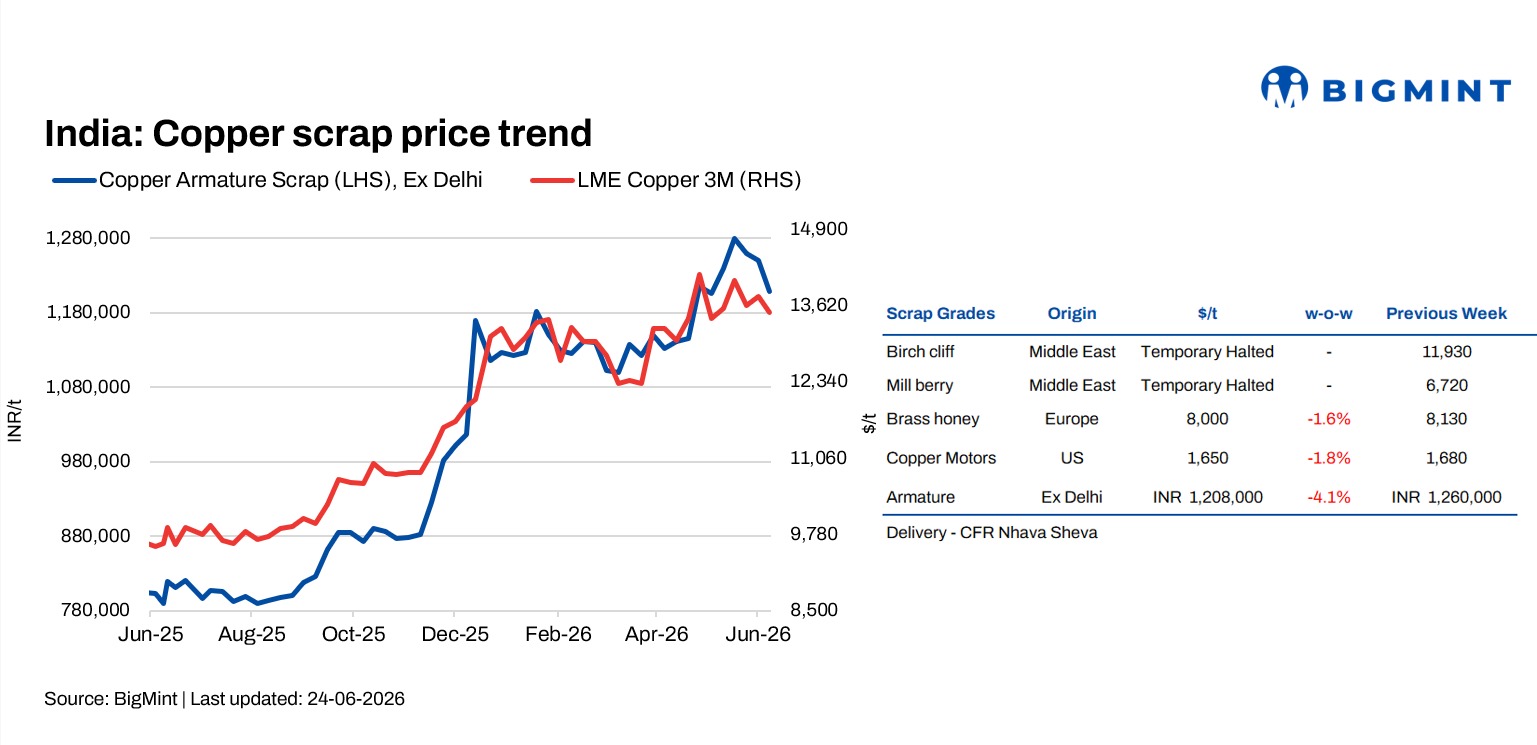
Copper scrap prices in India declined w-o-w on 24 June 2026, as benchmark prices fell however, domestic market sentiment remained cautious. London Metal Exchange (LME) copper prices fell $450/t to around $13,350/t from $13,800/t a week back, despite the news US tariff uncertainty.
At the domestic level, buying activity remained largely requirement-driven across key trading hubs. According to BigMint’s assessment, copper armature scrap, ex-Delhi, fell around 3% w-o-w to INR 1,208,000/t from INR 1,250,000/t last week.
Market insight
Market participants indicated that trading activity continues across major copper scrap grades, although deals remain largely restricted to smaller lot sizes as buyers focus on immediate requirements amid volatile international prices.
Market participants indicated that trading activity continues across major copper scrap grades, although transactions are largely limited to smaller lot sizes. Buyers remain focused on immediate requirements rather than building inventories amid volatile international prices.
Several traders highlighted that certain imported grades are currently becoming less attractive for Indian buyers. Copper motors, for instance, are reportedly witnessing reduced offers to India as exporters achieve better realizations in Pakistan, where demand for motor scrap remains comparatively stronger by around $100/t more than Indian buyers.
At the same time, market sources indicated that a significant portion of high-grade copper scrap, particularly Millberry, continues to find its way to Far East markets, where demand and pricing remain supportive. This has limited the availability of premium-grade scrap units in India and kept competition for quality material intact despite softer benchmark prices.
New trading entities may improve market liquidity
Market participants also expect changes in the domestic trading landscape over the coming months. Several primary copper producers and large metal companies are heard to be evaluating dedicated trading divisions for non-ferrous scrap, including copper.
Industry sources believe the entry of larger organised players into the scrap trade could improve market liquidity, strengthen procurement networks, and enhance overall transparency in the copper recycling value chain. Greater participation from established companies may also support demand for quality scrap and facilitate better integration between recyclers, traders, and end-users.
Formalisation of recycling sector gains attention
Meanwhile, the International Copper Association India (ICA India) has reiterated the need for formalisation of India’s copper recycling sector to improve the availability of high-quality recycled copper and strengthen the country’s circular economy ambitions.
According to ICA India, India currently generates around 600,000 tonnes of copper scrap annually, of which nearly 60-70% is estimated to be traded through informal channels. Industry stakeholders argue that the existing GST structure remains a key obstacle to formalisation, increasing transaction costs and encouraging cash-based trading practices.
The association has advocated reducing the GST rate on copper scrap and copper articles to 5% from the current 18%. According to industry representatives, a lower tax rate could improve compliance, reduce tax evasion, lower financing costs for recyclers and refiners, and encourage greater participation in the organised sector.
Stakeholders also emphasised that proper recycling infrastructure is essential to ensure recycled copper matches the quality standards of refined copper. Improved collection, segregation, and processing systems could help increase domestic copper availability while reducing dependence on imported raw materials.
Going forward, market participants expect copper scrap prices to remain closely linked to LME movements and global trade developments. While short-term sentiment remains cautious, expectations of greater sector formalisation, stronger participation from organised players, and continued growth in copper consumption are likely to support the long-term outlook for India’s copper recycling industry.
Deals level heard
* USA-origin mixed copper motors traded at $1,920/t CIF Pakistan.
* USA-origin mixed copper motors traded at $1,700/t CIF India.
* USA-origin large copper motors traded at $1,510/t CIF India.
* USA-origin small copper motors traded at $1,850-1,900/t CIF Pakistan.
* USA-origin Birch/Cliff traded at 94% of LME CIF Nhava Sheva.
* USA-origin T-Birch traded at 91% of LME CIF Nhava Sheva.
* USA/Europe-origin Candy Berry traded at 98% of LME CIF Nhava Sheva.
* USA/Europe-origin Millberry traded at 99% of LME CIF Nhava Sheva.
* USA-origin Meatballs traded at $2,650/t CIF Nhava Sheva.
Leave a Reply