- Supply tightness limiting price declines despite weak demand
- RKAB approvals remain key to future supply and price direction
Indonesia’s thermal coal market is continuing to see a period of softer demand but tighter supply.
Buying interest from China and India remains subdued, resulting in modest price corrections across mid- and lower-calorific-value coal grades. However, export availability continues to be constrained by domestic supply commitments, lower-than-normal shipment volumes and uncertainty surrounding second-half production approvals.
As a result, the market is experiencing a gradual correction rather than a sharp decline, with supply-side factors providing an important floor to prices.
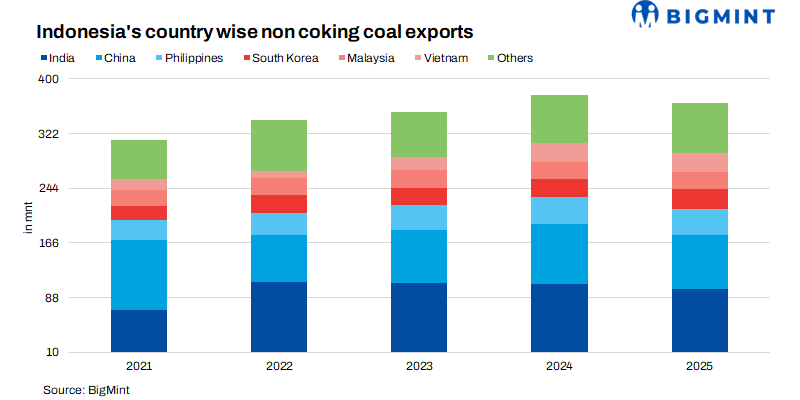
Export flows remain below normal
Despite softer buying activity, Indonesian exports have yet to recover to typical levels.
The five-day average of thermal coal exports currently stands at approximately 1 million tonnes per day, well below the 2025 average of 1.31 million tonnes per day.
This suggests that supply remains tighter than headline demand indicators imply and helps explain why prices have corrected only gradually despite cautious buying across Asia.
Domestic obligations continue to limit exports
Indonesia’s state utility PLN continues to require significant coal deliveries to maintain power generation.
An Indonesian miner stated that “PLN (Perusahaan Listrik Negara – Indonesia’s state electricity company) attributed the recent power outages to insufficient mid-CV coal availability at its stockpiles, driven by reduced RKAB quotas, stronger export economics compared with domestic PLN pricing, and longer PLN payment cycles affecting smaller miners’ cash flow. To address the supply gap, the government has directed several major coal producers to allocate prompt cargoes to PLN for June deliveries.”
Market participants report that several producers are continuing to prioritise domestic deliveries and finalise additional contracts with PLN, limiting the availability of export cargoes.
Although export sales remain more attractive from a pricing perspective, domestic market obligations continue to absorb a meaningful portion of production.
This policy-driven supply diversion is reducing the amount of coal available for international buyers.
Weak demand drives modest correction
Demand conditions remain mixed across Asia.
Chinese utilities continue to purchase cautiously as rainfall reduces electricity demand and port inventories remain comfortable.
Indian buyers are also adopting a wait-and-watch approach, supported by comfortable domestic coal availability and expectations of lower international prices.
Consequently, pressure has been greatest on mid- and lower-calorific-value Indonesian coal, while higher-calorific-value material has remained relatively resilient.
The latest market assessments suggest that the current correction is being driven primarily by weaker buying rather than an increase in available supply.
RKAB approvals remain key uncertainty
Attention is increasingly turning towards Indonesia’s second-half RKAB (Work Plan and Budget) approvals.
Any delay or restriction in production approvals could further tighten export availability during the third quarter.
Conversely, a faster approval process could allow producers to increase output and place additional pressure on prices.
The timing and scale of these approvals are likely to become one of the most important determinants of market direction over the coming months.
Indonesia remains central to Asian coal markets
As the world’s largest thermal coal exporter, Indonesia continues to play a critical role in balancing Asian coal markets.
Even relatively small changes in Indonesian export availability can significantly influence procurement strategies in China, India, Vietnam and other major importing countries.
Current market conditions suggest that supply-side constraints are offsetting weak demand, preventing a more pronounced price correction.
Takeaway
Indonesia’s thermal coal market is no longer being driven solely by demand from China and India.
Instead, the balance between domestic obligations, export availability and production approvals has become the dominant price driver.
Export shipments remain well below normal levels, while domestic commitments continue to divert tonnes away from international markets. This is limiting downside pressure even as Chinese and Indian buyers remain cautious.
The result is a market where mid- and low-calorific-value coal may continue to soften in the short term, but the scope for a significant correction appears limited unless export volumes recover materially through higher production or faster RKAB approvals.
This represents a subtle but important shift in market dynamics: Indonesia’s supply constraints are now proving more influential than Asia’s demand weakness.

Leave a Reply