- Controlled yard availability prevents price correction
- Billet, rebar prices fall across Gujarat, limiting scrap demand
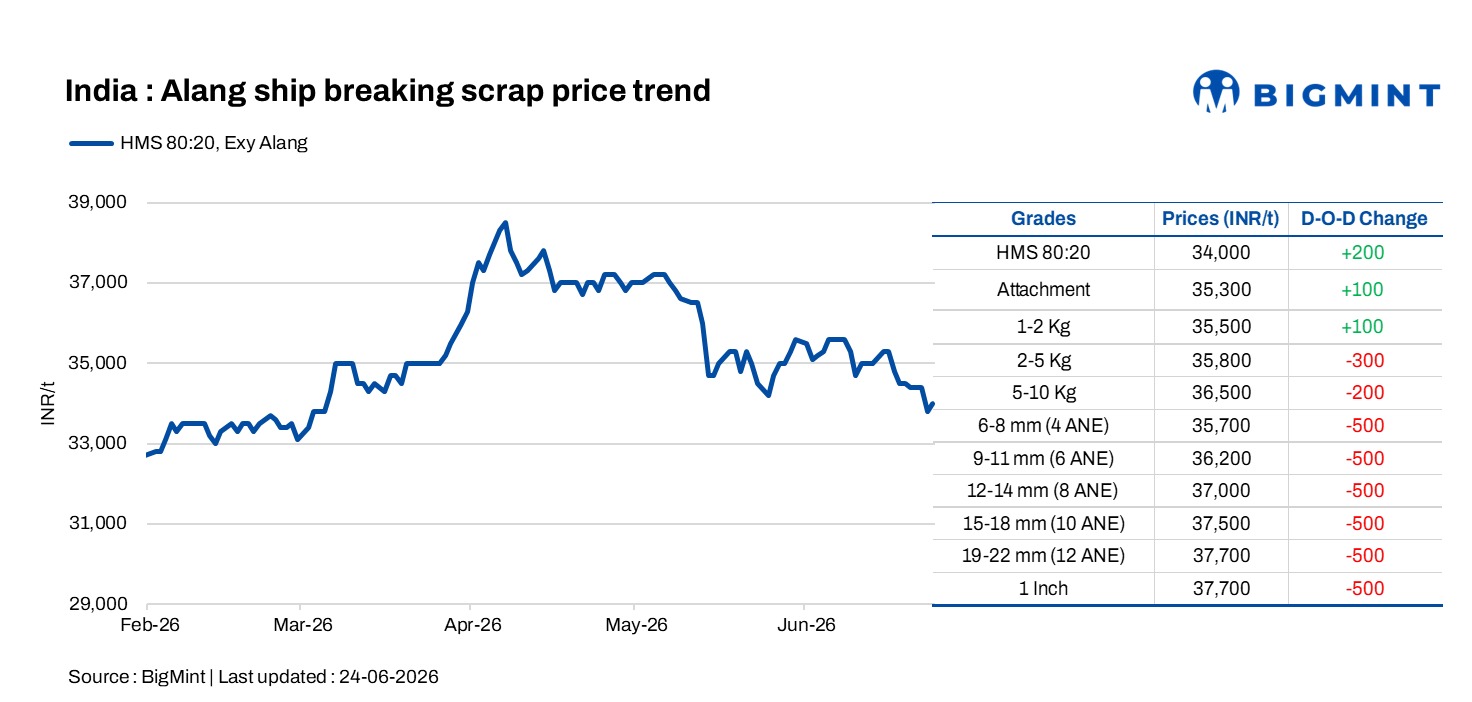
Ship-breaking scrap sentiment in Alang remained cautiously firm but fundamentally weak d-o-d on 24 June. HMS (80:20) prices increased marginally by INR 200/t to INR 34,000/t ex-yard, indicating limited support from controlled yard availability rather than any meaningful improvement in steel demand.
The broader ferrous value chain continued to exert downward pressure on sentiment. Bhavnagar billet prices fell by INR 200/t d-o-d to INR 41,500/t DAP, while Ahmedabad rebar prices declined by INR 200/t to INR 46,100/t ex-works. Similar weakness was observed in northern markets, where Mandi Gobindgarh billet and rebar prices corrected by INR 100/t each, reflecting subdued downstream consumption.

Despite the price uptick in Alang scrap, mills largely continued with need-based or hand-to-mouth procurement, as lower finished steel realisations compressed conversion margins and discouraged aggressive raw material buying. The stable HMS scrap price in Mandi Gobindgarh at INR 34,800/t DAP further highlights the absence of strong restocking activity across major secondary steel clusters.
Additional sentiment was influenced by vessel arrivals at Alang. The data shows seven vessels either beached or awaiting dismantling during June, including LNG carriers, tankers, containers, and general cargo vessels. The steady flow of incoming ships indicates adequate medium-term scrap generation potential and supports recycling yard utilisation rates.

While vessel arrivals remain healthy, market sources indicated that immediate scrap supply has not become excessive enough to trigger a sharper correction. Instead, price direction continues to be dictated primarily by steel demand fundamentals rather than availability from recycling yards.
For now, scrap prices are likely to remain under pressure until construction activity and finished steel demand improve, encouraging mills to return to the market with stronger restocking requirements.
Leave a Reply