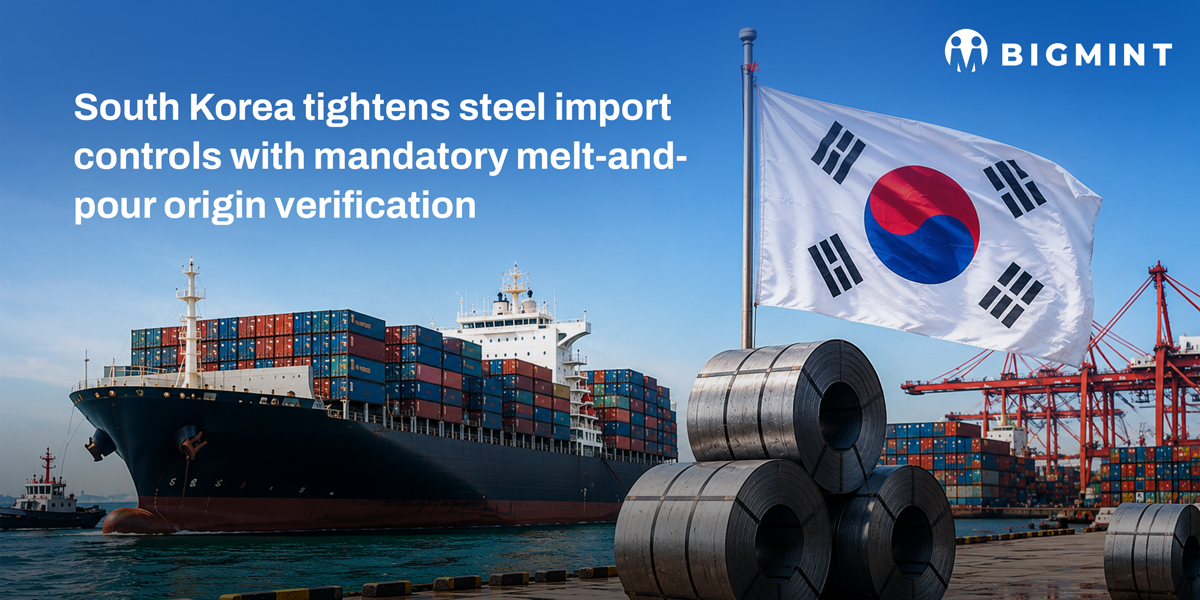
- New rules create non-tariff barriers to transshipped imports
- Most major steel imports brought under approval regime
SteelDaily: South Korea will now require importers to disclose where steel was originally melted and poured, potentially raising non-tariff barriers for low-cost and indirectly sourced material. The proposed amendments, announced by the Ministry of Trade, Industry and Energy (MOTIE) on 15 June, would institutionalise the submission of quality inspection certificates, known as mill test certificates (MTCs), and establish a formal import approval system covering most major steel products under HS Chapter 72.
The measures expand the government’s focus beyond conventional country-of-origin declarations to verification of the country where steel was first produced. Authorities are seeking to strengthen oversight of supply chains amid growing concerns over transshipment, third-country processing, and origin laundering in global steel trade. Public comments on the amendments are being accepted until 6 July.
Melt-and-pour verification becomes central
Under the proposed changes, importers of designated steel products will be required to obtain import approval and submit documentation identifying the “Country of Melted and Poured”. Where this information is not explicitly included in the MTC, importers must provide an additional manufacturer-issued warranty certificate confirming the origin of the steel.
The new framework effectively introduces a pre-clearance verification mechanism that traces steel products back to crude steel production. For example, steel produced in one country and subsequently processed into cold-rolled, coated, or finished products elsewhere would still require disclosure of the original steelmaking location.
The requirement mirrors growing international efforts to identify the true origin of steel products as governments seek to prevent circumvention of trade remedies and improve supply-chain transparency.
Most major steel imports brought under approval regime
The proposed Annex 4 covers a broad range of steel products between HS 7208 and HS 7229, including hot-rolled coil, cold-rolled coil, coated flat products, wire rod, bar, section steel, stainless steel, and alloy steel products. Import approval authority would be delegated to the Korea Iron and Steel Association.
The scope captures most key flat and long steel products imported into South Korea, although downstream steel tube products under HS Chapter 73 remain outside the immediate framework. The breadth of coverage suggests the government intends to establish a comprehensive monitoring system across the majority of the country’s primary steel imports.
A new standardised certificate format will also be introduced. Manufacturers may be required to certify product details, invoice information, MTC references, and the country where steel was melted and poured, while agreeing to provide additional supporting evidence if requested by authorities. The requirement for manufacturer signatures and seals means documentation can no longer be supplied solely by traders or intermediaries.
Compliance burden shifts upstream
The proposed system is likely to alter procurement practices for steel importers. Beyond price, specifications, and delivery schedules, buyers may increasingly assess suppliers based on documentation capabilities and traceability systems. Import contracts may need to include provisions covering MTC requirements, manufacturer certification obligations, and responsibility for customs delays arising from incomplete paperwork.
Large overseas steelmakers with established export relationships in South Korea are expected to adapt relatively quickly. However, smaller mills, trading houses, and suppliers relying on complex multi-country supply chains could face greater compliance challenges. Obtaining manufacturer-certified documentation may become particularly difficult for spot cargoes and products that undergo multiple stages of processing across different jurisdictions.
As a result, customs clearance lead times may lengthen during the transition period, especially for suppliers whose existing MTC formats do not contain melted-and-poured origin information.
Potential non-tariff barrier emerges
Although the amendments do not impose tariffs or trade remedy duties, market participants are likely to view the measures as a de facto non-tariff barrier. The impact could be particularly significant for low-priced imports routed through third countries, where tracing the original steelmaking source is often more difficult.
For domestic steelmakers, the measures could strengthen oversight of imported material quality and manufacturing history. Previously, industry concerns regarding inconsistencies in origin declarations, quality certification, and material traceability have periodically surfaced in the South Korean market.
Market awaits implementation details
The ultimate impact of the regulations will depend on implementation details that remain under consultation. Market participants are seeking clarity on approval timelines, document recognition standards, certification authorities, and the treatment of existing contracts and cargoes already in transit.
If adopted, the amendments would represent one of the most significant changes to South Korea’s steel import framework in recent years. The shift would move the market away from a purely price-driven import model towards one increasingly shaped by traceability, documentation quality, and supply chain transparency.
Note: This article has been published as part of a content exchange agreement between SteelDaily and BigMint.
Leave a Reply