- UK warns rising scrap exports threaten supply
- Hormuz reopening unlikely to ease prices quickly
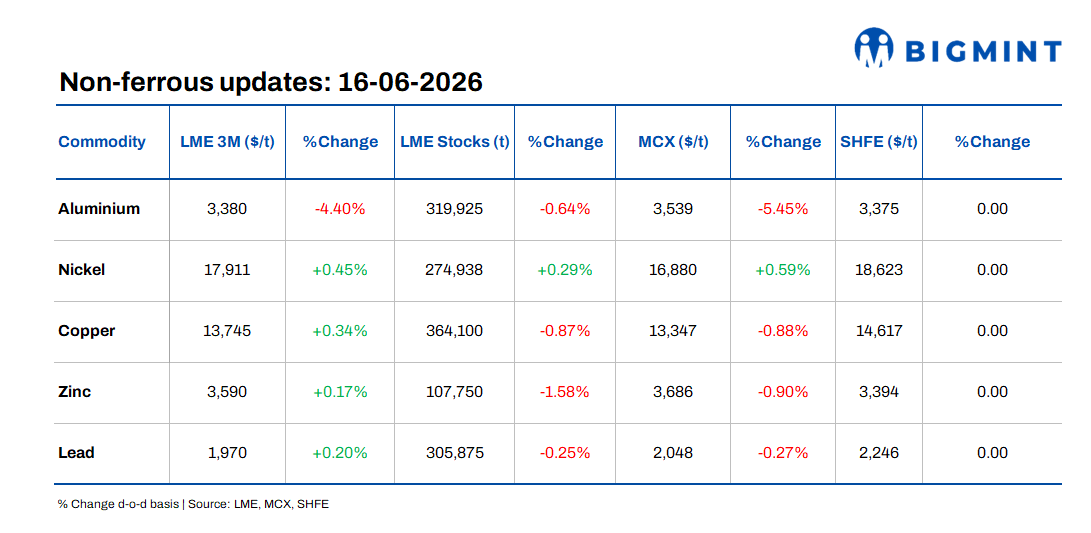
Base metals on the London Metal Exchange (LME) traded mostly higher on 15 June 2026, with gains led by nickel and copper, while aluminium came under significant pressure. Nickel recorded the strongest increase among major non-ferrous metals, rising 0.45% d-o-d to $17,911/t, followed by copper, which gained 0.34% to $13,745/t. Lead and zinc also edged up 0.20% and 0.17% to $1,970/t and $3,590/t, respectively. In contrast, aluminium declined sharply by 4.40% to $3,380/t, reflecting profit-booking after recent gains and easing concerns over global supply disruptions.
On the inventory side, trends remained mixed. Nickel was the only metal to record a stock increase, rising 0.29% d-o-d to 274,938 t. Meanwhile, zinc inventories registered the steepest decline, falling 1.58% to 107,750 t, followed by copper stocks, which dropped 0.87% to 364,100 t. Aluminium inventories declined 0.64% to 319,925 t, while lead stocks fell 0.25% to 305,875 t. The continued drawdown in most exchange inventories suggests underlying physical demand remains supportive despite recent market volatility.
Domestic market overview
India’s non-ferrous scrap market remained largely stable on 16 June amid subdued trading activity and mixed movements in benchmark metal prices. Aluminium tense scrap (loose), ex-Delhi, declined by INR 1,000/t, or 0.33% d-o-d, to INR 300,000/t, while ex-Chennai prices remained unchanged at INR 305,000/t.
Meanwhile, copper armature scrap (Cu 99%), ex-Delhi, was stable at INR 1,260,000/t with no d-o-d change. Market participants largely adopted a wait-and-watch approach amid uncertainty in global metals markets and fluctuating commodity prices.

Oil prices stabilise as markets assess US-Iran peace deal
Global crude oil prices traded mixed on 16 June 2026 as markets continued to assess the implications of the proposed US-Iran peace agreement and the eventual reopening of the Strait of Hormuz. Brent crude slipped 0.37% d-o-d to $82.93/bbl, while WTI crude edged up 0.14% to $80.66/bbl. Natural gas prices gained 2.71% to $3.14/MMBtu, reflecting ongoing uncertainty around global energy supply chains.
Market attention has now turned to rebuilding disrupted energy flows after more than 100 days of severe supply disruptions in the Middle East. While the proposed US-Iran agreement has reduced immediate fears of shortages, analysts expect the restoration of oil exports to be gradual due to stranded tankers, infrastructure bottlenecks, and insurance-related challenges.
More than 160 oil tankers remain stranded in the Gulf region, while mine-clearing operations and infrastructure restoration could delay the full recovery of exports. Although oil flows are expected to gradually improve, prices are projected to remain in the $80–90/bbl range in the near term as countries replenish depleted strategic reserves and energy supply chains continue to normalize.
Vedanta, Hindalco, NALCO fall on aluminium weakness
Shares of major Indian aluminium producers, including Vedanta, Hindalco, and NALCO, fell by up to 5% on 16 June after LME aluminium prices dropped 4.4% to $3,380/t, their lowest level since 27 March. The decline followed news of an interim US-Iran agreement that could lead to the reopening of the Strait of Hormuz and the resumption of disrupted metal shipments.
During the conflict, Middle Eastern smelters faced supply shortages due to missile attacks and logistical disruptions, contributing to a significant global aluminium deficit. With expectations of easing supply constraints, investors booked profits in aluminium-related stocks, pressuring share prices across the sector.
UK warns of aluminium scrap shortage risk
UK manufacturing body Make UK has warned that rising exports of aluminium scrap could leave the country short of a critical raw material needed for defence, clean energy, digital technologies, and automotive manufacturing. UK aluminium scrap exports reached 624,314 t in 2025, up 43% from 2016, with shipments to India rising 94% to nearly 199,000 t.
The industry body estimates that domestic manufacturers could require up to 6 million t of scrap by 2035 to meet growing aluminium demand and support recycling goals. Make UK has called for greater investment in domestic scrap processing capacity and measures to retain strategic aluminium materials within the country to strengthen industrial competitiveness and supply chain resilience.

Leave a Reply