- Higher freight costs keep imported material uncompetitive
- Long products segment remains stagnant on rising scrap costs
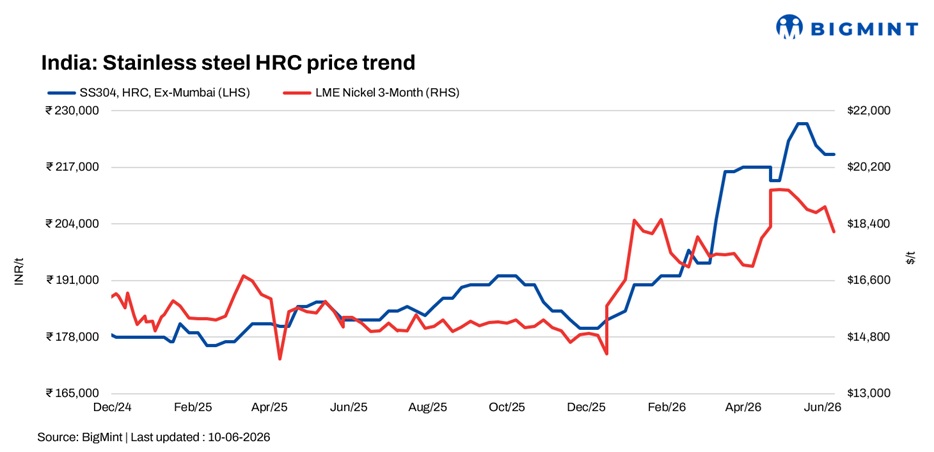
India’s stainless steel market softened in the week ended 10 June 2026 as weak demand across both flat and long product segments continued to weigh on market sentiment. Buyers remained cautious amid volatile nickel prices, rising molybdenum costs, and ongoing global uncertainties.
Flat products face demand pressure
The stainless steel flat products market remained under pressure due to subdued buying activity and concerns over material availability.
According to BigMint’s assessment, 304-grade hot-rolled coil (HRC) prices remained unchanged w-o-w at INR 220,000/t ex-Mumbai. In contrast, 316-grade HRC prices declined by INR 5,000/t to INR 400,000/t ex-Mumbai, reflecting weak demand despite elevated alloy costs.
In the import market, participants reported limited competitiveness of Chinese-origin material. Higher freights and container shortages continued to inflate landed costs, with shipping charges increasing by nearly $2,000 per 20-ft container. As a result, imported offers were heard largely at parity with domestic prices, restricting fresh bookings.
Long products market remains sluggish
India’s stainless steel long products segment remained sluggish during the week. Rising scrap costs failed to translate into stronger finished steel demand, while mills focused on executing existing orders and clearing pending bookings.
Export activity continued to face headwinds from geopolitical uncertainties, container shortages, and elevated freight costs, limiting overseas sales opportunities.
BigMint’s benchmark 304L black round bar prices remained stable at INR 195,000/t ex-Mumbai. Similarly, 316L black round bar prices held steady at INR 350,000/t ex-Mumbai, supported by higher molybdenum costs despite muted demand.
Raw material scenario

Outlook
India’s stainless steel market is expected to remain subdued in the near term. While firm nickel prices, elevated freight rates, and higher alloy costs may provide cost support, weak downstream demand, and cautious purchasing activity are likely to limit any meaningful price recovery across both flat and long product segments.
Leave a Reply