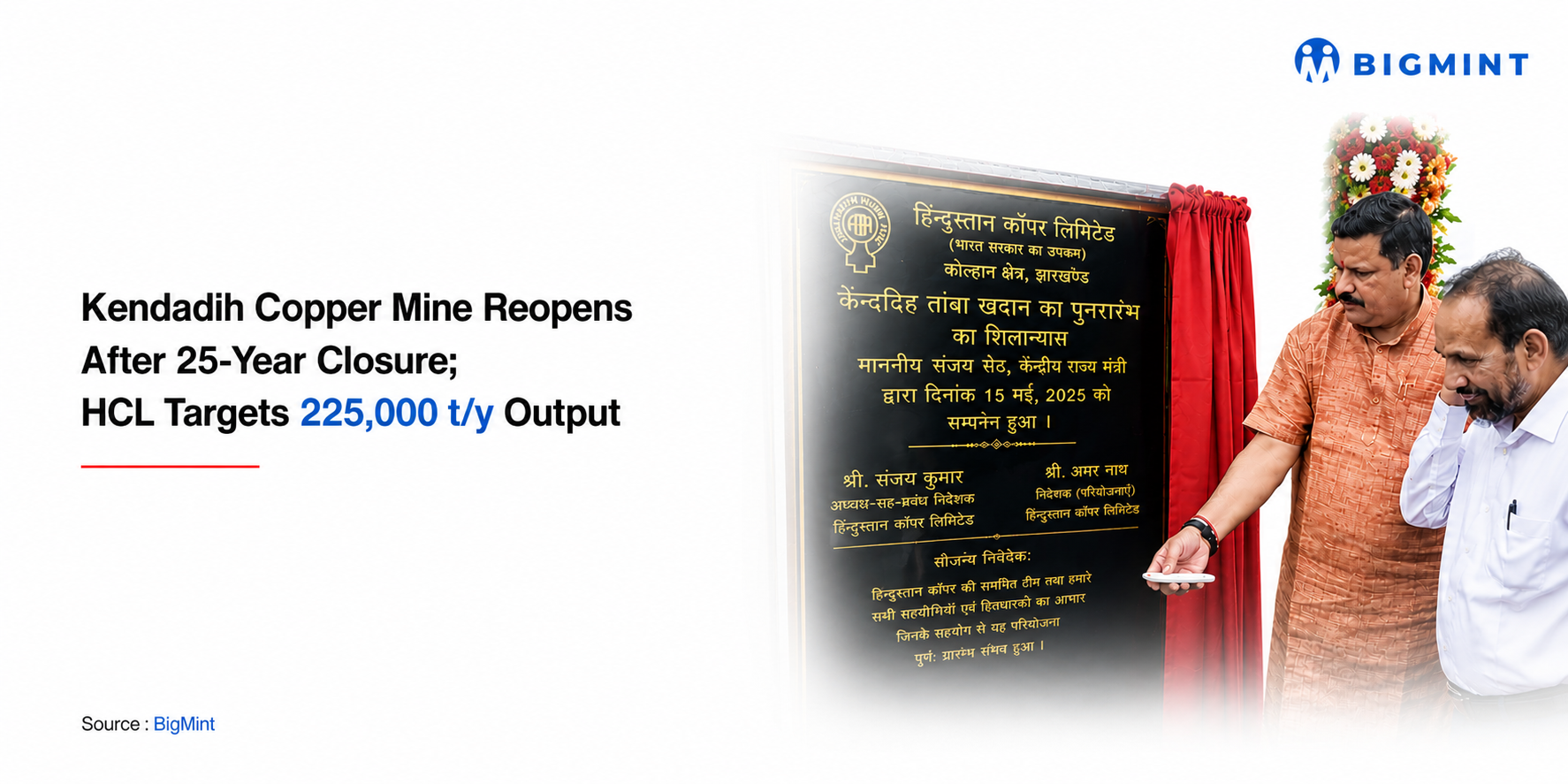
- Kendadih targets 225,000 tonnes annual output
- HCL expands concentrator capacity to 0.9 MTPA
Hindustan Copper Ltd. (HCL) has restarted operations at the Kendadih copper mine in Jharkhand’s East Singhbhum district after a gap of nearly 25 years, marking a significant milestone for India’s domestic copper mining sector. The reopening was formally inaugurated by Union Minister of State for Coal and Mines Satish Chandra Dubey at HCL’s Indian Copper Complex (ICC), alongside the launch of the expansion of the ICC concentrator plant from 0.4 million tonnes per annum (MTPA) to 0.9 MTPA.
The development aligns with the government’s Atmanirbhar Bharat initiative and aims to strengthen domestic copper production amid rising demand from infrastructure, electric vehicles (EVs), and renewable energy sectors.
The Kendadih mine is expected to play an important role in increasing ore availability for HCL. The company has set a target of producing 225,000 tonnes of copper ore annually from the mine, while ongoing efforts are underway to increase ore production at the Surda mine from 400,000 tonnes to 900,000 tonnes per year.
The concentrator expansion at ICC is expected to improve processing capacity and support future growth in MIC output. Company officials also indicated that the reopening of Kendadih could accelerate plans to revive the Chapri and Rakha mines in the Singhbhum copper belt.
The mine’s revival comes after a prolonged period of inactivity. The Kendadih mining lease, covering 1,139.6 hectares, expired in June 2023, leading to the suspension of operations. During FY’25, the Government of Jharkhand extended the lease for another 20 years until June 2043.
The project is currently awaiting key statutory approvals, including Stage-I forest clearance for 413.5 hectares of forest land and amendments to environmental clearances. Once all approvals are secured, HCL plans to increase Kendadih’s ore production capacity from 0.21 MTPA to 0.45 MTPA.
Despite being India’s only copper mining company, HCL’s contribution to the country’s mined copper output remains relatively small. The company currently accounts for only around 4% of India’s total mined copper concentrate requirement, while nearly 96% is met through imports.
Although HCL recorded its highest mine production in seven years during FY’25, domestic mining growth has struggled to keep pace with rapidly expanding refining capacity and consumption demand.
The revival of Kendadih and expansion of processing infrastructure could help partially address India’s growing dependence on imported copper concentrate. India’s copper concentrate imports rose to 1.44 million tonnes in CY’25 from 1.17 million tonnes in CY’24, reflecting a 23% year-on-year increase. Additional domestic ore production from Kendadih, Surda, and potentially Chapri and Rakha mines could improve raw material availability for domestic smelters and reduce import reliance over the medium term.
However, given the scale of India’s copper demand growth, imports are expected to remain a key component of the supply chain.
Outlook
Looking ahead, HCL’s mine revival strategy forms a critical part of its Vision 2030 roadmap. By expanding mining capacity, improving operational efficiency, and supporting India’s resource security goals, the company aims to strengthen its role in the domestic copper value chain while contributing to the country’s long-term objective of reducing dependence on imported copper raw materials.

Leave a Reply