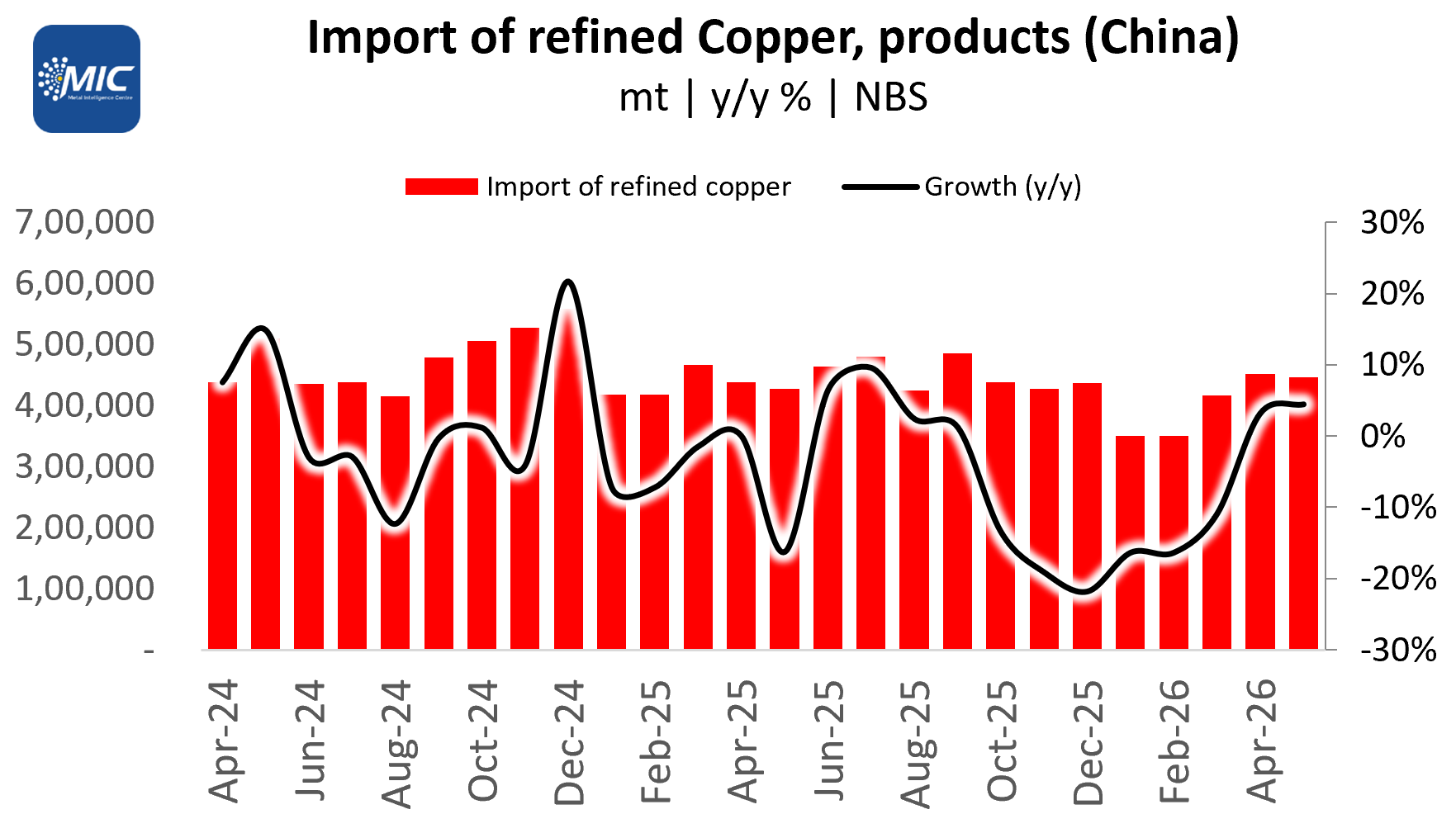
- China refined copper imports rise 4.4% YoY
- Global copper surplus narrows sharply to 30,000 t
Metal Intelligence Centre: China’s refined copper imports continued to strengthen in May, highlighting resilient demand despite elevated domestic production levels. According to customs data, refined copper imports increased 4.4% year-on-year to 446,600 t, marking the second consecutive month of annual growth and the strongest expansion since August 2025.
The increase in imports comes even as China’s domestic refined copper production remains near record highs. Data from the National Bureau of Statistics (NBS) showed that refined copper output reached approximately 1.26 million tonnes in April, up 1.2% from a year earlier. Although production eased slightly from the all-time high recorded in March, smelters continued operating at high rates, supported by steady demand from downstream sectors such as power infrastructure, electric vehicles, renewable energy, and manufacturing.
China remains the world’s largest copper consumer, accounting for nearly 58% of global copper demand, with annual consumption exceeding 16 million tonnes. Despite severe pressure on treatment and refining charges (TC/RCs) due to tight concentrate availability, Chinese smelters have maintained strong output levels through long-term concentrate supply contracts, greater use of secondary copper, and diversified feedstock sourcing strategies.
In contrast, imports of copper ore and concentrate declined by 1% year-on-year to 2.36 million tonnes in May. The decline reflects ongoing tightness in the raw material market, which continues to face supply disruptions from major mining regions and increasing competition among global smelters for concentrate supplies. Persistent shortages of concentrate have pushed spot TC/RCs to historically low levels, increasing pressure on smelter margins.

Meanwhile, China’s growing use of alternative raw materials has helped offset some of the pressure from concentrate shortages. Increased utilization of copper scrap and lower-grade concentrates has enabled smelters to sustain production while reducing reliance on imported refined metal. This structural shift has gradually strengthened China’s self-sufficiency in refined copper production and altered its import patterns.
At the same time, the global copper market is showing signs of tightening. According to the International Copper Study Group (ICSG), the global refined copper surplus narrowed sharply to 30,000 tonnes in March, down from a revised surplus of 277,000 tonnes in February. The significant reduction reflects improving demand conditions, particularly in Asia, and a more balanced supply-demand environment.
The combination of strong Chinese consumption, sustained smelter operating rates, and tighter global market balances is expected to keep copper market sentiment supported in the coming months. However, ongoing risks surrounding mine supply, concentrate availability, and global trade developments will remain key factors influencing copper flows and pricing trends worldwide.
Note: This article has been published as part of a content partnership between MIC and BigMint
Leave a Reply