- Copper loses momentum as risk sentiment weakens across LME metals
- Oil markets regain strength on stalled Iran peace expectations
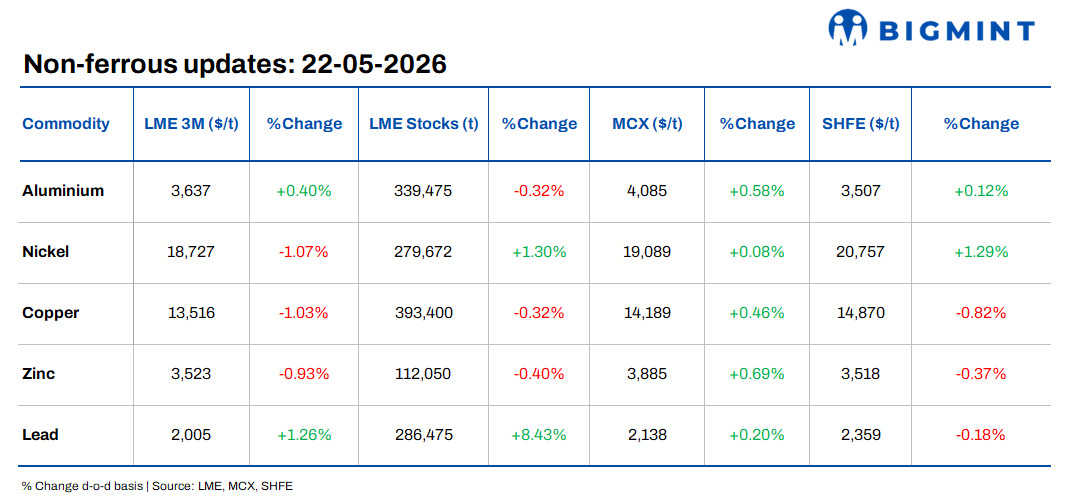
Base metals prices on the London Metal Exchange (LME) traded mostly lower on 21 May 2026, with weakness in copper, nickel and zinc outweighing gains in lead and aluminium. Lead recorded the highest increase among major non-ferrous metals, rising 1.26% d-o-d to $2,005/t, while aluminium edged higher by 0.40% to $3,637/t. Meanwhile, nickel declined 1.07% to $18,727/t, followed by copper and zinc, which fell 1.03% and 0.93% to $13,516/t and $3,523/t, respectively, reflecting cautious sentiment across the broader metals complex.
LME inventory trends remained mixed across major base metals. Lead stocks recorded a sharp increase of 8.43% d-o-d to 286,475 t, while nickel inventories also rose 1.30% to 279,672 t. In contrast, zinc, aluminium and copper stocks declined by 0.40%, 0.32% and 0.32% to 112,050 t, 339,475 t and 393,400 t, respectively, indicating selective tightness across exchange-monitored warehouses.
Domestic market overview
India’s non-ferrous scrap market remained largely stable d-o-d. Aluminium tense scrap (loose), ex-Delhi, was unchanged at INR 304,000/t, while ex-Chennai prices also remained stable at INR 310,000/t amid balanced regional market activity.
Meanwhile, copper armature scrap (Cu 99%), ex-Delhi, increased by INR 5,000/t or 0.4% d-o-d to INR 1,210,000/t from INR 1,205,000/t, supported by firmer buying interest despite weaker global trends.

Other updates
Copper heads for steady weekly close
Copper prices were headed for a broadly steady weekly performance as traders remained cautious over ongoing uncertainty surrounding US-Iran peace negotiations and potential supply disruptions in the Middle East. Market participants continued to monitor developments linked to the Strait of Hormuz, a key global energy shipping route, keeping overall risk sentiment volatile.
Despite geopolitical uncertainty, copper prices remained supported by tight global supply conditions and stable demand expectations, while broader commodity markets continued reacting to fluctuations in oil prices and energy-related risks.
China accelerates Xinjiang industrial expansion
China is accelerating development of coal, aluminium and chemical infrastructure in Xinjiang as ongoing Middle East tensions continue to disrupt global energy and supply chains. The region, which holds nearly 390 billion tonnes of coal reserves, is emerging as a major coal-to-chemicals and downstream industrial hub supported by advanced mining technologies and large-scale power projects.
Authorities are also expanding coal gasification, coal-to-gas and integrated industrial projects in Xinjiang to strengthen domestic energy security and reduce dependence on volatile overseas energy markets.
Oil prices rise as doubts persist over US-Iran peace talks
Oil prices edged higher after investors grew sceptical about the prospects of a breakthrough in US-Iran peace negotiations, with unresolved disagreements over Iran’s uranium stockpile and control of the Strait of Hormuz continuing to support market uncertainty. US WTI crude futures rose over 1% to around $97.5/bbl in early trade, recovering part of the previous session’s losses.
Market sentiment remained volatile as concerns over prolonged disruption to energy flows through the Strait of Hormuz continued to support crude prices, despite expectations of a weekly decline in oil benchmarks
Hormuz transit talks keep shipping markets on edge
Iran is reportedly in talks with Oman to establish a permanent transit mechanism for the Strait of Hormuz, including protocols for vessel monitoring, shipping permits and potential toll collection systems. The discussions come amid ongoing geopolitical tensions and continued disruption to global energy flows through the key maritime corridor.
The Strait of Hormuz handles nearly one-fifth of global oil trade, and any formalised transit or toll framework could significantly impact global shipping costs, crude flows and energy market sentiment. Market participants continue to closely monitor developments as uncertainty around maritime access and regional security remains elevated.
Leave a Reply