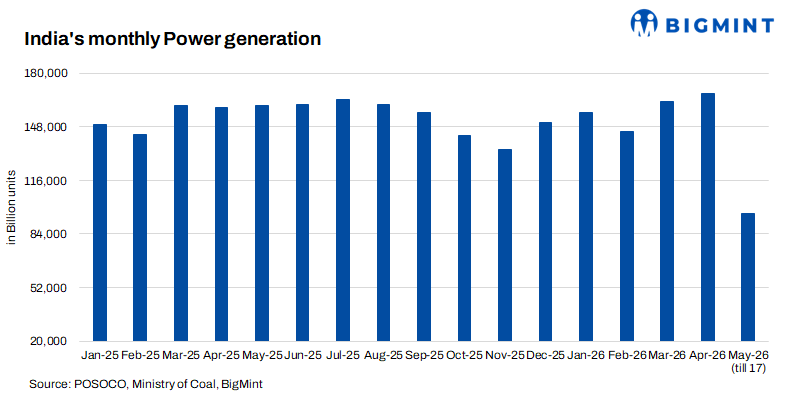
- Grid demand continues to surge after sunset when solar output drops
- India focusing on scaling storage, transmission to boost grid flexibility
India’s power demand profile has shifted in recent months, with sharp demand surges increasingly extending into night hours when solar generation is unavailable. As a result, the next phase of India’s power infrastructure expansion is likely to be driven less by aggregate capacity additions and more by investments in evening reliability through energy storage, transmission corridor expansion, and flexible cleaner thermal generation. BigMint analyses the measures India is taking to enhance its power grid flexibility.
What happened – power demand hits peak on 18 May
India’s latest heatwave pushed total power demand to about 257.37 gigawatts (GW) on 18 May. The National Load Despatch Centre’s (NLDC) transmission system peak (excludes behind-the-meter sources such as rooftop solar and captive power) arrived later at 238.4 GW around 22:30. Through the afternoon, behind-the-meter solar depressed grid demand; once the sun set and air conditioning stayed high, more of the burden shifted to the high voltage network.
The generation stack during the 22:00-22:45 band was coal heavy (above 180 GW), with solar at zero, hydro providing much of the flexibility, natural gas marginal, and a small but meaningful contribution from storage. Battery Energy Storage Systems (BESS) and pumped storage hydropower (PSP) together discharged roughly 2.5-2.6 GW during the critical hours.
Market prints told the same story: the day ahead Market Clearing Price (MCP) on the Indian Energy Exchange (IEX) hit the INR 10,000 per megawatt hour ceiling for eight hours (00:00-04:00 and 20:00-24:00), lifting the day’s weighted average to about INR 5,710/MWh. Inter-regional highways into the North and South ran close to limits, notably the Talcher-Kolar high voltage direct current (HVDC) bipole and the 765 kilovolt (kV) Angul-Srikakulam corridor.
Station logs from the Central Electricity Authority (CEA) reflected high summer utilisation: economiser and superheater tube leakages, air preheater and induced draft fan faults, and condenser cleanings across multiple coal stations. The system met both peaks and stayed within frequency bounds, but the margin was thin.
Where India is headed – the building blocks
1. Firming the evening with storage
Battery Energy Storage Systems (BESS) are moving from pilots to operations. The recently commissioned 180 megawatt (MW)/360 megawatt hour (MWh) project in Gujarat stores mid-day solar and discharges into the 19:00-23:00 ramp. Central tenders that link renewables with storage, plus viability gap funding (VGF), are catalysing a multi-gigawatt pipeline.
Pumped storage hydropower (PSP) is returning to the mainstream. States are advancing sites and concession frameworks; new scheduling and tariff designs enable PSPs to supply evening energy and ancillary grid services.
2. “Firm green” contracting
Renewable procurements are shifting from energy only to time-bound delivery: round-the-clock (RTC), hybrid (solar plus wind), and peak power products. These structures explicitly target post-sunset demand and reduce exposure to merchant price spikes.
3. Transmission and market plumbing
The national plan to integrate 500 GW of non-fossil capacity by 2030 is adding high-voltage direct current (HVDC) backbones and 765 kV meshes to move daytime surpluses and reinforce evening imports into the North and South. Projects include Leh-Kaithal HVDC and expansions around Raigarh-Pugalur.
Five-minute Real Time Market (RTM) trading and upgraded ancillary services allow flexible resources to be priced and dispatched closer to need.
4. Cleaner, more flexible thermal
Coal remains central to the evening ramp for now. Plants are adopting faster ramp protocols, digital operations and maintenance (O&M), and biomass co-firing to reduce local pollutants and equipment stress while maintaining reliability.
5. Demand-side modernisation
Smart prepaid meters under the Revamped Distribution Sector Scheme (RDSS), time of use tariffs, and early demand response pilots in commercial and industrial facilities are beginning to shave the sharpest evening peaks.
Implications for materials and fuels
1. Steel and related materials
- Transmission build out: HVDC terminals, 765 kV towers, substations and switchyards are steel-intensive. As green corridors and national backbones progress, power sector steel demand receives multi-year support.
- Storage and flexibility: Utility-scale BESS requires steel for enclosures, racks, and electrical balance of plant; PSPs require significant civil works (concrete and rebar) along with penstocks and powerhouse structures. The PSP footprint is materially larger per MW and could be a notable steel consumer as projects move to construction.
- Renewable balance of system: Continued solar and wind additions sustain demand for galvanised and structural steel in module mounting structures, lattice towers, and evacuation infrastructure.
- Thermal fleet maintenance: High plant load factors (PLFs) during summer increase orders for boiler tubes, air preheater elements, fans, and condenser retubing, supporting alloy and speciality steel consumption in spares and overhauls.
2. Coal and other fossil fuels
- Coal remains the marginal evening workhorse. If peaks rise toward 270 GW during low wind conditions, incremental thermal output of 15-20 GW would imply roughly 120,000-200,000 tonnes of additional coal burn per day (3.6-6 million tonnes per month), depending on efficiency and coal quality. Domestic mining can lift supply, but rail rakes, port unloaders, and stockyards are the practical bottlenecks. Coastal utilities in Gujarat, Maharashtra, Tamil Nadu, and Andhra Pradesh are the likely swing buyers of imported mid-calorific-value coal when logistics tighten.
- Natural gas plays a limited peaking role today due to price and availability; it can still help at the margin in tight evening hours where fuel is available.
What to watch next
- Storage cadence: Awards, financial closures, and commissioning timelines for BESS and PSP — and whether new assets are explicitly scheduled into the 19:00-23:00 ramp.
- Corridor progress: North-south and east-west reinforcements that relieve evening transfer constraints, especially HVDC additions and 765 kV meshes.
- Contract evolution: More round-the-clock, hybrid, and peak power tenders indicate deeper decarbonisation of evening supply.
- Thermal outage rates: Tube leak and fan fault incidence through the summer and into the monsoon shoulder — an indicator of how hard the fleet is being run and the scale of maintenance demand for metals and components.
- Coal inventories and import tenders: Activity at coastal plants during extended heat spells provides a near-term read on seaborne demand.
Bottom line
India’s days are getting greener; however, its evenings are becoming the system’s defining challenge. The combination now taking shape — storage aimed at the ramp, sturdier corridors, time-bound renewable contracting, and cleaner, better-maintained thermal — has direct bearings on steel demand across grid infrastructure and on coal use during peak hours. Over the next few summers, both grid steel and thermal coal are likely to remain in firm demand, even as new storage and market designs gradually reshape how the evening is supplied.

Leave a Reply