- Copper leads LME rally, rising nearly 2% d-o-d
- Brazil extends scrutiny on aluminium plate imports
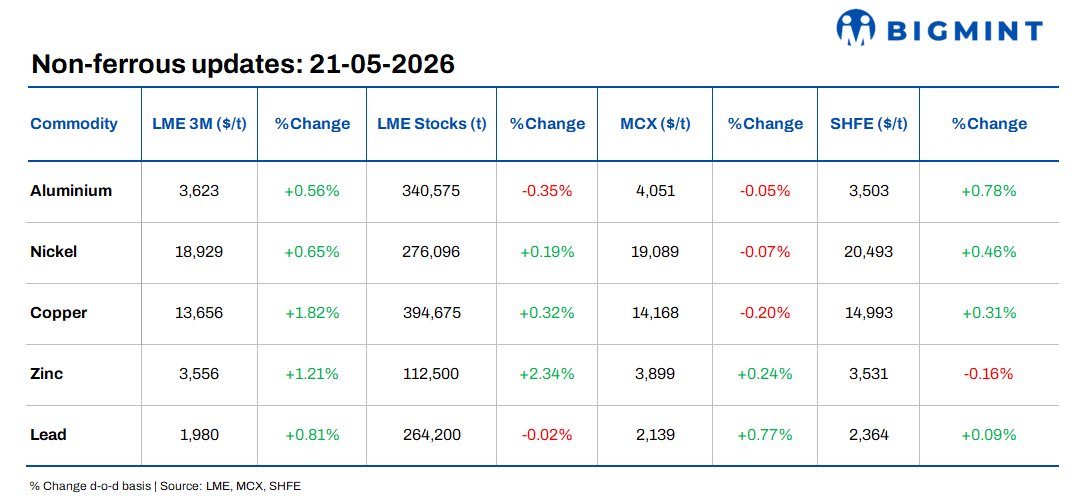
Base metals prices on the London Metal Exchange (LME) extended gains on 20 May 2026 amid improved market sentiment. Copper led the uptrend, rising 1.82% d-o-d to $13,656/t, while zinc gained 1.21% to $3,556/t. Lead, nickel and aluminium also moved higher by 0.81%, 0.65%, and 0.56% to $1,980/t, $18,929/t, and $3,623/t, respectively, supported by firm buying interest across the broader metals complex.
LME inventory trends, however, remained mixed. Zinc stocks recorded a notable increase of 2.34% d-o-d to 112,500 t, while copper and nickel inventories also edged higher to 394,675 t and 276,096 t, respectively. In contrast, aluminium stocks declined 0.35% to 340,575 t, while lead inventories remained largely stable at 264,200 t, reflecting selective supply tightness across exchange warehouses.
Domestic market overview
India’s non-ferrous scrap market remained stable d-o-d. Aluminium tense scrap (loose), ex-Delhi, was unchanged at INR 304,000/t, while ex-Chennai prices also held steady at INR 310,000/t amid balanced regional market activity.
Meanwhile, copper armature scrap (Cu 99%), ex-Delhi, increased by INR 5,000/t or 0.4% d-o-d to INR 1,205,000/t from INR 1,200,000/t, supported by firmer global copper prices and improved buying sentiment.

Other market updates
Brazil reassesses AD duties on aluminium printing plates
Brazil’s Secretariat of Foreign Trade (SECEX) has initiated a second sunset review of anti-dumping (AD) duties on imports of pre-sensitised aluminium plates used in offset printing from China. The review covers products classified under NCM codes 3701.30.21 and 3701.30.31.
The duties, first imposed in 2014 and extended in 2020 following the first sunset review, are being reassessed to determine whether removal of the measures could result in continuation or recurrence of dumping and injury to Brazil’s domestic industry.
Tsingshan JV seeks LME listing for Indonesian aluminium brand
China’s Tsingshan Holding Group has applied to list aluminium produced by its Indonesian joint venture Hua Chin for delivery on the London Metal Exchange (LME). If approved, Hua Chin would become only the second Indonesian high-grade primary aluminium brand accepted by the LME after state-owned Inalum.
The Hua Chin project, located in Sulawesi and backed by Tsingshan and Huafon Group, recently commissioned its second phase, taking annual aluminium ingot capacity to around 480,000 t. The move comes amid Indonesia’s expanding aluminium production and exports, which could help offset supply disruptions linked to ongoing geopolitical tensions in the Middle East.
Oil rebounds on uncertainty over Iran peace deal, inventory drawdowns
Oil prices rebounded on 21 May after sharp losses in the previous session, supported by uncertainty surrounding a potential US-Iran peace agreement and larger-than-expected US inventory drawdowns. Brent crude rose to around $105.8/bbl, while WTI crude increased to nearly $99.1/bbl.
Market sentiment remained volatile as concerns over supply disruptions through the Strait of Hormuz continued to support prices. Meanwhile, the US Energy Information Administration (EIA) reported significant declines in crude inventories and strategic petroleum reserves, reinforcing expectations of tightening global oil supply conditions.
Oil flows through Hormuz may take months to recover post-conflict
Global oil flows through the Strait of Hormuz could take at least four months to recover to nearly 80% of pre-conflict levels even if the ongoing Iran conflict ends immediately, highlighting continued risks to global energy supply chains and shipping movements.
Meanwhile, the UAE is accelerating development of a new crude pipeline bypassing the Strait of Hormuz, with the project reported to be around 50% complete and targeted for commissioning by 2027 to strengthen export security and reduce dependence on the key maritime route. The Strait of Hormuz handles nearly one-fifth of global oil trade, and prolonged disruptions in the region continue to keep global crude markets volatile.
Leave a Reply