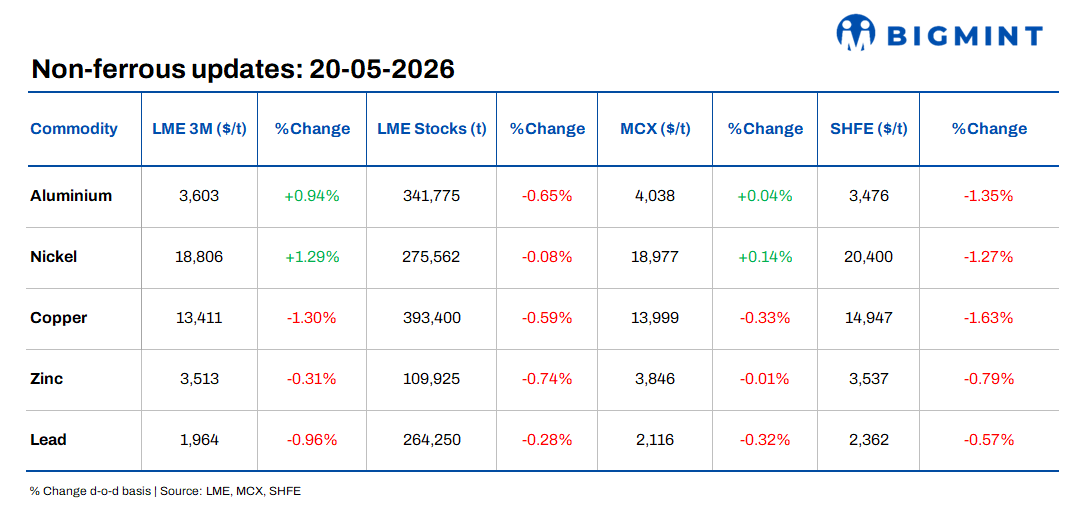
Base metals prices on the London Metal Exchange (LME) traded mixed on 19 May 2026, with gains in aluminium and nickel offset by weakness in copper, zinc and lead. Nickel recorded the highest increase among major base metals, rising 1.29% d-o-d to $18,806/t, followed by aluminium, which increased 0.94% to $3,603/t. Meanwhile, copper declined 1.30% to $13,411/t, while lead and zinc fell 0.96% and 0.31% to $1,964/t and $3,513/t, respectively, reflecting cautious sentiment across the non-ferrous complex.
On the inventory side, LME stocks declined across all major base metals, indicating continued drawdowns in exchange-monitored warehouses. Aluminium inventories fell 0.65% to 341,775 t, while copper stocks declined 0.59% to 393,400 t. Zinc inventories dropped 0.74% to 109,925 t, followed by lead, which edged lower by 0.28% to 264,250 t. Meanwhile, nickel inventories also eased marginally by 0.08% to 275,562 t, reflecting continued tightness across the broader non-ferrous complex.
Domestic market overview
India’s non-ferrous scrap market traded mixed d-o-d. Aluminium Tense scrap (loose), ex-Delhi, remained unchanged at INR 304,000/t, while ex-Chennai prices declined by INR 2,000/t or 0.6% d-o-d to INR 310,000/t from INR 312,000/t amid relatively softer regional buying activity.
Meanwhile, copper armature scrap (Cu 99%), ex-Delhi, increased by INR 4,000/t or 0.3% d-o-d to INR 1,200,000/t from INR 1,196,000/t, tracking firm global copper market sentiment.

Other market updates
Aluminium prices remain firm amid renewed US-Iran conflict concerns
Global aluminium prices continued to trade near multi-year highs amid renewed geopolitical tensions between the US and Iran, with supply-side concerns supporting stronger London Metal Exchange (LME) sentiment. LME aluminium closed at $3,603/t, supported by declining exchange inventories and tightening physical market conditions.
Market sentiment remained bullish amid concerns over potential disruptions to Middle East aluminium supply chains and energy markets. Tightening LME inventories and a stronger Cash-3M premium structure continued to reflect persistent supply tightness outside China.
Oil prices ease as Trump signals possible quick end to Iran conflict
Global oil prices edged lower on 20 May after US President Donald Trump indicated that the ongoing Iran conflict could end “very quickly,” easing immediate concerns over prolonged supply disruptions in the Middle East. Brent crude and WTI futures declined amid expectations of potential diplomatic progress around the Strait of Hormuz.
Despite the correction, market sentiment remained cautious as traders continued to monitor risks to Middle East supply chains and global crude flows. Any further escalation in the region could keep oil prices volatile in the near term.
Zinc supply disruptions tighten market despite surplus expectations
Global zinc markets remained tight despite earlier surplus forecasts, as operational disruptions at key smelters in Kazakhstan and Peru restricted refined metal availability and supported higher LME prices. LME zinc recently touched a near four-year high of $3,633/t.
Meanwhile, low LME inventories and constrained smelter output outside China continued to support bullish zinc sentiment, with the International Lead and Zinc Study Group (ILZSG) now projecting a 19,000 t global zinc deficit for 2026.
India prepares oil tanker movement through Hormuz amid Gulf supply concerns
India is preparing to resume crude cargo movements through the Strait of Hormuz to secure fresh oil supplies amid ongoing disruptions in the Gulf region. The move comes as geopolitical tensions continue to tighten tanker availability and increase freight and insurance costs across global energy markets.
The Strait of Hormuz handles nearly one-fifth of global oil trade, and prolonged disruptions in the region continue to keep global crude markets volatile.
Leave a Reply