- Non-basmati rice exports surge to over 200,000 t
- Over 724,000 t remain in anchorage on slow loadings
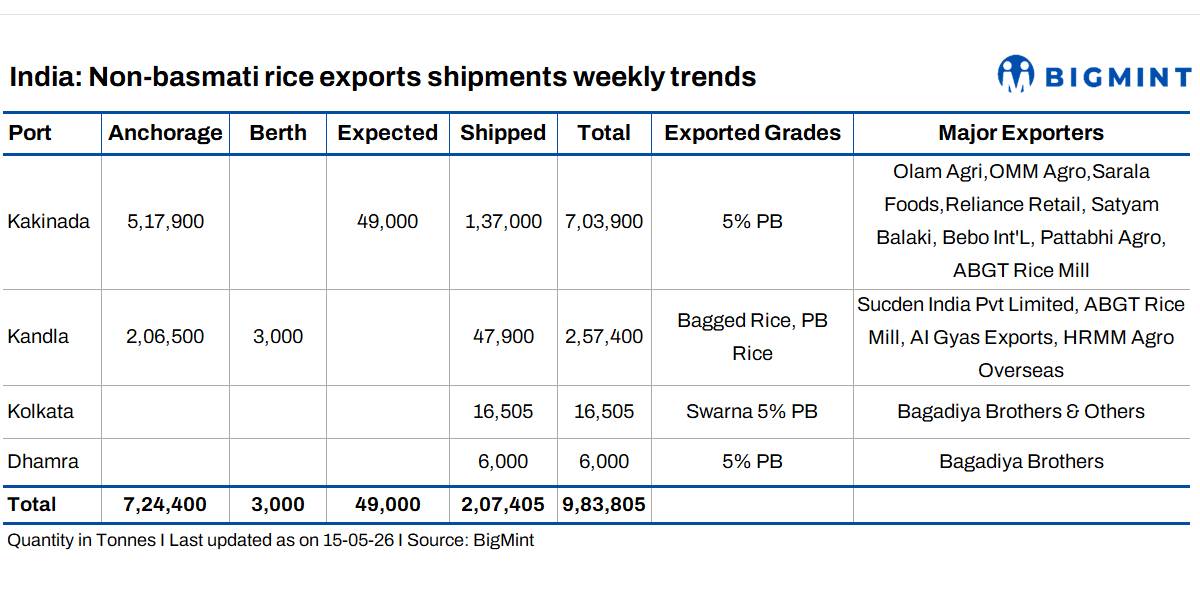
India’s non-basmati rice exports picked up sharply this week, with shipped volumes rising to 207,405 tonnes (t) compared to just 60,400 t last week, according to BigMint vessel tracking data. The increase suggests improved vessel clearances and faster cargo movement across major ports.
However, despite the rise in shipments, a significant portion of the export pipeline remains pending, with over 724,400 t still under anchorage or awaiting loading, indicating continued vessel congestion and slower cargo evacuation amid softer demand conditions in some destination markets.
Kakinada dominates export activity
Kakinada remains the primary export hub, accounting for 703,900 t, or more than 70% of the total vessel pipeline. The port currently has 517,900 t under anchorage, 49,000 t expected, and 137,000 t already shipped.
Exports from Kakinada are largely concentrated in 5% parboiled rice, with major exporters including Olam Agri, OMM Agro, Sarala Foods, Reliance Retail, Satyam Balaki, Bebo International, Pattabhi Agro, and ABGT Rice Mill. The large anchored volume suggests substantial cargo is still awaiting vessel loading.
Kandla – second-largest contributor
Kandla reported a total pipeline of 257,400 t, including 206,500 t under anchorage, 3,000 t at berth, and 47,900 t shipped. The port is handling a mix of bagged rice and parboiled rice, supported by exporters such as Sucden India Pvt. Ltd., ABGT Rice Mill, Al Gyas Exports, and HRMM Agro Overseas.
Eastern ports contribute smaller volumes
On the eastern coast, Kolkata shipped 16,505 t, primarily 5% PB Swarna rice, while Dhamra recorded 6,000 t of 5% PB rice exports. Though volumes remain limited, these ports continue to support India’s overall shipments.
Import restrictions, slow demand may be delaying cargo movement
While shipment volumes improved this week, the large share of cargo still under anchorage suggests that export movement remains slower than vessel arrivals. Import restrictions and tighter trade regulations in some key destination markets, particularly in parts of West Africa, may be weighing on fresh buying activity and contributing to delays in cargo execution.
Outlook
The sharp rise in weekly shipments is a positive sign for export movement, but the high anchored volumes indicate that logistical clearance remains uneven. Export pace in the coming weeks will depend on how quickly pending cargo is loaded, along with demand recovery in key importing markets and broader trade policy developments.
Leave a Reply