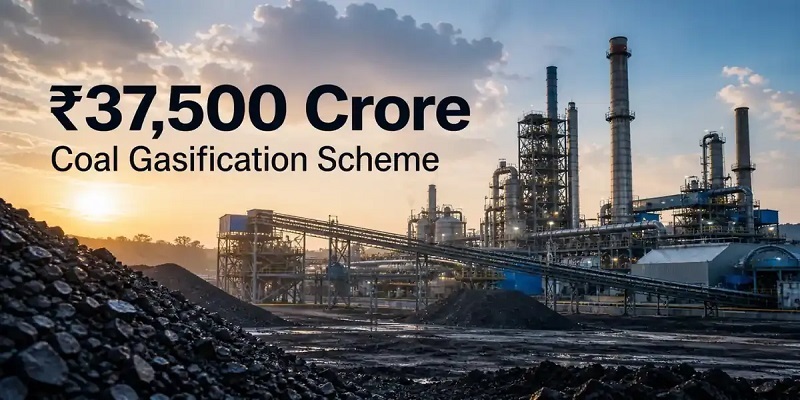
- Move marks strong policy push toward import substitution, energy security
- However, key commercial, technology-related risks remain unresolved
The Union Cabinet has approved an INR 37,500 crore incentive scheme for surface coal/lignite gasification projects, with a target of 75 mnt per annum of coal gasification by 2030, building on the earlier 100 mnt national target. This note outlines what the scheme actually offers, where the money goes, and what participants in the coal and energy value chain should realistically expect.
1. What was actually approved

The scheme is technology-agnostic. It does not replace the January 2024 scheme (INR 8,500 crore), which already has 8 projects worth INR 6,233 crore under implementation. This is an additional, larger tranche.
2. Why now – the circumstances
Three factors appear to have driven the timing:
a) Import dependence remains high: As of FY’25, India imported 50% of LNG, 20% of urea, 80-90% of methanol, and 100% of ammonia. The total import bill for substitutable products came to around INR 2.77 lakh crore.
b) Geopolitical supply chain pressure: The ongoing situation in West Asia has affected gas prices and supply predictability. The government’s note explicitly cites “global price volatility and geopolitical supply-chain disruptions” as a factor.
c) Previous projects are moving: The Coal India-BHEL joint venture (BCGCL) has awarded an INR 5,000 crore engineering, procurement, and construction (EPC) contract to L&T for a 2,000 tonnes per day (tpd) coal-to-ammonium nitrate plant in Odisha. This demonstrates that at least one large-scale project has reached financial and technical closure, reducing perceived risk.
3. How the incentive disbursement works
Incentive disbursement is critical for project finance modelling. However, the 20% incentive on P&M cost is not an upfront grant. Disbursement is in four equal instalments, linked to the award of the contract, civil work completion, mechanical completion, and commissioning and performance guarantee.
The practical implication is that developers still need to arrange around 80% of the plant and machinery (P&M) costs upfront. The incentive improves project internal rate of return (IRR) but does not replace equity or debt.
4. Coal linkage – the real operational change
The extension of coal linkage tenure to 30 years under the “Production of Syngas leading to Coal Gasification” sub-sector is significant.
Previously, non-regulated sector linkages were shorter and less certain. However, a 30-year linkage allows (1) depreciation schedules aligned with asset life, (2) long-term offtake contracts for syngas or downstream products, and (3) more favourable debt terms from financial institutions.
This does not guarantee coal quality. Participants will still need to wash or blend high-ash Indian coal (typically 30-45% ash) to meet gasifier specifications.
5. Expected investment and employment

These are government estimates. Actual outcomes will depend on bidder interest, technology performance, and downstream market prices.
6. Downstream products – where the incentive flows
The scheme caps incentives differently by product category:
- Synthetic natural gas (SNG) and urea: Cap of INR 5,000 crore per project. These are direct import substitutes for LNG and imported urea.
- Ammonia, methanol, dimethyl ether (DME), ammonium nitrate, etc.: Cap of INR 9,000 crore per product category.
- Entity-level cap: INR 12,000 crore across all projects by a single corporate group.
The per-product cap for non-SNG/non-urea products (INR 9,000 crore) is higher than the per-project cap (INR 5,000 crore). This suggests a single large entity could potentially develop multiple projects for different products, as long as each project respects the INR 5,000 crore limit.
7. What this does not change
a) India remains a coal importer for coking coal: The scheme targets thermal coal and lignite gasification. It does not materially reduce coking coal imports for steelmaking. The government’s own note lists coking coal among import-dependent products.
b) Economics depend on global prices: Coal-to-methanol or coal-to-urea projects compete with imported product prices. If global LNG or methanol prices fall sharply, project viability changes regardless of the 20% P&M incentive.
c) Technology risk for high-ash coal is not eliminated: Indian coal has high ash content. Proven large-scale gasifiers for 35%+ ash coal are limited globally. The scheme encourages indigenous technology but does not guarantee its availability at a commercial scale.
8. What participants should track

9. Comparison with previous scheme (Jan’24)

The new scheme does not replace or restrict access to incentives under the commercial coal mining regime or other central/state schemes.
Conclusion
The scheme creates a financial incentive structure. However, the scheme does not solve high-ash coal gasification technology risk or coking coal import dependence. Project viability also remains exposed to global prices of LNG, methanol, ammonia, and urea. As such, whether the scheme delivers the intended import substitution will depend on actual bids, technology performance, and market conditions over the next 5-7 years.
Leave a Reply