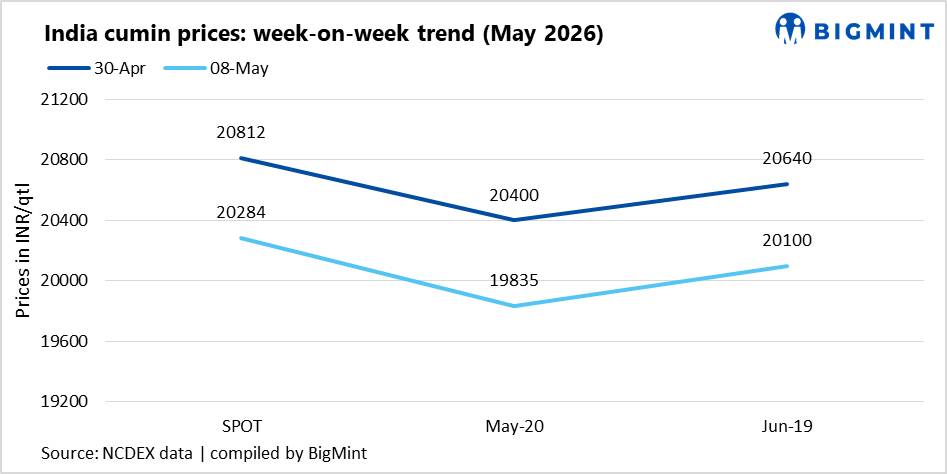
- Lower arrivals, restricted farmer selling support spot prices
- Export demand recovery critical for fresh upside momentum
India’s jeera market remained under mild pressure during the week ended 8 May 2026 as rollover activity and cautious participation in NCDEX futures weighed on prices, despite improving physical market fundamentals. While futures corrected on long liquidation ahead of contract expiry, the spot market continued to show resilience due to declining arrivals and limited farmer selling.
NCDEX jeera May futures fell from around INR 20,400/qtl on 30 April to below INR 19,850/qtl by 8 May, while the actively traded June contract eased to near INR 20,000/qtl. Market participants indicated that the decline was largely technical in nature, driven by expiry-led position unwinding rather than any major deterioration in supply-demand fundamentals. Meanwhile, spot prices in Unjha also softened marginally to around INR 20,090/qtl.
Rollover shifts focus to June contract
The market witnessed a visible rollover from the May to June contract. Open interest in the May contract declined sharply from 7,650 lots to 5,655 lots, while June open interest nearly doubled to 6,087 lots, reflecting fresh positioning in the next active series. Traders noted that speculative participation remains limited, keeping overall market sentiment cautious.
Spot market support strengthens
Fundamentally, the physical market structure has started improving as arrivals in Unjha gradually decline from peak harvest levels. Farmers are reportedly reluctant to sell aggressively at current prices, while the availability of quality jeera remains relatively tight. Warehouse stocks of around 6,988 tonnes (t) are considered adequate but not burdensome enough to create heavy supply pressure.
Demand currently remains need-based, supported by moderate domestic buying and steady export enquiries. Market participants believe jeera is likely to trade in a sideways-to-firm range in the near term, with stronger upside dependent on improved export demand from China and Gulf countries.
Leave a Reply