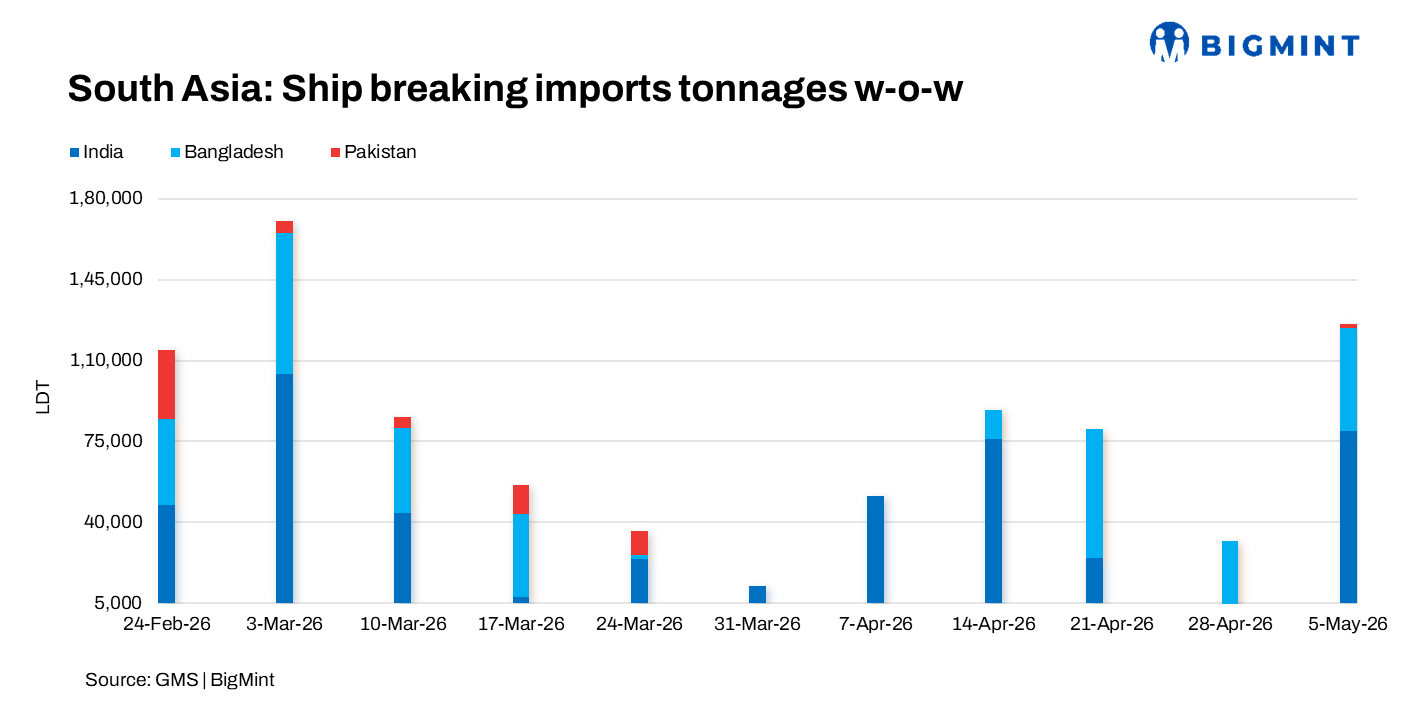
- Alang remains most active recycling destination
- April recycled tonnage rises sharply m-o-m
As of 5 May 2026, South Asian ship recycling markets remain stable amid currency movements, geopolitical uncertainty, and a narrowing pre-monsoon window. While fundamentals vary across India, Bangladesh, and Pakistan, limited vessel supply continues to be the key constraint on market activity.
Meanwhile, total ship-breaking tonnage increased m-o-m, supported by higher volumes in India, while Bangladesh saw reduced activity and Pakistan reported no vessel arrivals.
Ship-breaking tonnage recycled in Apr’26
Across all three South Asian hubs, total ship-recycling tonnage processed in April stood at 1,92,695 LDT, up 153% m-o-m from 76,279 LDT in March, mainly supported by higher activity in India.
India: India processed 1,69,131 LDT in April, up from 75,590 LDT in March. A total of 13 ships were recycled during the month, keeping Alang as the most active yard in the region.
Pakistan: Pakistan reported no recycling activity in April, with zero ships recycled, reflecting continued weak vessel inflows and limited deal conversions at Gadani.
Bangladesh: Bangladesh recycled 23,564 LDT in April, down from 65,199 LDT in March. A total of 6 ships were recycled, as activity slowed due to limited vessel availability despite steady demand.

Weekly updates
India: Rupee weakness persists, but pricing stability cap activity
India’s ship recycling market remained stable despite continued rupee depreciation, with USD/INR touching a record 95. The currency weakness, driven by higher crude import costs, has not fully translated into lower USD plate prices, which remained stable. Alang remains the most competitively priced destination in the sub-continent, with a widening gap versus Pakistan.
However, with the monsoon window approaching and vessel supply constrained, limited tonnage availability continues to restrict market activity despite adequate capacity and compliance strength.
Bangladesh: Stable market with improved LC flow
Bangladesh’s ship recycling market remained stable supported by a steady currency and firm plate prices. Chattogram continues to lead regional pricing, staying above Alang and Aliaga. LC conditions have improved, with faster approvals easing earlier bottlenecks and supporting smoother transactions.
However, compliance checks remain strict. With inflation elevated and the pre-monsoon window narrowing, activity is time-bound. Despite firm demand, vessel supply remains constrained due to high bunker costs and stronger trading earnings keeping ships in operation.

Pakistan: Currency stability, geographic advantage strengthen market
Pakistan’s ship recycling market showed resilience, with USD/PKR firming slightly, making it the most stable currency in the region. This stability, combined with proximity to the Gulf, strengthens Gadani’s positioning. Local plate prices remained steady, with slight USD gains due to currency strength.
Geopolitical developments around Hormuz continue to favour Pakistan’s strategic location, while HKC-compliant yard capacity is gradually expanding. Despite strong fundamentals, the key uncertainty is whether improved positioning will translate into actual vessel arrivals within the limited pre-monsoon window.

Leave a Reply