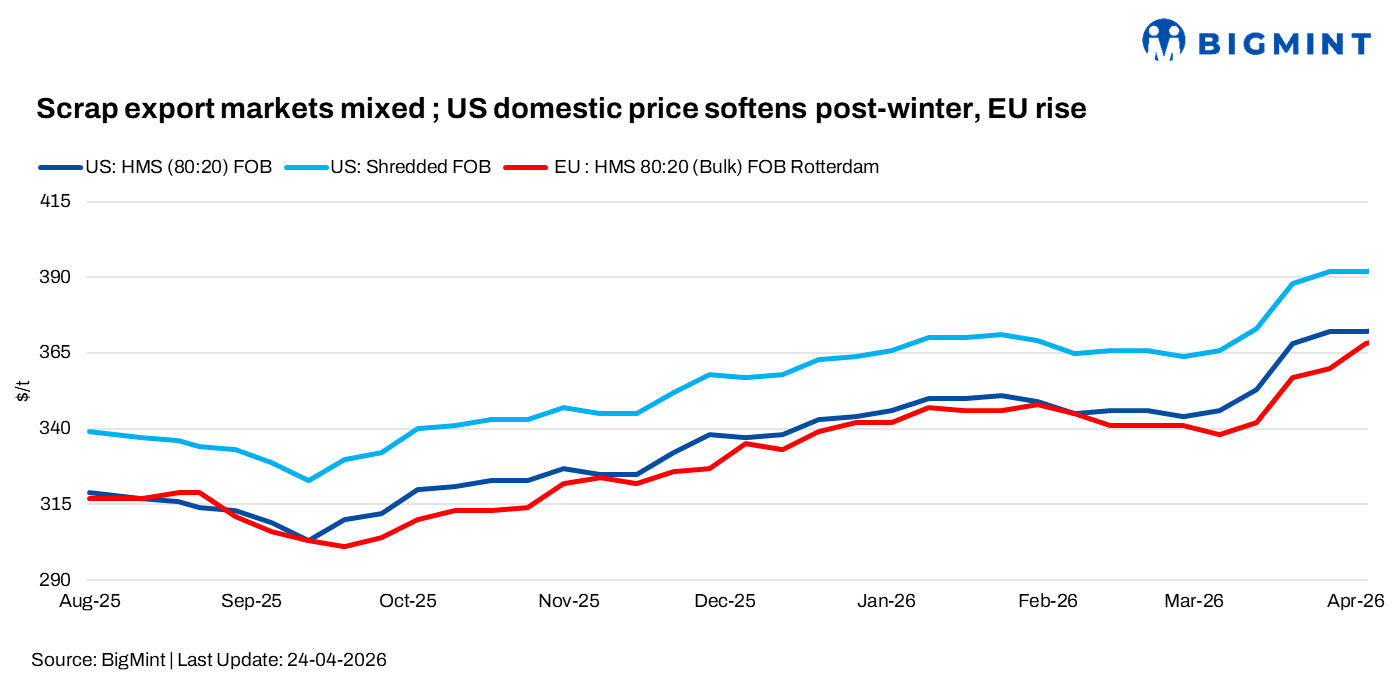
- US: Export activity rises; prices firm amid freight support
- Brazil: Export market steady despite mixed domestic signals
Global scrap export markets remained firm to stable towards the second half of April, with US prices supported by tight supply and high freight costs, while Europe saw steady levels amid cautious buying, as weak Turkish downstream demand continued to limit stronger price gains.
US
US ferrous scrap export activity picked up in mid-April, with exporters securing multiple deep-sea cargoes over consecutive days at elevated levels. The market showed a firm tone, supported by tight supply conditions and continued pressure from high freight and fuel costs, even as downstream demand in Turkiye remained weak.
US scrap export prices edged up w-o-w, with shredded scrap assessed at $395/t FOB East Coast and HMS at $375/t FOB, both up by $3/t. US-origin HMS 80:20 to Turkiye was heard tradable at around $406/t CFR, also up by $3/t, reflecting firm seller expectations. Multiple cargo sales reinforced the upward momentum, although activity remained selective.
Elevated freight rates continued to support export pricing, with East Coast freight to Turkiye reported at $45-46/t and West Coast to Bangladesh around $70/t, with upside risks due to rising fuel costs. However, weak downstream conditions in Turkiye, particularly sluggish rebar demand and stagnant sales, limited aggressive buying. US domestic rebar markets also remained subdued, with weak construction activity and limited spot transactions.
Europe: Benelux scrap prices remained largely stable despite subdued demand, supported by firm offers and limited downward pressure. Market participants indicated that high-priced inventories held by stockists are gradually being liquidated, after which fresh buying interest may re-emerge.
On the export front, bulk scrap levels are estimated at Euro 300/t ($351/t) FOB, with additional costs of $15/t (dock) and $30/t (freight), translating to around $395-400/t CFR Turkiye. Recent bookings reflect similar levels, with HMS 80:20 traded around $400/t CFR, while higher-grade HMS (85:15) was heard at $401/t CFR. Shredded scrap continues to command a premium, with indications in the $420-425/t CFR range, pointing to stable pricing sentiment.
At the same time, European steelmakers, particularly in Germany and Italy, have announced price increases of Euro 50-70/t ($59-82/t) for long products such as rebar. German delivered offers are nearing Euro 710/t ($831/t), while Italian ex-works prices have crossed Euro 680/t ($796/t). These hikes are being driven by rising energy costs, tighter import protection, and CBAM-related pressures.

Brazil
The Brazilian ferrous scrap market showed mixed trends, with stable export pricing but varying domestic sentiment. While international demand continued to support exports, domestic market conditions remained uncertain due to inconsistent pricing behaviour from steel mills.
Export HMS remained stable at $300/t FOB, while shredded scrap stood at $320/t FOB. Both grades have seen notable increases since January, driven by stronger global demand and improved export opportunities.
From a buyer’s perspective, the market is expected to remain stable, although fluctuations are largely driven by steel mills adjusting prices amid perceived low inventory levels. This has created mixed sentiment in the domestic market, with some participants indicating stability while others highlighted price corrections.
Outlook
US scrap prices are expected to stay firm in the coming weeks, supported by tight supply and elevated freight costs, though any easing in fuel prices and seasonal pickup in availability could limit further upside, especially if Turkish demand remains subdued. Brazil’s export market is likely to remain steady on consistent global demand, but domestic uncertainty and mill-led price adjustments may keep local prices volatile. Turkish buyers are gradually coming to terms with higher price levels, which could support scrap demand in the near term.

Leave a Reply