- Indian Energy Exchange prices hit cap as solar fades
- High PLF and declining stocks risk significant outages
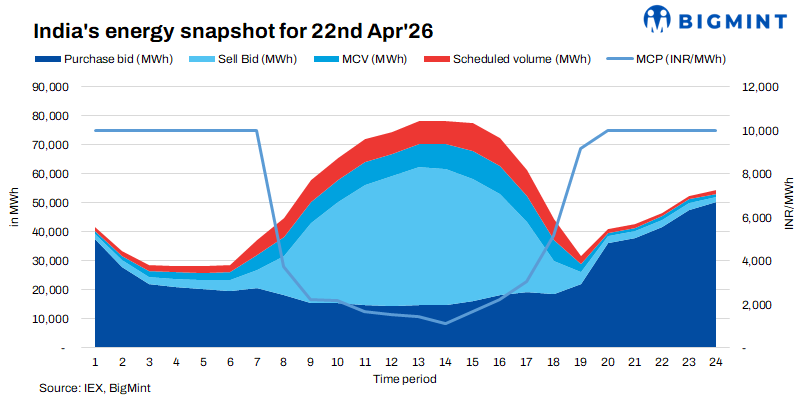
IEX hourly data for April 2026 shows a market that functions smoothly during the day, when solar power floods the grid and prices stay low. But as evening approaches and air conditioners hum to life, the balance tips. Buyers scramble for power. Sellers run out. And prices shoot up – sometimes to the maximum allowed.
This is not a problem of total generation. India is producing more power than ever. It is a problem of timing. And the daily coal reports for 19-20 April reveal the real reason: India’s coal plants are already running as hard as they can, and many are burning coal faster than it arrives.
Cheap power and plenty of it
In the first week of April, before the worst of the heatwave hit, afternoon prices collapsed. On 5 April between 10:00 AM and 1:00 PM, prices fell to just INR 14, INR 6, INR 0.50, and INR 0.39 per megawatt-hour. Sellers were practically giving power away. The market was awash with supply – mostly solar, which peaks during these hours.
Even during the peak heatwave days of mid-April, afternoons remained comfortable. Between 11:00 AM and 3:00 PM, prices averaged just INR 1,000-1,500 per MWh. Solar generation was doing its job.
But the afternoon calm was deceptive. It masked a growing crisis that would arrive a few hours later.
The evening: Prices explode as sellers run dry
The shift happens around 4:00 PM. Solar output begins to fade. People return home from work. They turn on lights, fans, and air conditioners. Demand surges.
In early April, the market absorbed this shift reasonably well. By mid-April, the pattern was unmistakable. Between 16-23 April average evening prices (5:00 PM to 11:00 PM) jumped to INR 7,800 per MWh – a 50% increase from early April. Hour 18 (6:00-7:00 PM) saw the biggest rise, from INR 5,200 to INR 8,500 – a jump of 63%.
On several evenings, prices hit the INR 10,000 ceiling. On 2 April at 7:00 PM, the price touched INR 10,000. On 3 April at midnight, it hit INR 10,000 again. On 10 April at 7:00 PM, once more. The market was screaming for supply – and sellers could not provide enough.
Why can’t supply meet demand?
The answer lies in the daily coal plant reports. India’s coal-based power generation sector is already running at high average Plant Load Factor (PLF) – the percentage of maximum possible output. States like West Bengal (81%), Madhya Pradesh (78%), Karnataka (76%), and Andhra Pradesh (72%) are already running flat out. They cannot ramp up further.
But the real problem is not the plants that are running. It is the plants that are running out of coal.
Across India, coal plants are burning fuel much faster than new supplies are arriving. On 19 April, total coal consumption was 1,763,500 t while receipts were only 1,528,200 t – a deficit of 235,300 t in a single day. On 20 April, the deficit was even larger: 237,700 t.
Over just two days, India’s coal plants consumed nearly half a million tonnes more coal than they received. National coal stocks are falling by almost a quarter of a million tonnes every day.
Over 21,000 MW plamts on borrowed time
Now look at the plants that are critically at risk – those with less than 35% of normative coal stocks. These plants are still generating, but they are running on borrowed time.

Total capacity of these critically stressed plants: over 21,000 MW.
On 20 April, these critically stressed plants consumed 192,400 t of coal but received only 161,900 t – a daily deficit of 30,500 t. Their collective stockpile is shrinking by over 30,000 tonnes every single day.
Some plants are in even worse shape. Tuticorin TPS received zero coal on April 20 and consumed 9,400 t. With only 23% stock left, it could run out in 3-5 days. Raichur TPS burned 19,400 tonnes but received just 7,800 tonnes – a deficit of 11,600 t in a single day. At that rate, with only 31% stock left, it could run out in 4-5 days.
If these plants – and others like them – run out of coal, the grid will lose over 21,000 MW of generation capacity. That is nearly 9% of India’s peak demand of 239 GW.
What happens when they run out?
When a coal plant runs out of fuel, it cannot simply restart. It must cool down, then undergo a lengthy restart process that can take 12 to 24 hours or more. A sudden, unplanned shutdown of multiple large plants could cause a cascading grid failure.
If just three of the critical plants – say, Chandrapur (2,920 MW), Yadadri (2,400 MW), and Tuticorin (1,050 MW) – were to trip simultaneously, the grid would lose over 6,300 MW in an instant. That is more than the entire evening peak demand of a large city like Mumbai. The frequency would drop, and automatic load shedding would cut power to millions of homes.
Will it get worse?
Yes, if temperatures rise further. Peak demand touched 238,945 MW on 17 April and is forecast to reach 240+ GW. Every additional degree of heat adds thousands of megawatts of air conditioner load.
The only solution is to deliver coal faster to the stressed plants. But rail transport takes 3-7 days. And every day of delay pushes stocks lower.
The coal exists – pit head stocks are at 151 mnt, port stocks at 14 mnt But moving it to the right place at the right time is the challenge. Nationwide, coal stocks are falling by nearly 240,000 t every day. The critically stressed plants – over 21,000 MW of capacity – are falling even faster relative to their already dangerously low levels.
Without immediate and sustained coal deliveries to these plants, India faces the real prospect of evening blackouts within the next week. For now, the evening power market is running on empty – and the lights are flickering.


Leave a Reply