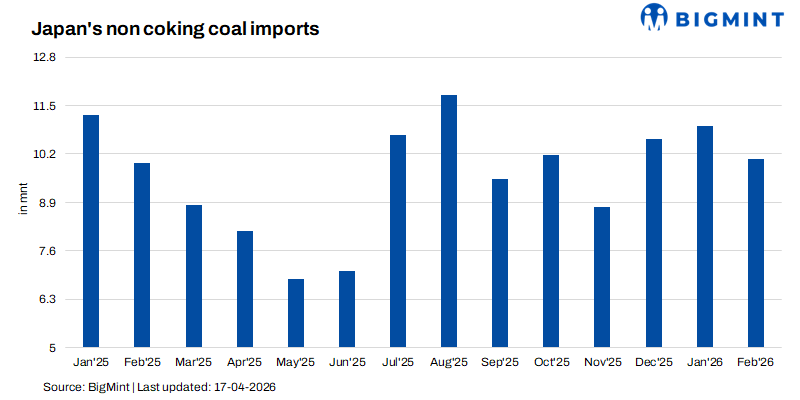
- High LNG prices, lower nuclear output drive switch to coal
- Forecast for Q1CY’26 thermal coal usage revised upward by 3%
After years of steady decline, coal is making a quiet comeback in Japan’s power mix. The increase is modest so far, but the trend is significant. Japan, the world’s third-largest economy, is turning back to coal as high LNG prices and energy security concerns reshape its fuel choices. There may be more upside to come.
Shift in power mix
Data from December shows a clear turning point. Within Japan’s power mix from November to December, coal was the only source that gained share. It rose by 3.4 percentage points to 34% of total generation.
Every other source lost ground. Gas fell almost 2 percentage points to 34%. Nuclear fell to 12%. Renewables also declined. This is not an anomaly. Coal’s December share of 34% matches the average of the previous five years, which ranged from 33% to 36%.

The volume story
The volume data confirms the shift. Steam coal usage at Japan’s ten largest utilities gained 27% m-o-m in December, reaching 8.3 million tonnes (mnt). This was just 3% below previous estimates.
For the full year 2025, coal usage at these utilities totalled 91.6 mnt, up 1.8% or 1.6 mnt compared to 2024. After years of decline, coal demand has stabilised and is now edging higher.
Raising the forecast
Looking ahead, the forecast for Japanese coal demand has been revised upward. Q1CY’26 coal usage at thermal power plants has been increased from 8.7 mnt per month to 9.0 mnt per month, a 3% increase.
This still implies a 2% y-o-y decline for the quarter. But the key observation is that there is “upside potential once the gas to coal switching we are expecting kicks in.” The current forecast may prove too conservative.
Why coal is returning
Several factors explain Japan’s renewed interest in coal. First, LNG prices have spiked due to the Middle East conflict. Japanese utilities are heavily dependent on imported gas, and higher prices make coal more economical by comparison.
Second, nuclear power has not recovered as expected. Nuclear’s share fell to 12% in December from higher levels earlier in the year. Any shortfall in nuclear output must be covered by either gas or coal.
Third, energy security concerns are driving a reassessment of fuel strategies. Japan imports almost all its energy. Diversifying away from over-reliance on any single fuel is a priority. Coal offers a hedge against gas price volatility.
What to watch
For market participants tracking Japanese coal demand, several indicators will be important. Monthly utility generation data will show whether coal’s share gains continue. LNG price movements will determine the economics of gas-to-coal switching, and nuclear reactor restart schedules will affect how much baseload power coal needs to provide.
The shift is not yet a flood. Japanese coal demand is picking up “even if not massively.” But the direction is clear. After years of decline, coal is moving in the opposite direction. For a market that had written off Japanese coal demand, this quiet comeback is worth watching.

Leave a Reply