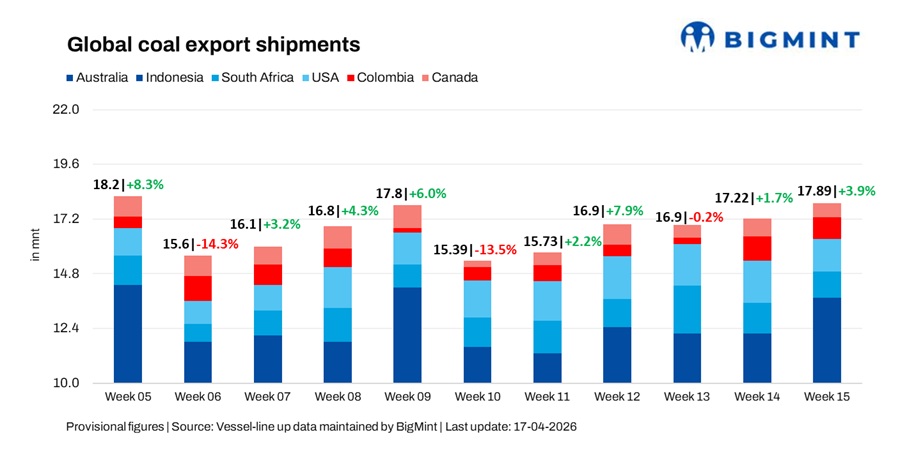
- Only Australia logs growth, driven by improved weather
- Muted demand, high freights pressure Atlantic volumes
Global seaborne coal shipments rose 3.9% w-o-w to 17.89 million tonnes (mnt) in the week ended 10 April 2026, driven by a sharp rebound in Australian exports. Improved weather and firm Queensland shipments supported gains, while Indonesia, South Africa, the US, Colombia and Canada saw softer volumes amid weak demand and logistical constraints.
Country-wise trends

Port & shipper-wise trends
Pacific flows remain supported, led by Australia
- Australian shipments were led by Newcastle (3.03 mnt), Gladstone (1.42 mnt) and DBCT (1.24 mnt), with Japan (2.33 mnt) and South Korea (0.83 mnt) as key destinations. BHP (0.70 mnt) and Glencore (0.53 mnt) supported supply.
- Indonesian shipments were led by Taboneo (1.24 mnt), Samarinda (0.83 mnt) and Balikpapan (0.76 mnt), with India (1.72 mnt), China (0.85 mnt) and the Philippines (0.81 mnt) as key buyers.
- Canadian shipments were led by Roberts Bank (0.54 mnt), with Japan (0.38 mnt) as the key destination.
Atlantic flows remain subdued
- South African shipments were routed via Richards Bay (1.14 mnt), with India (0.41 mnt) and Pakistan (0.20 mnt) as key destinations, as rail constraints capped volumes.
- US shipments were led by Baltimore (0.58 mnt) and Mobile (0.35 mnt), with India (0.41 mnt) as a key buyer, amid weak Atlantic demand.
- Colombian shipments were driven by Puerto Nuevo (0.44 mnt) and Puerto Bolivar (0.32 mnt), with the Netherlands (0.18 mnt) and Brazil (0.10 mnt) as key destinations. Carbosan supported supply with 0.53 mnt.
Coal freights to India remain volatile
Coal freights to India remained volatile, with uneven cargo availability and cautious participation keeping sentiment mixed. Elevated vessel supply and fluctuating bunker prices continued to pressure rates despite intermittent enquiries.
Outlook
BigMint expects coal exports to show mixed trends in the subsequent weeks. Australian shipments may stay firm, while Indonesian volumes could remain range-bound amid weak Chinese demand. Atlantic performance is likely to stay uneven, with logistics constraints and demand weakness persisting, alongside continued freight volatility.

Leave a Reply