- Japan’s reserve release and Hormuz restart signal easing oil supply concerns
- Nickel outlook mixed amid supply tightness and demand-side weakness
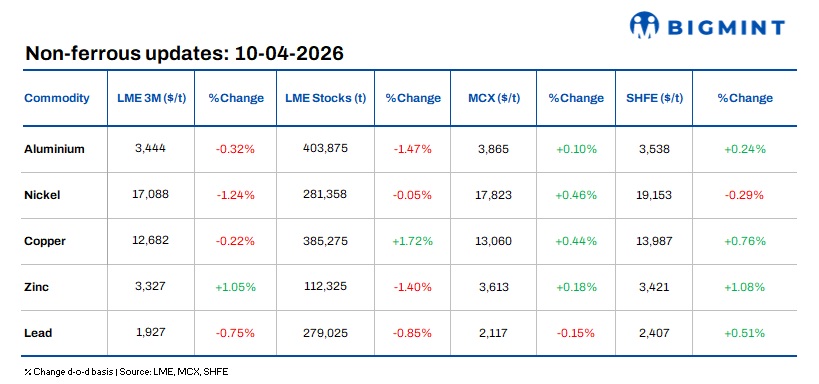
Base metals prices on the London Metal Exchange (LME) closed largely weaker d-o-d on 9 April 2026, with most prices under pressure except zinc. Aluminium declined 0.32% to $3,444/t, nickel fell 1.24% to $17,088/t, copper slipped 0.22% to $12,682/t, and lead dropped 0.75% to $1,927/t. In contrast, zinc was the sole gainer, rising 1.05% to $3,327/t.
Inventory trends were largely lower across base metals. Aluminium stocks declined 1.47% to 403,875 t, nickel inventories edged down 0.05% to 281,358 t, zinc stocks fell 1.40% to 112,325 t, and lead inventories decreased 0.85% to 279,025 t. Copper was the only exception, with inventories rising 1.72% to 385,275 t, indicating relatively higher exchange availability.
Domestic market overview
India’s non-ferrous scrap market remained largely stable d-o-d, reflecting steady demand conditions. Aluminium tense scrap (loose), ex-Delhi, held steady at INR 276,000/t, unchanged from the previous day. Similarly, ex-Chennai prices remained flat at INR 282,000/t, indicating no movement on a day-on-day basis.
Meanwhile, copper armature scrap (Cu 99%), ex-Delhi, was also unchanged at INR 1,123,000/t compared to the previous day, pointing to stable buying interest in the market.

Other market updates
Oil prices rise amid escalating Middle East tensions
Oil prices moved higher, supported by escalating geopolitical tensions in the Middle East, which continue to disrupt supply flows and elevate risk premiums. Brent crude rose by 1.11% to $96.75/bbl, while WTI gained 0.67% to $98.53/bbl, reflecting tightening supply expectations.
Market sentiment remains firm as ongoing disruptions across key energy infrastructure and trade routes raise concerns over sustained supply constraints, keeping prices volatile in the near term.
Japan plans additional oil reserve release
Japan is considering releasing an additional 20 days’ worth of oil from its strategic reserves as early as May, amid continued uncertainty over the reopening of the Strait of Hormuz and ongoing Middle East supply disruptions.
The move follows earlier coordinated and unilateral releases totaling around 50 days of consumption, aimed at easing domestic supply tightness and cushioning price volatility. Japan currently holds reserves equivalent to near 230 days of demand, providing a significant buffer.
The decision comes as refinery utilisation has dropped to around 67.7%, reflecting reduced crude availability, while logistical bottlenecks continue to create regional supply imbalances despite adequate overall stock levels.
Overall, Japan’s proactive stockpile strategy underscores efforts to maintain energy security, with further releases contingent on the pace of supply normalisation via key trade routes.
Middle East oil flows set to resume via Hormuz
Middle East oil producers are preparing to resume crude exports through the Strait of Hormuz following a temporary ceasefire, with tankers being positioned and chartered to restart shipments.
Key producers, including Iraq and major traders, have begun securing vessels, indicating a gradual normalization of flows after weeks of severe disruption that curtailed exports and tightened global supply.
The Strait of Hormuz, which handles nearly 20% of global oil trade, had seen exports drop sharply amid geopolitical tensions and shipping restrictions, prompting rerouting and production cuts across the Gulf.
However, recovery remains cautious as logistical bottlenecks, elevated freight rates, and security risks persist, with market participants closely monitoring the durability of the ceasefire and actual flow normalisation.
Leave a Reply