- Import from India and China down sharply m-o-m
- Mixed sentiment and higher freight kept demand in check
Monthly exports recover amid improved shipment activity
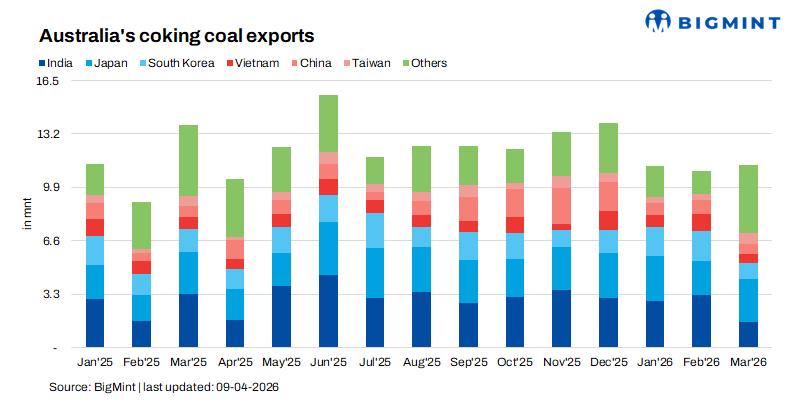
Australia’s coking coal exports rose to 11.28 million tonnes (mnt) in March 2026, registering a 3.6% month-on-month (m-o-m) increase compared with 10.89 mnt in February. The marginal recovery was mainly supported by improved port operations and the easing of earlier weather-related and logistical disruptions, which had temporarily affected loading schedules in previous months.
However, on a year-on-year (y-o-y) basis, exports declined by 18%, indicating weaker global steel demand compared with the same period last year. Despite the monthly improvement, overall shipment momentum remained relatively subdued as several key importing markets maintained cautious procurement strategies amid volatile freight costs and uncertain steel sector demand.
Q1 2026 (Jan-Mar) shipments show stable but slightly weaker trade flows
On a quarterly basis, Australia’s cumulative coking coal exports reached around 33.38 mnt in Q1 2026, reflecting a 2% decline compared with 34.06 mnt in Q1 2025. The marginal contraction suggests that although supply chains have stabilised, global trade flows remain restrained due to uneven steel production trends and cautious buying by major Asian steelmakers.
Mixed import demand across major Asian markets
Import demand from key Asian buyers displayed diverging trends, reflecting uneven performance across regional steel sectors. India’s imports declined 15.6% m-o-m to 1.57 mnt and dropped sharply around 62% y-o-y. The decline was largely attributed to soft buying interest and elevated landed costs, as freight rates remained high amid escalating geopolitical tensions in the Middle East.
In contrast, Japan’s imports increased by 28% m-o-m to 2.63 mnt, although volumes remained 3% lower y-o-y, indicating short-term restocking but still cautious long-term demand. South Korea recorded a sharp 44% m-o-m decline to 1.04 mnt (down 30% y-o-y), reflecting reduced blast furnace utilisation.
Similarly, China’s imports fell 23% m-o-m to 0.62 mnt (down 14% y-o-y), as improved domestic coal availability and steady Mongolian supply continued to reduce reliance on Australian cargoes.
Among smaller importers, Vietnam’s purchases declined 31% m-o-m to 0.50 mnt (down 52% y-o-y), reflecting weak steel sector demand. Conversely, Taiwan’s imports surged 92% m-o-m to 0.73 mnt (up 9% y-o-y), suggesting short-term restocking activity.
Port performance shows mixed operational trends
Export performance across Australia’s major coal terminals recorded mixed operational trends during March.
Shipments through Dalrymple Bay Coal Terminal (DBCT) rose 8% m-o-m to 3.98 mnt, although volumes were still 8.6% lower y-o-y, indicating relatively stable but softer annual performance. Abbot Point registered a significant 41% m-o-m increase to 1.11 mnt, though shipments remained 36.2% lower y-o-y, reflecting recovery from a relatively low base.
In contrast, Gladstone exports declined 9.5% m-o-m to 3.35 mnt (down 13.9% y-o-y), while Hay Point shipments fell 10.1% m-o-m to 2.31 mnt (down 29.4% y-o-y), highlighting weaker loading activity at some major export hubs.
Prices decline amid improved supply and cautious buying
Australian coking coal prices declined m-o-m in March, primarily due to improved supply availability early in the month and cautious procurement by steelmakers. Market participants also remained wary of fresh purchases as freight rates stayed elevated amid geopolitical tensions linked to the US-Iran conflict, which increased overall landed costs for Asian buyers.
Outlook
Australian coking coal exports are expected to remain stable to slightly volatile in the near term. While intermittent restocking from Japan and smaller Asian buyers may lend some support. On the supply side, improved weather and smoother port operations could support shipments.

Leave a Reply