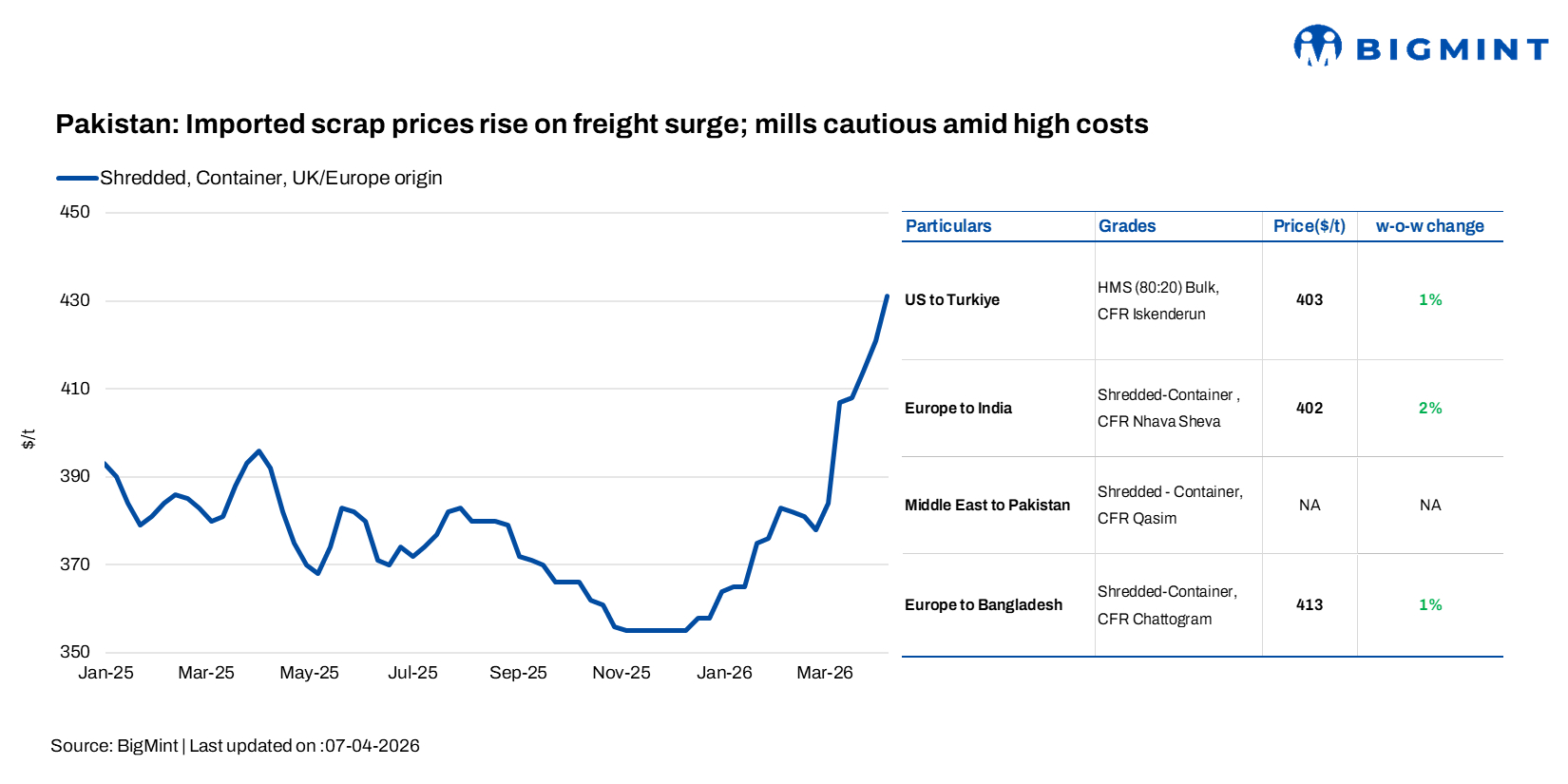
- Price gains driven by freight spike and tight supply
- Domestic market firm, but demand recovery remains slow
Pakistan’s ferrous scrap market edged higher in the week ended 7 April, mainly driven by tightening supply and a sharp rise in freight costs. However, activity remained muted, with most buyers staying cautious and avoiding aggressive bookings at elevated levels. Meanwhile, European-origin shredded scrap assessment stood at $431/t, rising by $10/t w-o-w.
Imported shredded scrap deals were heard at $415-430/t CFR, up from mid-March levels. Market participants noted that while offers have firmed up, actual trades remain limited. “Prices are going up, but buyers are not comfortable at these levels,” a Karachi-based trader said, pointing to weak demand and tight margins.
Freight has emerged as a major pressure point, with container rates from the UK and Europe after increasing by $300 in March and another $100-150 in early April. This has significantly pushed up landed costs. “Freight is doing most of the damage right now–material itself is secondary,” another importer noted.

Additional pressure from war-related surcharges, longer shipping routes, and delays has further tightened near-term supply, with most cargoes now expected only in May-June. This has kept sellers firm, even as buyers hesitate.
Global linkage keeps sentiment firm
Globally, scrap sentiment remains supported. Demand from Turkiye and higher buying prices from European mills are keeping export markets firm. In the UK, scrap prices moved up in early April, supported by stronger overseas demand and rising freight. Dockside prices also increased amid tighter supply and active export interest.
At the same time, gradually improving rebar demand is lending some support to sentiment. “Demand is picking up slowly, but not enough to justify aggressive buying,” a trader said.
Domestic market firm, but mills under pressure
Locally, scrap prices strengthened amid shortages, with domestic levels rising to around PKR 165,000-170,000/t ($591-609/t). Finished steel prices also moved up, with billet at PKR 220,000-230,000/t ($788-824/t) and rebar at PKR 265,000-280,000/t ($949-1,003/t).
 Despite this, mills remain under pressure. “Prices are higher, but sales are not matching–it’s difficult to pass on the full cost,” a Peshawar mill source said. Many mills are operating at reduced capacity of 30-40%, while some units remain temporarily shut or running on low inventories.
Imports from the UAE have largely dried up due to ongoing geopolitical tensions, forcing buyers to rely more on Europe, the UK, and Africa. This shift has increased dependence on higher-cost origins.
Outlook
We expect scrap prices to stay firm in the coming days, supported by tight supply, delayed shipments, and elevated freight costs. However, buyer resistance is likely to persist due to affordability constraints and uncertain demand. Mills are expected to continue buying on a need-based basis, with BigMint’s market feedback indicating that while prices may remain firm, trading activity is likely to stay selective.

Leave a Reply