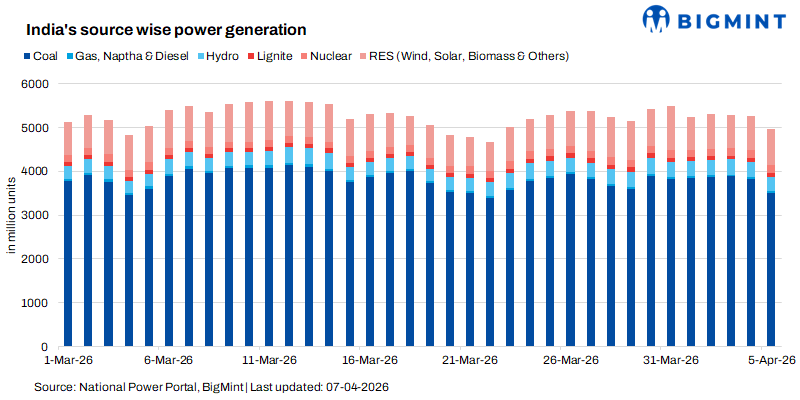
- Coal share declines as renewables meet growth
- Low IEX prices signal weakening coal competitiveness
Coal-fired generation in India during April 1-5, 2026 declined to 18,912 million units (MU) from 19,259 MU in the corresponding period last year, indicating a contraction of 1.8% year on year, while total power generation increased to 26,071 MU from 25,624 MU, reflecting a growth of 1.7%. The divergence shows incremental demand was absorbed outside coal, reducing coal’s share in the generation mix to 72.5% from 75.2%
The reduction in coal’s share is driven by higher renewable and hydro output, which increased by 18% and 22% respectively on year, displacing marginal coal-based generation despite higher system demand. This indicates that incremental electricity demand is being met through non-thermal sources, limiting coal burn even as overall generation expands
The shift suggests coal is transitioning from a growth driver to a balancing source within the generation stack, where its role is to provide system stability rather than absorb incremental demand. If renewable and hydro additions sustain current growth rates, coal intensity in the generation mix is likely to decline further even in periods of rising power consumption
Daily coal burn remains steady
The daily coal stock reports from the Central Electricity Authority show that coal consumption across monitored thermal power plants remained remarkably stable throughout these five days.

India’s thermal power plants burned approximately 2.4 million tonnes of coal every day in early April. Receipts marginally exceeded consumption, allowing a small build-up of stock. At a national level, coal logistics appear comfortable.
Plant load factor varies acroos regions
The Plant Load Factor (PLF)-a measure of how much of a plant’s capacity is being used-varies sharply across categories. Central sector plants (like NTPC) ran at a moderate 42% , while state sector plants averaged 55% . However, this average hides deep trouble.

Several state-owned plants-especially in Tamil Nadu and Telangana-are running with critically low coal stocks (below 25% of the normative requirement). For example, North Chennai TPS Stage 3 had less than two days of coal left on April 5. This is not a national crisis, but it is a serious regional one.
Why is coal burn not rising?
Coal-based generation remained flat despite higher total output due to a combination of supply-side expansion and demand-side weakness. Renewable generation including wind, solar, and biomass increased by nearly 600 MU on year during April 1-5, 2026, while early seasonal inflows supported higher hydro output, increasing non-thermal supply in the system. At the same time, peak demand on April 5 declined to 200,631 MW from 210,820 MW in the corresponding period last year, reducing dispatch requirements for coal-based plants
Market signals from the Indian Energy Exchange reinforce the supply overhang. On April 5, 2026, sell bids stood at 534,000 MWh against purchase bids of 205,000 MWh, indicating excess availability in the spot market. The market clearing price fell to INR 2,013 per MWh, below the variable cost of coal-based generation, resulting in coal plants being displaced from the merit order by lower-cost renewable and hydro supply
The combined impact of higher non-thermal generation and weaker peak demand indicates that coal-based generation is increasingly constrained by merit order economics rather than fuel availability, limiting its ability to respond to incremental demand even during periods of overall system growth
Outlook
Coal-fired generation during April 1-5, 2026 remained stable with daily consumption at 2.4 million tonnes, but its share in the generation mix declined as renewable output increased. The fall in exchange prices indicates coal is no longer the marginal source of generation on several days, with lower-cost supply setting the clearing price. The system remains adequately supplied, but thermal plants in the southern region continue to operate with tighter coal inventories, creating supply risk if peak summer demand rises sharply. Coal continues to support system reliability, but its share in the generation mix is gradually declining

Leave a Reply