- Safeguard duty, currency depreciation raise import costs
- Imports from China, South Korea, Japan decline in FY’26
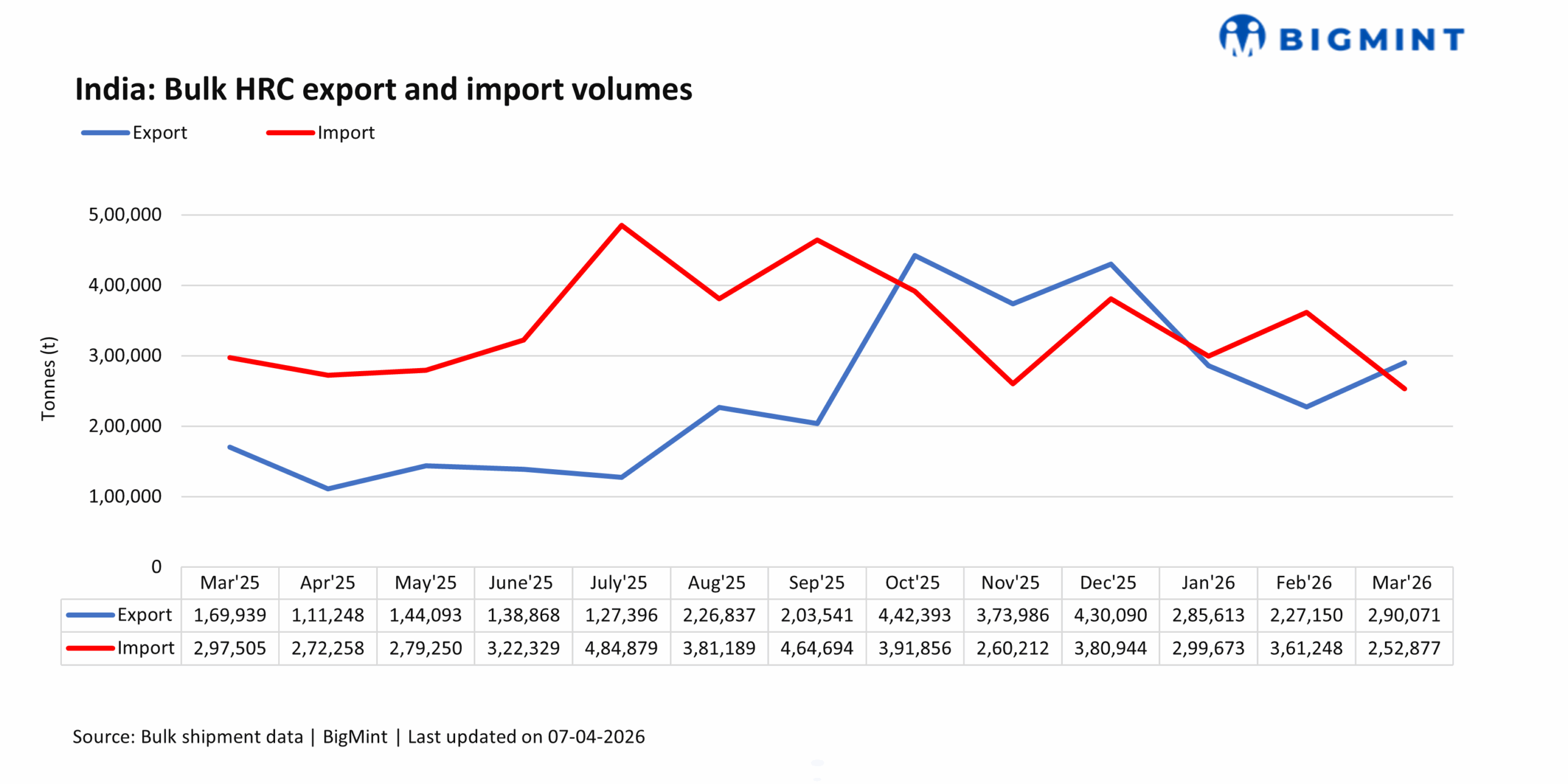
Bulk hot-rolled coil (HRC) imports into India totalled 4.16 million tonnes (mnt) in FY’26, declining by 29.9% from 5.94 mnt in FY’25, as per BigMint’s vessel line-up data.
Moreover, in March 2026, HRC imports into India stood at 252,877 tonnes (t), reflecting a 15% decline from 297,505 t recorded in March 2025, according to BigMint’s vessel line-up data. On a m-o-m basis, imports also fell by 30% compared to 361,248 t in February 2026.
In FY’26, shipments from South Korea stood at 1.78 mnt, marking a 16% decline, imports from China totalled 953,192 t, down by 25%, while volumes from Japan dropped sharply by 37% to 872,480 t.
The y-o-y decline reflects the higher landed cost of imports relative to domestic prices, primarily due to the imposition of the safeguard duty. This widened the price gap, making domestically produced material more attractive to market participants. Currency movements further reinforced this trend, with the rupee depreciating from INR 83 per US dollar in March 2025 to INR 94 in March 2026, increasing the cost of imports and reducing their competitiveness in the domestic market.
In March, South Korea, Japan, and China remained the top three bulk HRC exporters to India, shipping 114,344 t, 62,352 t, and 44,031 t, respectively. Imports from South Korea fell by 37% m-o-m and from China declined by 47%. However, shipments from Japan rose by 35% m-o-m. Imports from Japan surged due to the duty-free benefits of the India-Japan FTA (CEPA), making Japanese goods cheaper than those from China and other key destinations.
Export volumes climb up y-o-y
India’s bulk HRC exports increased by around 49% y-o-y to 3.02 mnt in FY’26 compared to 2.02 mnt in FY’25. Moreover, export volumes increased by 28% m-o-m from 227,150 t shipped in February. The m-o-m rise in March could be attributed to increased exports to Vietnam, as volumes were redirected from the EU and the Middle East amid ongoing geopolitical tensions affecting key export markets.
Outlook
The narrowing gap between import offers both from FTA and non-FTA countries and domestic prices may trigger a pick-up in imports in the near term. As a result, buyers and sellers are adopting a wait-and-watch approach. Meanwhile, exports are likely to remain limited due to supply constraints.
Leave a Reply