- US tariff rationalisation may ease pressure on metals trade
- EGA outage triggers alumina diversion, signalling supply imbalance
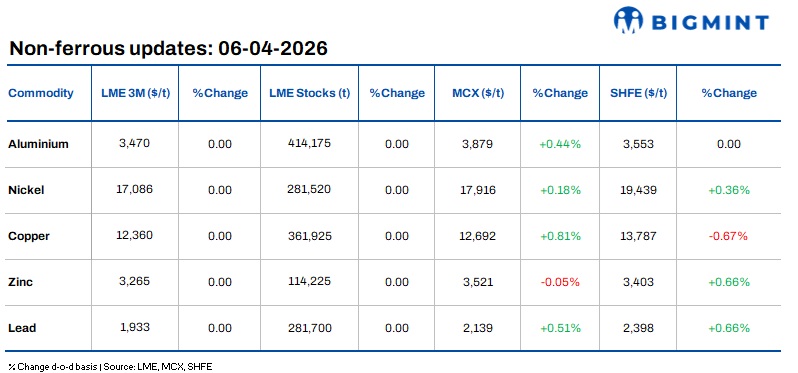
Base metals prices on the London Metal Exchange (LME) remained unchanged, as the exchange was closed on 03 April 2026. Aluminium held at $3,470/t, zinc at $3,265/t, copper at $12,360/t, nickel at $17,086/t, and lead at $1,933/t.

South Korea flags oil supply risks amid Hormuz disruptions
South Korea warned of rising energy security risks due to disruptions in the Strait of Hormuz, with President Lee Jae Myung stressing the need to balance risk while maintaining Middle East crude imports.
The strait — handling around 20% of global oil flows — remains a critical chokepoint, increasing vulnerability for import-dependent economies.
Authorities flagged that prolonged disruption could impact domestic supply, prompting efforts to diversify sourcing and utilise strategic reserves.
EGA moves to offload alumina cargoes amid smelter disruption post Iran strikes
UAE-based Emirates Global Aluminium (EGA) has moved to offload alumina cargoes for April-June shipments following disruptions at its Al Taweelah smelter after recent Iranian strikes. The damage to key infrastructure, including power and processing units, has led to an operational halt, creating supply-side uncertainty at the major global aluminium hub.
With smelting curtailed, the move reflects a temporary mismatch between alumina availability and processing capacity, while ongoing Hormuz-linked disruptions continue to tighten the aluminium value chain and elevate global supply risks.
US may narrow metal tariff scope to reduce compliance complexity
The Trump administration is considering limiting the scope of Section 232 tariffs on steel and aluminium, amid industry concerns over complex compliance and wide coverage of derivative products.
Officials signalled potential product-level exemptions and technical adjustments to simplify implementation, while EU continues to push for tariff rationalisation amid ongoing negotiations with the US.
However, any revisions remain subject to presidential approval, with the core focus still on protecting the domestic metals industry and addressing global overcapacity.
Iran refuses to reopen Hormuz for temporary ceasefire, escalating supply risks
Iran has refused to reopen the Strait of Hormuz in exchange for a temporary ceasefire, signalling a firm stance amid ongoing tensions. Officials indicated that any reopening would require long-term commitments, not short-term arrangements.
The move raises concerns over prolonged disruption to around 20% of global oil flows, keeping supply risks and geopolitical premiums elevated across oil and freight markets.
Australia secures fuel shipments through May, supply risks ease
Australia has secured fuel cargoes well into May, easing near-term supply concerns amid global disruptions.
Energy Minister Chris Bowen confirmed contracted shipments are in place, supporting supply continuity despite volatile oil markets.
While fuel availability is stabilising post-Easter, authorities cautioned that import dependence keeps exposure to global price and freight risks elevated.
Iraq seeks loading plans to stabilise exports post Hormuz exemption
Iraq’s state oil marketer SOMO has asked buyers to submit crude lifting schedules within 24 hours, following Iran’s exemption allowing Iraqi cargoes via the Strait of Hormuz.
The move aims to ensure smooth vessel nominations and contract execution, as Iraq works to normalise exports after disruptions that reduced flows to around 800,000 barrels per day.
While key terminals, including Basrah, remained operational, freight and tanker constraints persist, keeping supply chain risks elevated despite the exemption.
Leave a Reply