- CIL e-auctions saw selective demand but strong price premiums
- Bids rise 38% over the notified price
Coal India Limited released its Single Window Mode Agnostic (SWMA) e-auction data for March 2026 and FY 2025-26, highlighting evolving demand patterns in India’s coal market.
The data indicates moderate offtake volumes but strong price realization, suggesting that while buyers remained selective in procurement, the overall market continued to support premiums over notified prices.
March 2026: Lower allocation ratio amid selective buying
In March 2026, Coal India and its subsidiaries offered around 32.53 million tonnes (mnt) of coal through e-auction, of which 13.32 mnt were allocated, translating to an allocation ratio of about 41%. Despite the relatively modest allocation rate, the auctions achieved an average premium of around 45% over notified prices, indicating strong price discovery in the market.
The subdued allocation percentage suggests that buyers adopted a cautious procurement strategy, likely influenced by factors such as adequate inventories at power plants and industries, fluctuating international coal prices, and ongoing adjustments in domestic demand patterns. However, the strong premium demonstrates that buyers competing for specific grades or logistical advantages were willing to pay significantly higher prices, reinforcing the relevance of e-auction as a flexible supply channel.
Subsidiary-level trends highlight regional demand dynamics in Mar’26
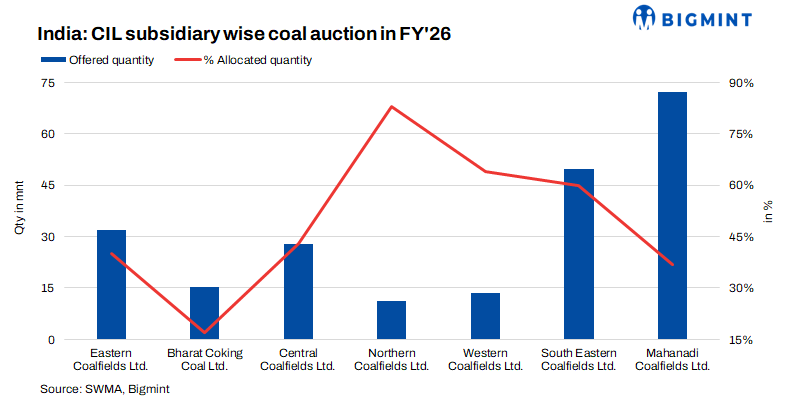
Performance across subsidiaries showed significant variation, reflecting regional demand and logistical dynamics. Northern Coalfields Limited (NCL) achieved 100% allocation, highlighting strong demand from nearby power plants that rely heavily on its supplies. Meanwhile, South Eastern Coalfields Limited (SECL) recorded 74% allocation, indicating robust regional consumption.
In contrast, Bharat Coking Coal Limited (BCCL) witnessed only 12% allocation, suggesting relatively weaker participation, possibly due to buyer preference for alternative sources or higher price sensitivity in the segment.
Other subsidiaries such as Western Coalfields Limited (WCL) and Mahanadi Coalfields Limited (MCL) registered moderate allocation levels of 53% and 43% respectively, reflecting balanced supply-demand conditions.
These variations underline how regional demand centers, transport economics, and coal quality preferences influence auction outcomes across Coal India’s operating companies.
FY 2025-26: Steady auction activity with strong price premiums
For the entire financial year 2025-26, Coal India offered 222.15 mnt of coal via e-auction, of which 101.72 mnt were successfully allocated, resulting in an allocation rate of around 46%. The auctions achieved an average premium of about 38% over notified prices, highlighting continued buyer willingness to pay above benchmark prices for assured and flexible supply.

The annual data suggests that e-auction continues to play an important role in balancing supply and demand, particularly for industries that require additional coal beyond their long-term fuel supply agreements (FSAs). The premium levels also reflect tightness in certain coal grades and logistical advantages associated with particular mines.
Overall, Coal India Limited (CIL) reported a marginal decline in both coal production and offtake for FY’26 (April 2025-March 2026), reflecting uneven subsidiary performance and softer dispatch trends, as per provisional data. The company’s total coal production stood at 768.1 million tonnes (mnt) in FY’26, down 1.7% year-on-year compared to 781.1 mnt in the previous year.
Market drivers supporting premium realisations
Several structural factors contributed to the sustained premium levels observed in Coal India’s e-auctions:
1. Flexible procurement needs of industries: Non-regulated sectors such as sponge iron, cement, and captive power producers rely heavily on e-auctions to meet variable fuel requirements.
2. Logistics and grade advantages: Buyers often prefer mines closer to consumption centers to reduce freight costs, leading to higher bids for certain subsidiaries.
3. Import substitution trend: Volatility in international coal markets has encouraged many Indian consumers to rely more on domestic coal, supporting auction premiums.
4. Supply discipline in auctions: Coal India’s controlled auction volumes help maintain market balance and prevent excessive price dilution.
Outlook
CIL’s e-auction is likely to remain a key price discovery platform. Allocation may improve with stronger industrial activity and summer power demand, while premiums should stay firm, supported by steady industrial consumption and ongoing import substitution.

Leave a Reply