- Strong wire demand drives higher imports in early CY’26
- Pipes and tubes imports decline amid weaker Vietnam shipments
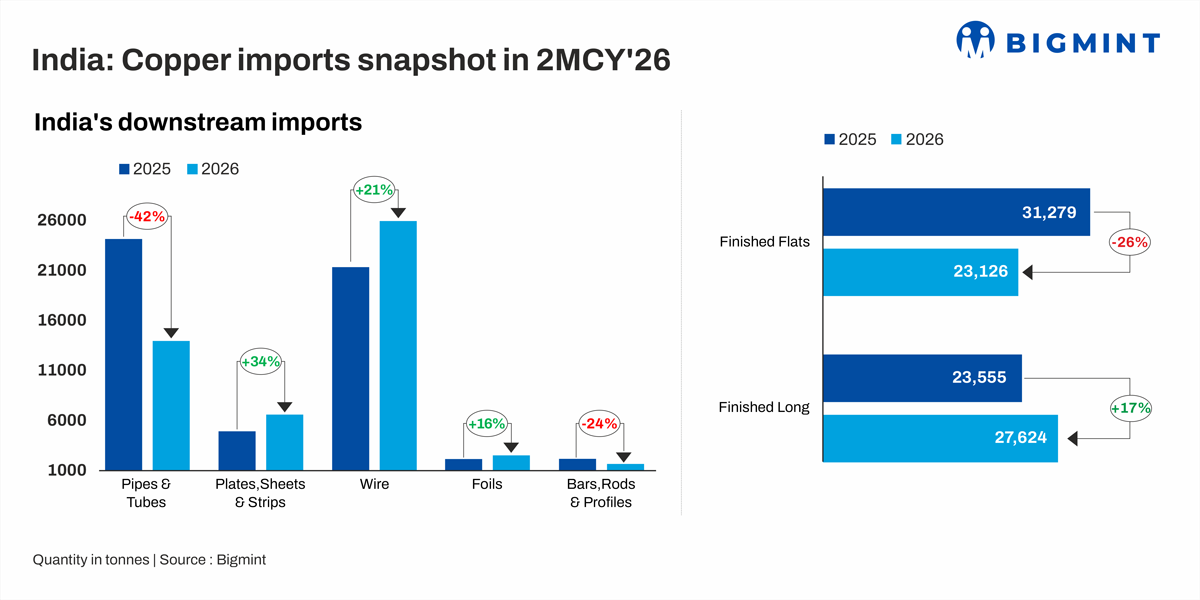
India’s copper downstream imports displayed a mixed trend in the first two months of CY’26, as strong growth in long products, particularly wires, offset a sharp decline in flat products.
This divergence is because of heavy spending in government-led power transmission (RDSS schemes, grid upgrades, renewable connectivity), which consumes wires immediately, while heating, ventilation, and air conditioner (HVAC) and real estate finishing segments (which use tubes) are seeing slower execution on ground.
Why are copper wire imports rising despite market volatility?
Copper wire imports increased by 21% y-o-y to 25,950 t in 2MCY’26, compared with 21,359 t in the same period last year. The rise was driven by steady demand from the wires and cables segment, supported by ongoing activity in power distribution, construction, and electrical applications.
Wire demand is being pulled by active engineering, procurement, and construction (EPC) orders with companies such as Polycab and KEI, especially in power distribution and infrastructure projects.
Higher imports were largely supported by shipments from the UAE, which remained the dominant supplier, with volumes rising 13% y-o-y to 16,823 t. China also recorded a notable increase of 34% in shipments to 3,658 t, supported by better landed costs versus Southeast Asia as exporters pushed volumes amid weak domestic demand.
What is driving strong demand from India’s wire and cable segment?
Strong demand is derived from steady activity across infrastructure, real estate, and consumer electrical segments. Companies such as R R Kabel and Polycab India are witnessing strong order inflows, prompting consistent raw material procurement beyond domestic supply.

Pipes, tube imports plunge
Copper pipes and tubes imports declined by 42% y-o-y to 13,973 t in 2MCY’26 from 24,155 t last year. The drop was mainly due to reduced shipments from Vietnam, a key supplier of air conditioning and refrigeration (ACR) and plumbing-grade tubes. Vietnamese imports fell by 50% y-o-y to 5,582 t as Indian buyers reduced fresh ACR tube bookings after strong inventory buildup in late 2025 and reduced ACR demand.
Malaysia also recorded a sharp decline of 48%. The region typically supplies smaller or spot-based volumes, so buyers reduce purchases from such secondary suppliers in a weak demand phase.
However, imports from China rose by 31% to 7,611 t, partly offsetting declines from other regions. South Korea and Thailand also saw modest growth, suggesting a shift in sourcing patterns.
Finished flat imports decline, while long products show growth
Imports of copper plates, sheets, and strips rose by 34% to 6,623 t in 2MCY’26, compared with 4,950 t in the same period last year.
Overall, imports of finished flat copper products declined by 26% y-o-y to 23,126 t in 2MCY’26 compared with 31,279 t in 2MCY’25, as the drop in pipes and tubes outweighed gains in other segments.
In contrast, finished long product imports increased by 17% y-o-y to 27,624 t, supported by strong wire demand. This divergence highlights robust consumption in electrical and infrastructure sectors, while other downstream applications remained relatively subdued.
Outlook
The near-term outlook for finished copper imports remains mixed. Wire demand is expected to stay firm, while flat product imports may remain under pressure unless supplies from key exporters, particularly Vietnam, recover.
Cable and wire demand is expected to improve from April with the start of the new financial year, as fresh government and private sector project execution picks up. This should support higher production by cable manufacturers and lead to a gradual rise in copper wire imports, driven by restocking and new orders. However, demand for pipes and tubes may remain under pressure in the near term, as HVAC and real estate-related consumption is yet to fully recover. Overall, imports are likely to trend higher, mainly supported by the wire segment.

Leave a Reply