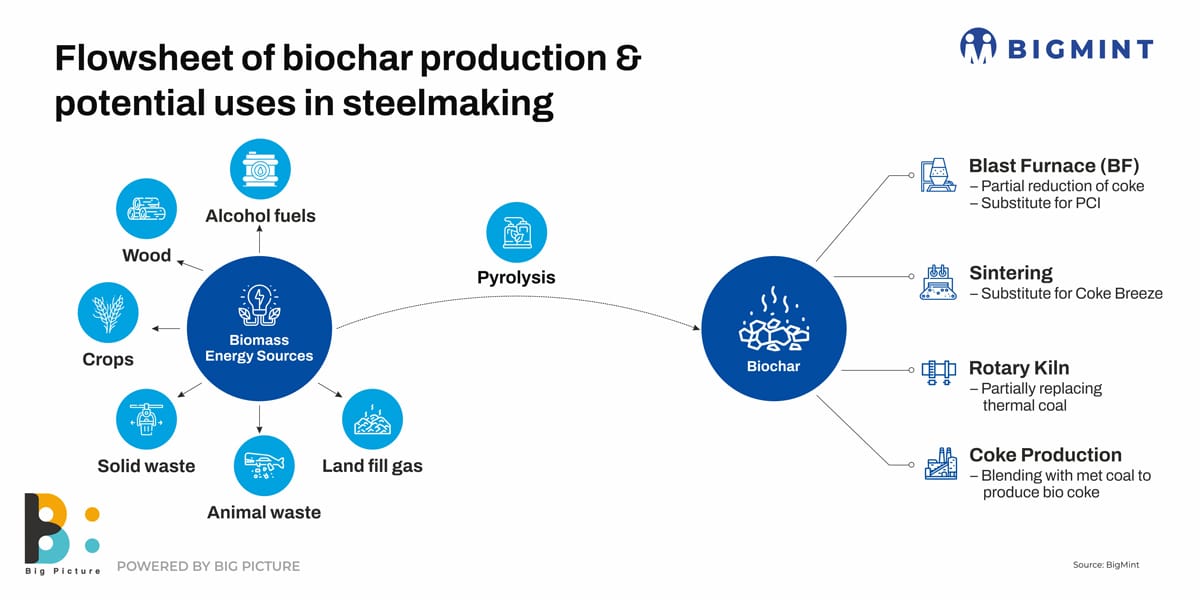
- Biomass can provide solid carbon, reducing gas, electricity, oil, and heat
- Cost-wise, biomass is a more viable CO2 mitigation lever than H2-DRI
For more than 150 years, steelmaking has depended on coal, coke, and fossil fuels. Blast furnaces, coke ovens, sinter plants, and basic oxygen furnaces were all designed around carbon from coal. Today, the steel industry emits nearly 7-8% of global CO₂ emissions, and therefore the future of steelmaking depends on replacing fossil carbon with alternative sources.
Hydrogen is one route, scrap recycling is another, but there is a third route that is less discussed and extremely powerful: biomass based steelmaking, where biomass replaces coal, coke, and fossil fuels across the entire steel plant.
The idea is not only to inject biomass into a blast furnace. The idea is much bigger. The idea is that biomass can provide solid carbon, reducing gas, liquid fuel, electricity, and heat, enough to run almost the entire steel plant. This is the concept of the biomass steel plant.
From biomass to steel: Conversion pathways
Biomass such as wood waste, agricultural waste, rice husk, bagasse, forestry residue, and organic waste can be thermally processed in two main ways: torrefaction and pyrolysis.
Torrefaction is a mild heating process at around 200-300°C without oxygen. It removes moisture and volatile compounds and produces a coal like material called biocoal or torrefied biomass. This material behaves like thermal coal and can be used in boilers, sinter plants, reheating furnaces, and pulverised coal injection systems.
Pyrolysis is a higher temperature process at around 400-700°C without oxygen. Pyrolysis produces three products: biochar (solid carbon), syngas (CO + H₂ gas), and bio-oil (liquid fuel). These three products together can replace many fossil fuel inputs in a steel plant.
Biochar, biocoal, coke replacement
In a blast furnace, coke has three roles: it provides heat, it produces reducing gas, and it provides structural support for the burden. Biomass cannot fully replace coke because the furnace still needs a strong structural coke skeleton, but biomass can replace a significant portion of coke and injected coal.
Biochar can replace coke carbon and injected coal carbon. Biocoal from torrefaction can replace pulverised coal injection or sinter fuel. In practice, the replacement is not one-to-one because biomass has lower carbon density. Roughly speaking, three to four tonnes of dry biomass are needed to produce about one tonne of biochar equivalent to coke carbon. This ratio depends on biomass type and pyrolysis efficiency.
Brazil has already demonstrated charcoal blast furnaces where charcoal replaces coke entirely in smaller furnaces. Several European steelmakers are testing biochar injection into large blast furnaces as partial coke replacement.
Syngas from biomass: Replacement for NG, reduction gas
The second and very important role of biomass is syngas production. When biomass is gasified or pyrolysed, it produces syngas consisting mainly of carbon monoxide and hydrogen. This gas is exactly the same type of reducing gas used in direct reduction ironmaking.
Therefore, biomass syngas can be used in DRI furnaces instead of natural gas reformer gas. This route is very promising because DRI furnaces do not need coke structure like blast furnaces. They only need reducing gas.
Biomass syngas can also be injected into blast furnace tuyeres to partially replace injected coal or natural gas injection. It can also be used in reheating furnaces, boilers, lime kilns, and power generation units within the steel plant.
This means biomass can replace natural gas, coal gas, coke oven gas, and part of the blast furnace reducing gas.
Bio-oil: Liquid fuel from biomass
Pyrolysis also produces bio-oil, a heavy liquid fuel similar to furnace oil. This bio-oil can be used in reheating furnaces, boilers, marine fuel, cement kilns, lime kilns, power plants, and various industrial furnaces. After upgrading and refining, bio-oil can be converted into diesel, aviation fuel, chemicals, phenols, resins, and synthetic fuels. This means the steel plant could replace furnace oil and fuel oil with biomass derived liquid fuel.
Running the entire plant on biomass
If we combine all biomass products, a future steel plant could operate like this: Biomass enters the plant. It is processed through pyrolysis and torrefaction. Biochar goes to blast furnace or electric arc furnace carbon injection. Syngas goes to DRI furnaces, reheating furnaces, or power generation. Bio-oil goes to boilers and reheating furnaces. Electricity generated from syngas and waste heat runs rolling mills and auxiliaries.
In this model, the steel plant runs on biomass plus electricity, instead of coal and gas. This is the concept of the biomass integrated steel plant.
Retrofitting existing BFs for biomass
Existing BFs can be modified to use biomass products. The modifications include biomass grinding and injection systems similar to PCI systems, gas injection lances for syngas injection, modifications in tuyere injection systems, storage and handling systems for biochar and torrefied biomass, and control systems for gas injection.
In addition, carbon capture systems can be installed on top gas systems. Carbon dioxide from blast furnace gas can be captured using pressure swing adsorption or vacuum swing adsorption. Captured CO₂ can be reused for dry reforming reactions to produce additional syngas or stored underground.
Top gas recycling blast furnace technology combined with biomass injection can significantly reduce coke consumption and emissions. These retrofits are much cheaper than building hydrogen DRI plants, which is why biomass blast furnace retrofits are receiving attention in Europe and Japan.
Economics of biomass steelmaking
The economics depend on biomass availability. Regions with large agricultural waste or forestry waste are best suited. Brazil, Scandinavia, Canada, Southeast Asia, and parts of India are good candidates.
Biomass is bulky but low energy density, so transport cost is important. Therefore, biomass steel plants may be located near agricultural or forestry regions rather than coal mines. If carbon pricing increases globally, biomass steelmaking becomes more economical because biomass carbon is considered carbon neutral.
Carbon neutrality explained
Biomass steel is considered carbon neutral because plants absorb carbon dioxide during growth. When biomass is converted into biochar or syngas and used in steelmaking, the carbon dioxide released is the same carbon dioxide that the plants absorbed earlier. Therefore, there is no net addition of new fossil carbon into the atmosphere.
Global examples
Brazil already uses charcoal blast furnaces for pig iron production. Several European companies are testing biochar injection in blast furnaces. Sweden is researching biomass reduction gas. Japan is studying biomass gasification for ironmaking. Austria and Germany are studying integrated biomass-steel concepts combined with carbon capture.
Future steel plant
The future integrated steel plant may not look like today’s coal-based steel plant. Instead, it may look like an energy-chemical-steel complex where biomass is converted into carbon, gas, oil, electricity and chemicals, and these products run the steel plant.
Biomass becomes the carbon source. Electricity becomes the energy source. Hydrogen becomes the reducing agent in some processes. Scrap becomes the raw material in electric arc furnaces. Carbon capture recycles emissions.
Steel plants of the future may not be coal plants. They may be carbon recycling plants powered by biomass and electricity.
This article is published by BigMint in collaboration with author Mr. R.V. Sridhar, Senior Independent Advisor, McKinsey & Co.
Leave a Reply