- Inventory build-up intensifies amid aluminium supply risks
- Policy shifts in nickel could reshape global supply dynamics
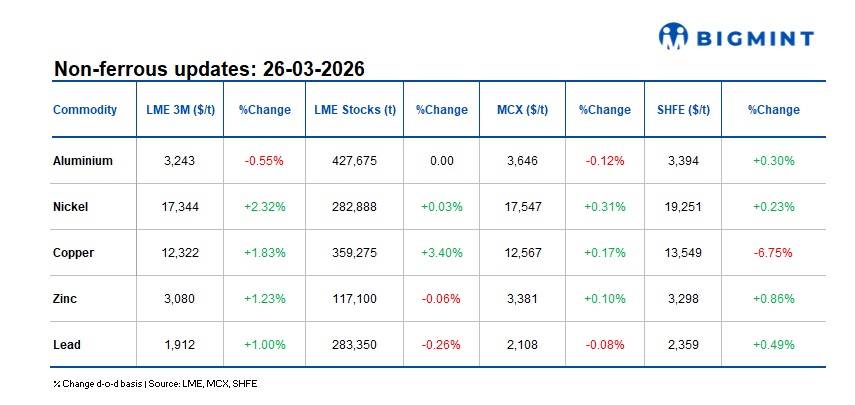
Base metals on the London Metal Exchange (LME) traded mostly higher d-o-d as of close of trading on 25 March, indicating an improvement in market sentiment. Copper led the gains, rising 1.83% to $12,322/t, followed by nickel, which increased 2.32% to $17,344/t. Zinc also advanced 1.23% to $3,080/t, while lead edged up 1% to $1,912/t. In contrast, aluminium slipped 0.55% to $3,243/t.
On the inventory side, trends remained mixed. Copper stocks increased 3.40% to 359,275 t, indicating relatively improved availability. Nickel inventories edged up marginally by 0.03% to 282,888 t, while aluminium stocks remained unchanged at 427,675 t. Zinc inventories declined 0.06% to 117,100 t, while lead stocks decreased 0.26% to 283,350 t, indicating a slight drawdown in warehouse levels.
Domestic market overview
India’s non-ferrous scrap market remained largely stable, reflecting cautious market sentiment. Aluminium tense scrap (loose), ex-Delhi, remained unchanged at INR 247,000/t, with similar stability observed in the ex-Chennai market, where prices also held steady at INR 247,000/t.
In contrast, copper armature scrap (Cu 99%), ex-Delhi, showed firmness in prices, increasing to INR 1,100,000/t from INR 1,070,000/t, marking a rise of INR 30,000 or 2.8%, indicating improved buying sentiment in the domestic market.
Other updates

Aluminium gains on Middle East supply disruptions
LME aluminium prices rose around 2%, supported by tightening supply amid disruptions in Gulf smelter operations and constrained shipments through the Strait of Hormuz.
With the Middle East accounting for around 8–9% of global aluminium output, force majeure declarations and production curtailments have tightened availability and lifted prices.
From an Indian perspective, higher primary prices are likely to support secondary scrap markets, including aluminium and copper-based scrap such as brass honey, by improving scrap competitiveness.
South Korea raises fuel price cap
South Korea has raised its fuel price cap and expanded tax relief, reflecting rising pressure from elevated global energy costs amid the Iran conflict.
Disruptions in flows through the Strait of Hormuz are increasing input costs for import-dependent economies, prompting policy intervention.
Higher energy costs are likely to raise primary metal production costs, enhancing the competitiveness of secondary scrap markets, including aluminium and copper scrap.
Global markets volatile as energy prices drive uncertainty
Global markets remain volatile, with mixed equity performance and elevated oil prices driven by Middle East supply disruptions. Rising energy costs are increasing inflationary pressures and supply chain risks.
Disruptions in key trade routes such as the Strait of Hormuz continue to impact global trade flows and market sentiment.
From a metals perspective, higher energy costs and uncertainty are expected to support base metal prices and boost scrap demand, including copper and brass honey.
Indonesia signals flexibility on nickel output amid elevated prices
Indonesia is considering easing nickel and coal production quotas if prices remain elevated, indicating potential supply-side flexibility.
As the world’s largest nickel producer, any policy shift could impact global supply dynamics, following earlier curbs that supported prices.
While easing may moderate volatility, continued policy uncertainty could keep markets sensitive, influencing scrap demand trends through primary supply fluctuations.
Leave a Reply