- West Africa bulk steady to firm, high freight caps fixing
- Gulf disruptions, surcharges and rerouting weigh on container trade
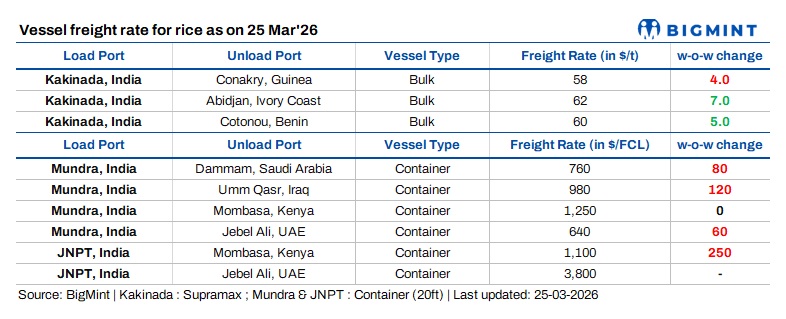
India’s rice export freight market remained under pressure as of 25 March 2026, with West Africa bulk rates firm w-o-w and container shipments disrupted by geopolitical tensions and rising surcharges.
Bulk market: Rates firm, but fixtures struggle
Freight sentiment improved slightly w-o-w on steady cargo flow and firm vessel supply, though elevated rates continued to restrict fresh fixtures. A market participant said, “Exporters don’t have stock currently, most of it is held by millers. That is why prices are stable, but new contracts at current freight levels are not viable.”
A trader explained, “When container or bulk freight increases, rice prices tend to adjust downward to match buyer expectations. The next 2-3 months could turn into a buyer’s market — let’s see, it’s a gamble.”
Container market: Gulf disruptions intensify, trade rerouted
Containerised rice shipments from India’s west coast witnessed heightened disruptions, particularly on Gulf and Middle East routes, as several shipping lines suspended or altered services due to ongoing geopolitical risks.
A rice trader told BigMint, “No direct service to Dammam; even Umm Qasr and Jebel Ali are shifting to multimodal routes. Cargo is now routed via Khor Fakkan, emerging as a key hub outside the Strait of Hormuz amid disruptions.”
“Freight rates rose with a $200 General Rate Increase (GRI), alongside a $180 Emergency War Surcharge (EWS) and additional war-related charges of $1,500-2,000 on select Gulf and Middle East routes,” sources said.
A ship broker added, “For the Far East and Gulf, the situation is worse. Currently, we are focusing more on exports to the USA and Europe.”
Rice market: Trade slows as freight costs hit margins
Exporters remain cautious amid elevated freight levels and operational uncertainties, with many market participants avoiding fresh commitments.
A trader noted, “It is a good time for some players, but we have been advised not to proceed with new sales until early April. The focus is only on execution.”
Another added, “Exporters are unable to absorb the freight increase. That is why movement is slow.”
Outlook
Freight sentiment in India’s rice export market is expected to remain under pressure in the near term, amid persistent geopolitical tensions, elevated surcharges and continued disruptions on key Gulf routes. While alternative routing via hubs such as Khor Fakkan may support cargo movement, high logistics costs and limited-service availability are likely to keep fixing activity subdued.
Leave a Reply