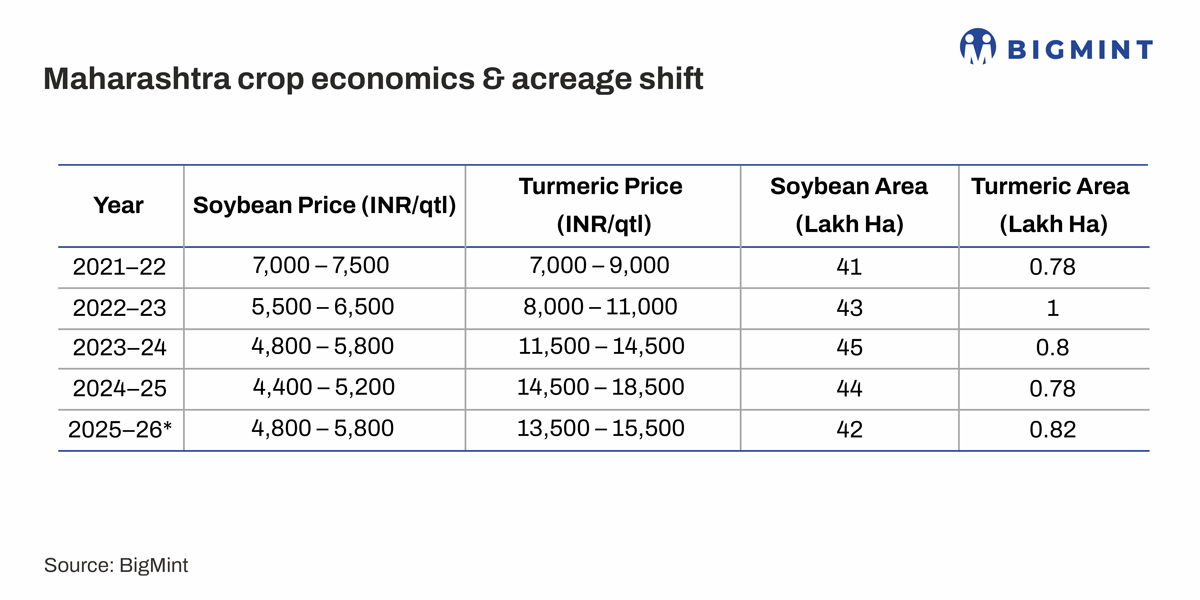
- Supply injection rises as soya farmers eye turmeric
- Exports impacted amid US-Israel war on Iran
India’s turmeric prices fell y-o-y in 2025-26 against the previous year’s levels but the moot point is, is this trend here to stay or just a seasonal shift?
Price trends
Average prices of the crop, as per BigMint data, rose sharply to INR 14,500-18,500/quintal in crop year 2024-25 (against INR 11,500-14,500/quintal in 2023-24) but fell back by INR 1,000-3,000/quintal to INR 13,500-15,500/quintal in 2025-26 with speculation rife that the downside support is firm which may not allow any further fall in the short to medium term.
Benchmark NCDEX futures hovered at INR 14,500-18,500/quintal (Nizamabad) and INR 15,800-19,500/quintal (Sangli). However, these dipped to INR 13,500-15,500/quintal and INR 14,500-16,800/quintal respectively in 2025-26.
Factors impacting turmeric prices downward
1) Soybean loses ground to turmeric: Turmeric prices rose sharply in 2024-25 as soyabean farmers, particularly in Maharashtra — India’s leading turmeric producing state — shifted to the former on account of poor price realisation in the latter. In fact, the last couple of years have seen soybean prices crashing to sub-MSP (4,892/quintal) levels of INR 4,400/quintal amid higher imports at domestic price parity or lesser from Brazil, Argentina, Chile and other locations. Due to this factor, there was injection of more supply within the turmeric market this year which has impacted prices downward.
2) Farmers migrate from other crops: The story was the same in other turmeric producing states which saw alternate crop prices tumbling to as low as INR 2,100/quintal, forcing them to migrate to turmeric. On the other hand, turmeric prices held firm because of insufficient supplies in the market over the past couple of years.
“Farmers usually follow a trend. If they see a particular crop fetching higher prices in a year, they go for it the following year. Prices of a particular commodity generally drop on higher supply, as it happened with soyabean. This same trend was seen as farmers migrated to turmeric,” informed a source.
3) Exports impacted by war: Exports offtake has become subdued because of the US-Israel was on Iran. Exports comprise around one-fourth of the production. India’s turmeric production rose a modest 0.9 lakh tonnes (LT) in 2024-25 to 12 LT, with exports at 1.76 LT, and is estimated to hover at a sluggish 11.8-12.2 LT in the current crop year of 2025-26. But exports are uncertain. Lesser exports would lead to more supply in the domestic market.
Outlook
Is this trend in turmeric here to stay or is it just a seasonal shift? This year, soyabean prices have rebounded so chances are that farmers may again go back to its farming since turmeric is an almost six-month long crop while soyabean spans three months. In such a scenario, turmeric prices may remain firm. Turmeric is harvested over mid-February till end-April while sowing spans June-July. On the other hand, soyabean is a kharif crop, sown in June-July but harvested during Diwali.
The turmeric season has just begun so there is still speculation as to whether farmers will revert to soyabean or stick to turmeric. The downside of turmeric is, they will not be able to grow a second crop, say chickpeas, because of the former’s longer duration. Soyabean, spanning a mere three months from sowing to market, offers benefit to farmers in the form of a quick second crop.
Exports offtake will also decide domestic prices. Thus, all eyes are on the current war.
Leave a Reply