- Accurate strip shape, temperature control and microstructure alloying are key
- HSM design influences which steel grades can be produced efficiently
For decades, discussions about steelmaking focused on blast furnaces, basic oxygen furnaces, and electric arc furnaces. These are the most visible machines in a steel plant. Yet in flat steel production, the true competitive battlefield lies downstream – in the hot strip mill (HSM).
The HSM ultimately determines strip thickness precision, shape and flatness, microstructure through controlled cooling, alloy efficiency, and production yield. In simple terms, it converts liquid steel’s potential into commercially usable steel products.
Modern HSMs are no longer just rolling machines. They function as thermomechanical metallurgical systems, where temperature, deformation, and cooling must be controlled with great precision. The technologies inside these mills have become critical for steelmakers aiming to produce higher quality and higher value flat products.
Reheating: First metallurgical control point
The first stage of a HSM is reheating. Reheating furnaces do far more than simply heat slabs; they establish the initial metallurgical conditions for rolling. Most modern plants use walking beam furnaces, where slabs are lifted and moved through the furnace instead of being dragged across skid pipes. This improves temperature uniformity, reduces surface defects, and minimises skid marks.
Recent advances in reheating include regenerative burners, low NOx combustion systems, oxygen enriched firing, and digital models that predict the internal temperature of the slab. These predictive furnace models allow mills to precisely plan the rolling schedule and maintain better process control.
Descaling and roughing
Before rolling begins, the oxide scale on the slab surface must be removed. High pressure water descaling systems operating at 200-400 bar clean the slab surface, improving final surface quality and reducing wear on the rolls.
The slab then enters the roughing mill, where heavy reductions occur. A typical 250 mm thick slab may be reduced to a 30-40 mm transfer bar. At this stage, the rolling process also destroys the cast dendritic structure created during continuous casting. Technologies such as edger mills and vertical stands help control strip width, while transfer bar thickness control ensures a uniform bar enters the finishing mill.
This stage also helps equalise temperature through the slab thickness, preparing the material for precise finishing rolling.
Coil box: Stabilising temperature
One of the most important innovations in modern hot strip mills is the coil box. Located between the roughing and finishing mills, the coil box temporarily coils the transfer bar. This reduces heat loss and equalises temperature along the strip length, minimising head-to-tail temperature differences.
Better temperature uniformity improves gauge control and reduces crop losses. Coil boxes are widely used in mills producing demanding grades such as pipeline steels and high strength structural steels, and some plants employ dual coil boxes for improved stabilisation.
Finishing mills: Precision matters
The finishing mill is the most critical part of the HSM. Typically consisting of six or seven high speed stands, it must control strip thickness and flatness within extremely tight tolerances. Modern finishing mills rely on several advanced control systems.
Hydraulic Gap Control (HGC) allows rapid adjustment of roll gaps, achieving thickness accuracy within 10-20 microns. Automatic Gauge Control (AGC) maintains strip thickness using feedback and predictive models.
Other important technologies include roll bending systems, roll shifting, and CVC (Continuously Variable Crown) rolls, which dynamically adjust crown profiles. Some mills also use Pair-Cross rolling, where rolls are slightly crossed to control strip shape. Together, these systems ensure stable rolling and precise strip geometry.
Laminar cooling: Creating the final microstructure
After the finishing mill, the strip moves across the run-out table, where laminar cooling systems determine the final microstructure of the steel.
Cooling is not merely about lowering temperature. By controlling cooling rates, mills can engineer specific microstructures. Slow cooling produces ferrite–pearlite structures. Faster cooling can create fine ferrite or bainite, while ultra-fast cooling enables dual phase and advanced high strength steels.
Modern systems include accelerated cooling and ultra-fast cooling, capable of cooling rates up to 300 C per second. Technologies such as SMS’s X-Roll Direct Compact Cooling provide highly uniform cooling while reducing water consumption and improving strength without additional alloying.
Downcoiling and digital automation
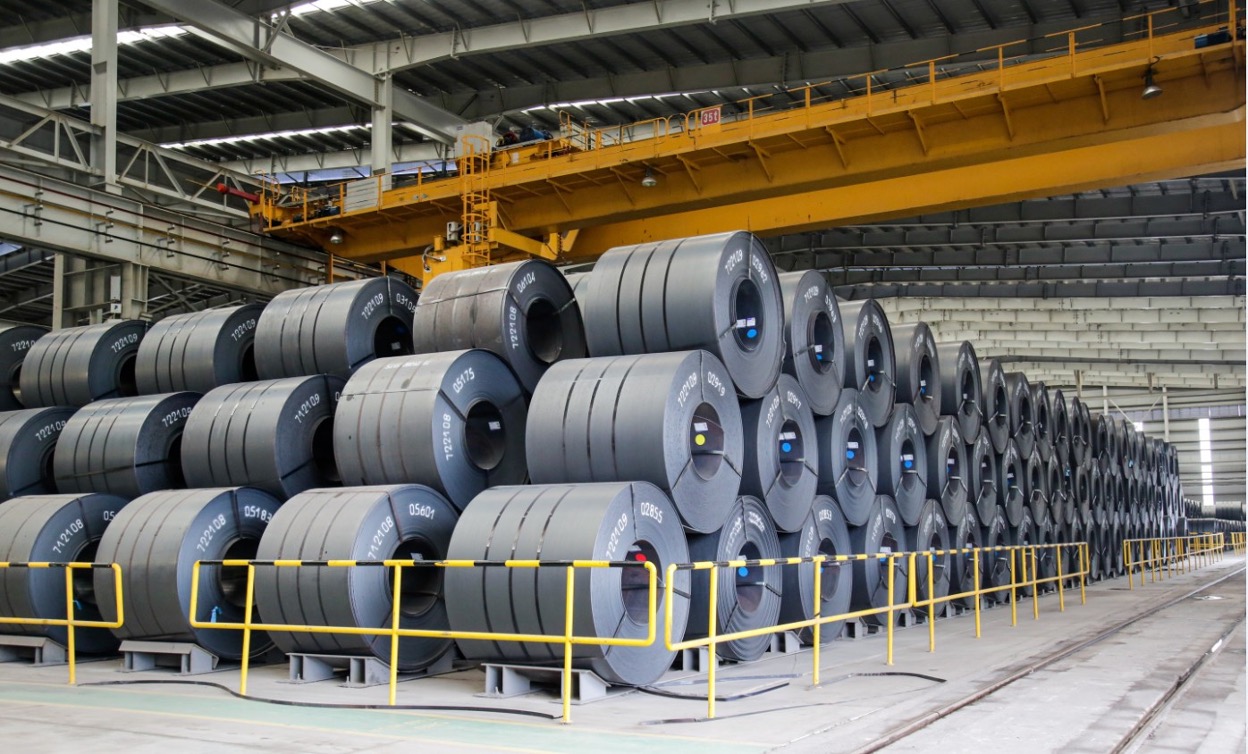
After cooling, the strip is wound into coils using mandrel downcoilers. Tension control systems maintain proper strip tension during coiling, while geometry control systems ensure consistent coil shape and density.
Today’s HSMs are also heavily dependent on digital automation. Systems such as SMS’s X-Pact automation platform integrate rolling models, thermal models, cooling control, and shape prediction algorithms. These systems continuously adjust roll gaps, rolling speed, cooling water flow, and inter-stand tension. The result is more stable strip quality, higher yield, and fewer manual adjustments by operators.
Integration with casting technologies
New steel plants increasingly integrate casting and rolling operations. Technologies such as CSP (Compact Strip Production), QSP (Quality Strip Production), and ESP (Endless Strip Production) reduce reheating energy, minimise temperature variation, and improve productivity.
In thin slab casting systems used in CSP and ESP plants, high casting speeds can cause slab bulging. Technologies such as Primetals’ anti-bulging systems stabilise the strand through improved roll support and dynamic force control, ensuring better slab quality before rolling.
Emerging innovations from Chinese suppliers
Chinese engineering companies such as CISDI and MCC have rapidly advanced their hot strip mill capabilities. They now offer full mill solutions with advanced hydraulic servo systems for precise roll control. Another innovation is the flying crank shear, which cuts moving strip without stopping the mill. Some Chinese mills can cut API X100 pipeline steel at full rolling speed.
Chinese plants also operate large width mills of up to 2,250 mm, enabling production of wide pipeline and structural products.
Matching mill design to steel grades
HSM design strongly influences which steel grades can be produced efficiently. Conventional thick slab mills from SMS and Primetals are best suited for automotive exposed sheet, advanced high strength steels, stainless substrates, and electrical steels.
Compact strip mills such as CSP and Danieli’s QSP are well suited for structural steels, HSLA grades, and pipeline steels up to X70.
ESP endless strip production excels at producing ultra-thin hot rolled strip for automotive and deep drawing applications. Chinese EPC mills have proven particularly strong in structural steels, HSLA grades, and pipeline steels.
Metallurgy behind hot rolling
Temperature strongly influences rolling forces because steel’s flow stress decreases as temperature rises. At higher temperatures, atomic vibrations increase and dislocations move more easily through the crystal lattice, making deformation easier.
During hot rolling, recrystallisation also plays a key role. Deformation generates dislocations and stored strain energy. At sufficiently high temperatures, new strain free grains form through recrystallisation, softening the steel and enabling further deformation.
At lower temperatures, however, recrystallisation slows or stops. Dislocations accumulate, work hardening occurs, and rolling forces increase. This regime is deliberately used in thermomechanical controlled processing (TMCP) steels to produce fine grain structures.
Heavy reductions in the roughing mill also break up the dendritic structure produced during continuous casting, effectively removing the steel’s “casting memory” and converting it into a wrought microstructure.
Modern mills compete on three capabilities: precise temperature control, accurate strip shape control, and microstructure engineering through controlled cooling.
Steelmakers that master these capabilities can produce thinner gauges, stronger steels, and higher value products, often with lower alloy content and lower cost. For this reason, the hot strip mill has quietly become the real profit engine of the modern steel plant.
This article is published by BigMint in collaboration with author Mr. R.V. Sridhar, Senior Independent Advisor, McKinsey & Co.
Leave a Reply