- Scrap supply shortage in Chennai supports steel prices
- Higher input costs squeeze sponge iron margins in Bellary
Steel prices in South India showed a mixed trend in the week ending 20 March 2026, influenced by divergent raw material movements. Prices remained firm in Chennai, supported by higher melting scrap costs. In contrast, Hindupur and Hyderabad witnessed softer sentiment, as easing sponge iron prices impacted semi-finished steel rates, leading to slight corrections and slower market activity across these regions.
Sponge iron and melting scrap
Sponge iron prices in the Bellary cluster declined by around INR 300-400/t w-o-w, primarily due to subdued buying interest from steel manufacturers. Moderately weak sales in finished steel demand led to cautious procurement, putting slight downward pressure on prices. Additionally, the inflow of lower-priced material from outstation suppliers into key markets intensified competition. This compelled local sponge iron producers to reduce their offers to remain competitive.
The conversion spread for sponge iron manufacturers has narrowed slightly due to the recent increase in key raw material costs, particularly iron ore pellets and non-coking coal. On 20 March 2026, iron ore Fe63% pellet prices stood at INR 11,000/t ex-Bellary. This has put pressure on margins, limiting overall profitability. If the trend continues, some producers may consider reducing their operating capacity.
On the other hand, scrap prices in the Chennai market climbed up due to tight availability. Reduced scrap generation, coupled with restricted LNG supply and elevated production costs, led suppliers to increase their offers. HMS 80:20 scrap prices in Chennai stood at around INR 34,000/t as of 20 March 2026, up nearly INR 700/t w-o-w.

Mild steel billet
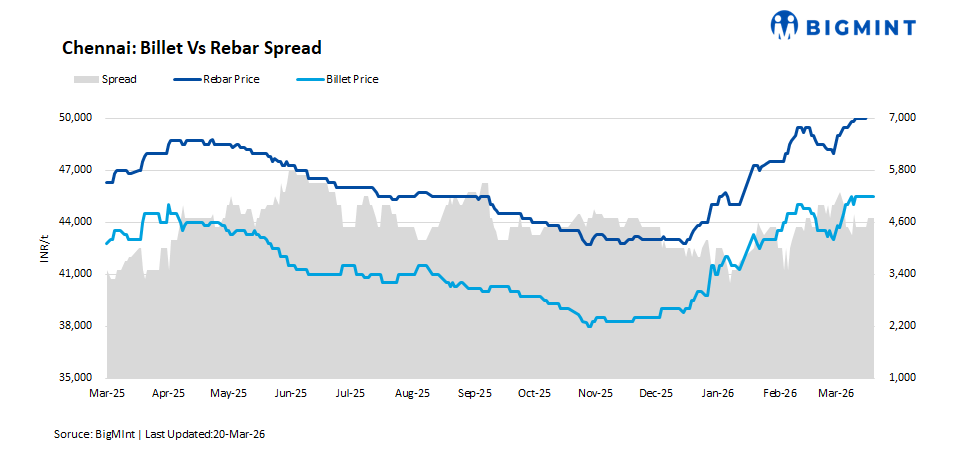
Mild steel (MS) billet prices across southern clusters showed a mixed trend during the week, influenced by varying raw material cost movements. In the Chennai market, higher melting scrap prices supported billet rates, leading to a slight upward movement.
Conversely, markets such as Hindupur and Hyderabad witnessed a marginal correction in billet prices. This was primarily due to easing sponge iron prices, which reduced input costs for manufacturers and, in turn, put mild pressure on billet prices.
On 20 March 2026, MS billet prices in Hyderabad were assessed at around INR 43,500/t (ex-works, with loading under standard payment terms), reflecting the overall balanced yet regionally varied market sentiment.
Rebar
Finished steel prices remained stable with a minor positive bias in the southern markets. Induction route (IF) rebar prices in Chennai rose slightly, mainly driven by higher input costs. On 20 March 2026, induction route rebar (Fe-500) prices for Chennai location stood at INR 50,200/t exw.
In Hyderabad, inventory levels at rebar mills remained tight, with most producers holding barely 5-7 days’ stock at plant premises. This indicates a balanced supply situation without immediate pressure to liquidate material.
Meanwhile, blast furnace (BF) route rebar prices in both Hyderabad and Chennai clusters stood at around INR 59,500/t (ex-yard), INR 400/t up w-o-w.
Leading steel manufacturers continue to offer induction route rebars in the local market at prevailing price levels, although selective discounts are being extended in offers to attract buying interest of customers :

Outlook
Steel prices in the southern region are expected to remain largely stable with a slight downside bias. This is mainly due to the financial year-end approaching, when market activity typically slows down.
During this period, many participants across the steel value chain tend to limit fresh procurement and focus on closing their books. As a result, buying interest remains subdued, which may restrict any significant upward movement in prices.
Additionally, steel producers are likely to prioritise liquidation of finished steel inventory and improving sales volumes rather than building raw material stocks. This cautious approach may keep prices either steady or under mild pressure in the short term.
Leave a Reply