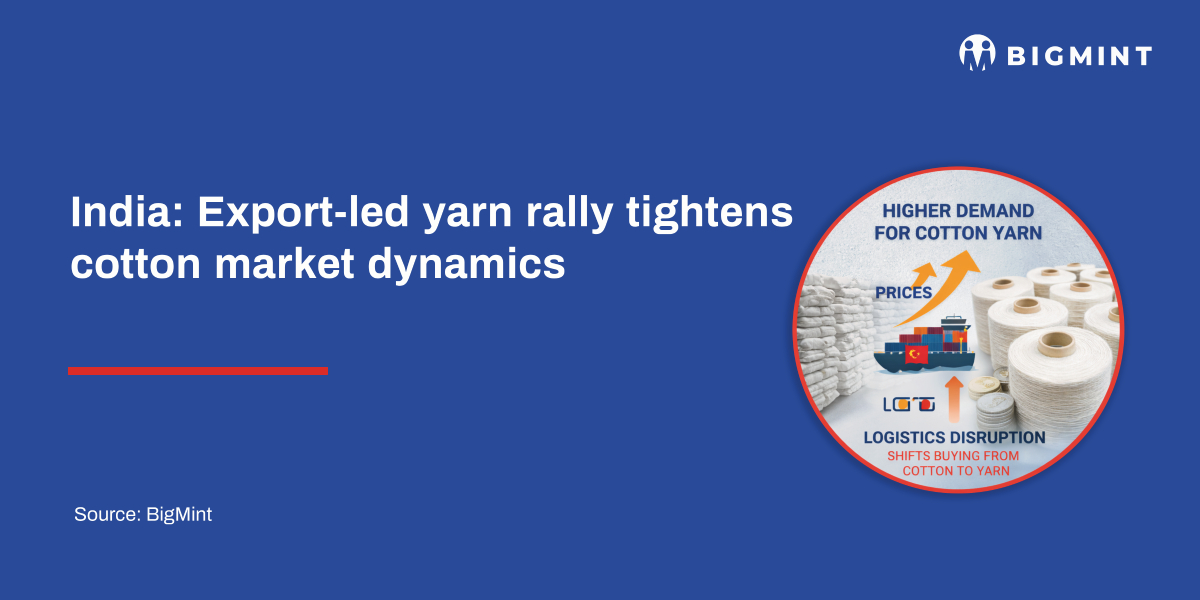
- China shifts to yarn buying, creating immediate demand shock
- Cotton prices gain but rally remains disruption-driven
India’s cotton market is currently being driven by a sudden and sharp shift in global buying behaviour, rather than a gradual demand recovery. China, along with Bangladesh and Vietnam, has aggressively moved to procure Indian cotton yarn due to delays in cotton shipments caused by West Asia-related logistics disruptions. With transit times increasing by 10-15 days and freight costs rising, buyers are prioritising faster availability over raw cotton sourcing. This has created an immediate demand spike in yarn, pushing prices higher by around INR 10-15 per kg and improving realisations for spinning millers.
This demand shock is now reflecting upstream. Strong yarn offtake has improved mill buying interest, tightening spot cotton availability and lifting domestic prices. The Cotton Corporation of India (CCI) raising prices by INR 1,200 per candy within two days clearly signals strengthening market confidence.
At the same time, global support remains firm, with ICE cotton futures rising nearly 13% in two weeks to around 68.78 cents/lb, reinforcing bullish sentiment across export-linked markets like India.
However, this is not a structural demand expansion-it is a supply chain-driven substitution effect. Chinese buyers are temporarily replacing cotton imports with yarn due to shipment uncertainties, not because of a fundamental increase in consumption. Even though China has increased its cotton import quota by 3 lakh tonnes (higher by 1 lakh tonnes y-o-y), immediate requirements are being fulfilled through yarn imports, creating a short-term imbalance in the yarn market.
The demand strength is strong enough for CAI to revise domestic cotton consumption upward by 10 lakh bales to 315 lakh bales, confirming that current offtake is real and measurable. For ginners, this means better price realization, while for spinning millers, improved yarn margins are currently offsetting rising cotton costs – a rare alignment supporting the entire value chain.
Going forward, the key risk lies in normalization of logistics. If shipment flows stabilize and cotton starts reaching China on time, the current yarn-led demand could cool quickly. This makes the ongoing rally event-driven and potentially short-lived, rather than a sustained bull cycle.
Trader takeaway:
Market has a clear short-term bullish bias, supported by export demand and global cues. However, this is a tactical rally, not a structural uptrend – ideal for trading strength, but risky to chase aggressively at higher levels.
Leave a Reply