- Fresh offers remain on hold amid elevated freight and shipment risks
- Cautious sentiment prevails amid ongoing geopolitical uncertainty
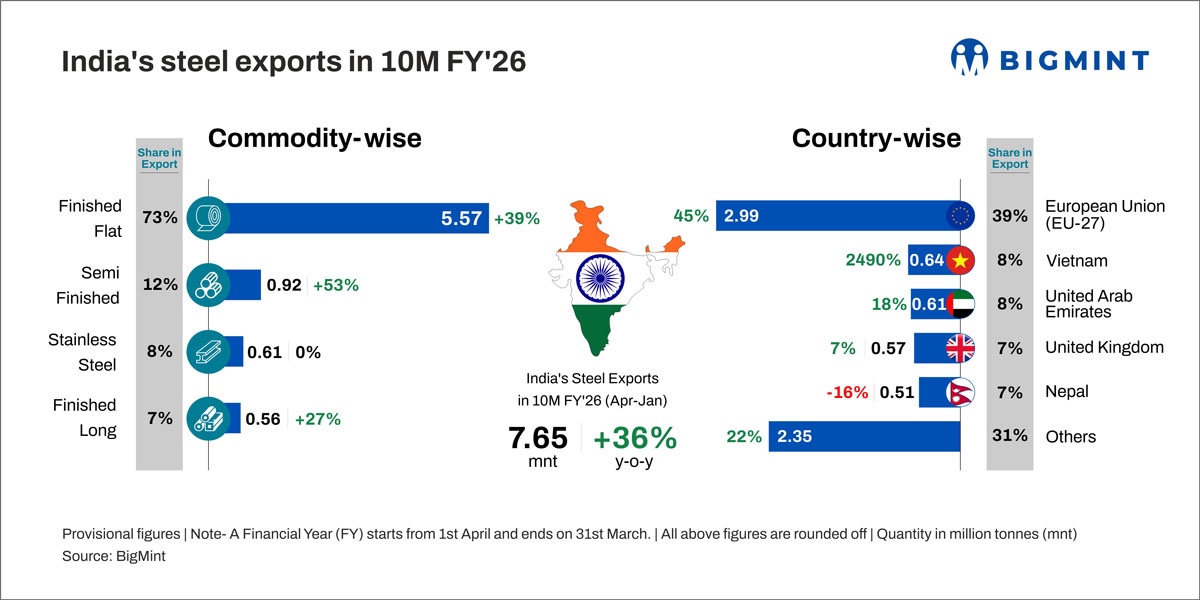
Indian HRC export offers remained absent w-o-w as the ongoing Iran-Israel-US conflict continues to disrupt key global shipping routes and reduce trade visibility. Exporters have largely stepped back from the market amid rising freight rates, elevated war-risk insurance premiums, and persistent uncertainty surrounding vessel movements. As a result, trade activity toward key destinations such as Europe and the Middle East has largely stalled, with market participants adopting a cautious wait-and-watch approach until shipping conditions stabilise.
HRC offers to Europe: Indian HRC export offers to Europe remained absent during the week, as security risks across key shipping corridors intensified. Several vessels are avoiding the Red Sea-Suez Canal route and are instead being rerouted via the Cape of Good Hope, extending transit times by approximately 15-20 days for shipments to Europe and the United States. This has not only disrupted delivery schedules but has also led to a sharp escalation in logistics costs, particularly freight and war-risk insurance premiums.
Market participants indicate that “freight rates from India to the EU have consequently surged by around 40-50%”, significantly eroding export competitiveness. In response, Indian exporters are holding back fresh offers, awaiting clearer direction on logistics and freight conditions. As a result, European buyers are also exercising caution and increasingly prioritising domestic sourcing amid uncertainty over import availability.
A Europe-based source indicated that already booked shipments continue to be honoured under existing contractual terms; however, shipping companies are not guaranteeing specific routes, highlighting ongoing uncertainty around vessel movements amid evolving security risks.
HRC offers to the Middle East: Export activity to the Middle East remains largely at a standstill, with no firm Indian HRC offers reported during the week as escalating geopolitical tensions continued to disrupt trade flows. The Strait of Hormuz, a vital corridor handling nearly 20% of global oil and LNG shipments, has emerged a high-risk zone, with rising missile, drone threats and ongoing attacks on merchant vessels significantly disrupting shipping activity and sharply increasing freight and war-risk insurance costs.
As a result, shipping companies and insurers have adopted a more cautious stance, with some vessels avoiding the route altogether and several carriers suspending operations in high-risk areas.
A Middle East‑based source indicated that the situation around the Hormuz corridor has significantly impacted shipments, particularly to and from the UAE, leading to production cuts and a potential temporary shutdown due to raw material shortages.
Similarly, no firm Chinese HRC export offers to the Middle East were heard this week amid ongoing uncertainty, with disruptions continuing to constrain trade flows to one of China’s key export destinations, which typically absorbs around 25-30 million tonnes (mnt) of steel annually.
Meanwhile, May 2026 HRC contracts on the Shanghai Futures Exchange (SHFE) rose by RMB 43/t ($6/t) w-o-w to RMB 3,303/t ($479/t) on 17 March, compared with RMB 3,260/t ($473/t) on 10 March 2026.

Outlook
The Indian HRC export market is expected to remain under pressure in the near term, as disruptions across the key global shipping routes continue to impact trade flows. Longer transit times, elevated freight rates, and higher insurance costs are likely to keep export activity subdued. Exporters are likely to remain cautious until shipping conditions normalise and geopolitical uncertainties ease.
Leave a Reply