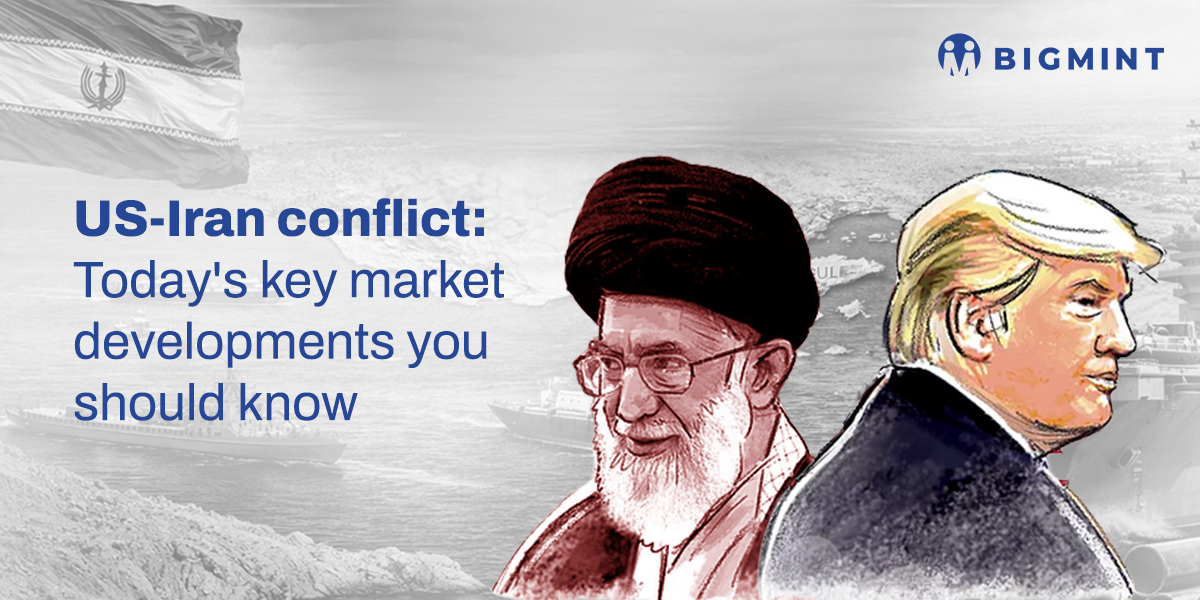
- Tanker attacks in shipping lanes disrupt global oil trade, push up war-risk premiums
- Bunker fuel surge, vessel rerouting raise freight and raw material costs
How will the ongoing conflict in the Middle East affect the global metals markets? As the US-Israel and Iran war escalates, BigMint presents a lowdown of the impact of this geopolitical conflict on the Indian metals, raw materials and energy markets:
Energy markets have entered a phase of heightened volatility after attacks on oil tankers and merchant vessels near the Strait of Hormuz disrupted shipping flows across one of the world’s most critical energy corridors. Brent crude futures climbed close to $100/bbl this week, while traders warned that continued attacks on tankers and threats to close the Strait could significantly tighten global oil supply.
Market participants estimate that disruptions in Gulf shipping lanes have temporarily removed a meaningful share of global seaborne oil flows from the market, forcing refiners to draw on strategic reserves and seek alternative supply routes. The International Energy Agency has responded by coordinating a 400 million barrel release from strategic reserves to stabilise markets amid one of the largest disruptions to oil trade flows in recent years.
The escalation has pushed insurers and shipowners to reassess risk exposure across the region. War-risk insurance premiums for vessels transiting the Gulf have surged, while some shipping companies have begun rerouting cargoes away from high-risk corridors. These disruptions are increasing freight costs and extending transit times across several commodity supply chains.
India has moved quickly to reduce exposure to potential disruptions through the Strait of Hormuz. The country is expanding liquefied petroleum gas import sources to include the United States, Norway, Canada and Russia alongside traditional Gulf suppliers to manage tightening global supply conditions.
India consumes roughly 33.15 million tonnes of LPG annually, with imports historically accounting for nearly 60% of demand from Gulf countries. To safeguard domestic availability, the government has instructed refiners to maximise LPG production and restrict industrial sales while prioritising supply for around 333 million household connections.
At the same time, India has accelerated diversification of crude procurement. Nearly 70% of the country’s crude imports now come from routes that bypass the Strait of Hormuz, helping limit exposure to shipping disruptions in the Gulf.
Steel
The escalation between the United States, Iran and Israel is reinforcing a cost-driven cycle in global steel markets as energy prices rise, freight rates increase and raw material costs strengthen. Much of the pressure is now emerging through maritime trade routes. Repeated attacks on oil tankers and merchant vessels near the Strait of Hormuz have increased war-risk premiums and insurance costs for ships operating in the region, raising the cost of transporting bulk commodities across key steel trade corridors.
Europe remains particularly vulnerable because of its heavy reliance on imported LNG supplies, while rising energy costs continue to weigh on industrial demand across automotive and manufacturing sectors. China exports roughly 25-30 million tonnes of steel annually to the Middle East, and disruptions to regional shipping routes could force Chinese mills to redirect shipments to Southeast Asia or domestic markets, increasing supply pressure across alternative export destinations.
Indian steel exports to the Middle East have also slowed as freight volatility and shipping risks disrupt trade flows. Cargoes already destined for Europe are increasingly being rerouted via the Cape of Good Hope to avoid high-risk shipping zones, extending transit times by roughly 10-20 days while significantly increasing freight costs. Domestic steel markets have softened slightly as buyers remain cautious amid freight volatility and geopolitical uncertainty.
Ferrous scrap
The conflict has pushed imported scrap markets across South Asia into a phase of rising prices and uncertain supply visibility. Freight disruptions and higher bunker fuel costs have tightened regional availability and increased replacement costs for mills relying on imported scrap cargoes.
Indicative prices for UK-origin HMS 80:20 delivered to India are now estimated near $370/t CFR, while shredded scrap cargoes are being discussed around $390-395/t. Pakistani mills have been actively booking cargoes and absorbing higher freight costs, which has further tightened supply availability for other regional buyers.
Freight costs have risen by roughly $20-30/t compared with normal shipping levels as insurers raise war-risk premiums and shipowners demand higher freight rates to compensate for security risks in Gulf shipping lanes. In some cases vessels are delaying port calls or rerouting away from sensitive maritime corridors, slowing cargo arrivals and tightening supply visibility across the regional scrap market.
Non ferrous metals
Aluminium
Aluminium markets have reacted more directly to the geopolitical tensions than most other base metals because of their heavy exposure to energy and logistics costs. LME aluminium prices remain above $3,300/t, while exchange inventories have continued to decline, reflecting persistent supply concerns.
Global aluminium premiums are also rising as buyers negotiate higher quarterly contract levels. Japanese buyers are discussing second-quarter premiums around $350/t, roughly forty percent higher than previous offers as freight disruptions, insurance costs and logistical risks across maritime routes support regional premiums.
In India both imported and domestic aluminium scrap markets remain firm despite cautious buying activity. Several secondary producers are operating at reduced utilisation levels due to logistical disruptions and uncertainty surrounding raw material arrivals. Imported scrap prices have reportedly increased by roughly $40–50/t in recent days.
Copper
Copper markets have shown limited direct reaction to the geopolitical tensions compared with energy or aluminium markets. Prices remain supported primarily by demand expectations and inventory trends rather than supply disruptions. Market participants note that the Middle East accounts for only a small share of global copper supply, limiting the immediate impact of regional conflicts on copper fundamentals.
Zinc
Zinc markets are being influenced mainly through energy and logistics channels rather than direct supply disruptions. Industry participants have raised concerns about potential LPG supply disruptions affecting galvanizing operations. LPG is widely used in galvanizing processes to heat zinc baths that coat steel components used in telecom towers and infrastructure projects. Any prolonged disruption to LPG supply chains could therefore affect galvanizing activity and downstream zinc consumption.
Coal and energy
Energy markets remain the most direct transmission channel through which the Middle East conflict is affecting metals supply chains. Brent crude futures climbed to around $100/bbl during the week amid tanker attacks and shipping disruptions in the Gulf, while concerns over a potential prolonged closure of the Strait of Hormuz continue to tighten global energy markets.
Thermal coal markets have also remained firm as buyers seek alternatives to gas supplies amid concerns about LNG availability and shipping disruptions across Middle Eastern trade routes.
Freight and logistics
Freight markets have become one of the most immediate pressure points across global commodity supply chains. Repeated attacks on oil tankers and merchant vessels in Gulf shipping lanes have forced shipowners, insurers and charterers to reassess risk exposure across the region. War-risk insurance premiums have surged while some shipping companies are avoiding high-risk corridors altogether.
Singapore very low sulphur fuel oil (VLSFO), a key benchmark for marine bunker fuel, surged to about $1,085.50/t on 12 March from roughly $515/t at the end of February. Because bunker fuel typically accounts for up to 60% of vessel operating expenses, the spike in marine fuel prices is pushing freight rates higher across bulk commodity shipments including iron ore, coal and steel products.
Shipping companies are increasingly rerouting vessels away from conflict-sensitive areas near the Strait of Hormuz and parts of the Red Sea, extending voyage distances and reducing vessel availability across global shipping markets.
These disruptions are raising landed raw material costs and increasing supply uncertainty across multiple commodities. If tensions persist or escalate further, tanker security risks, freight volatility and tighter gas supplies could continue shaping price movements across global metals and energy markets in the coming weeks.
Leave a Reply