- China halts March fuel exports to secure domestic supply
- Hormuz tanker attacks raise oil supply risks, market volatility
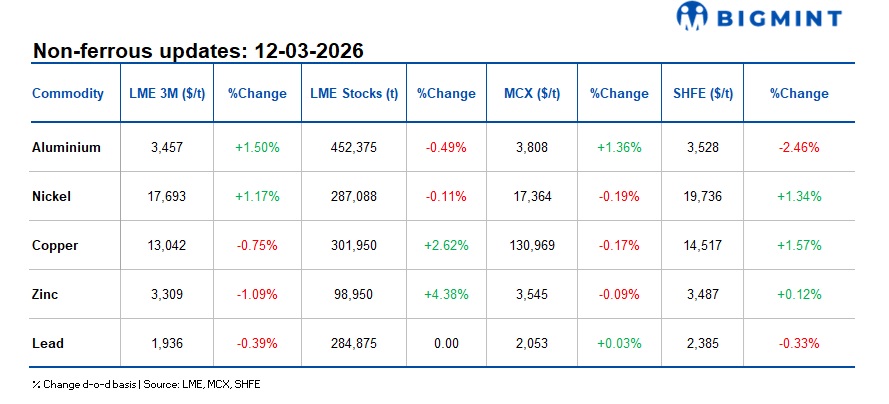
Base metals on the London Metal Exchange (LME) showed mixed trends but largely lowered d-o-d on 12 March 2026, reflecting cautious market sentiment. Aluminium gained 1.50% to $3,457/t, while zinc declined 1.09% to $3,309/t. Lead slipped 0.39% to $1,936/t, whereas nickel increased 1.17% to $17,693/t. Meanwhile, copper fell 0.75% to $13,042/t.
Warehouse inventory trends were also mixed. Aluminium stocks decreased 0.49% to 452,375 t, while zinc inventories rose 4.38% to 98,950 t. Nickel stocks edged down 0.11% to 287,088 t, and lead inventories remained unchanged at 284,875 t. In contrast, copper stocks increased 2.62% to 301,950 t.
Domestic market overview
Domestic non-ferrous scrap prices in India remained largely stable, supported by steady demand and cautious trading activity. Aluminium tense scrap (loose), ex-Delhi, increased by INR 1,500 or 0.6% to INR 233,000/t from INR 231,500/t, while ex-Chennai prices remained unchanged at INR 238,500/t.
Meanwhile, copper armature scrap (Cu 99%), ex-Delhi, also remained stable at INR 1,140,000/t, reflecting balanced market sentiment and steady buying interest.

Other updates
EU announces CBAM certificate price publication schedule
The European Commission has announced the timeline for publishing prices of certificates under the Carbon Border Adjustment Mechanism (CBAM) for 2026.
The first CBAM certificate price for Q1 2026 will be published on 7 April 2026, followed by 6 July 2026 (Q2), 5 October 2026 (Q3), and 4 January 2027 (Q4). The certificate prices will be calculated based on the average auction price of allowances under the European Union Emissions Trading System (EU ETS) during the respective quarter.
The CBAM framework applies to carbon-intensive imports such as steel, aluminium, cement, fertilisers, electricity, and hydrogen, aiming to align carbon costs between EU producers and importers while preventing carbon leakage.
Middle East conflict escalates as tankers burn in Iraqi waters
The conflict between the United States and Iran continues to escalate as attacks on oil shipping intensify in the Gulf region. Iranian-linked strikes reportedly set two oil tankers on fire in Iraqi waters, raising concerns over regional energy security.
US President Donald Trump said military operations will continue until objectives are achieved, indicating the conflict may persist. Iranian officials warned that prolonged instability could push global oil prices toward $200 per barrel.
The attacks have heightened fears of supply disruptions around the Strait of Hormuz, a critical corridor for global oil trade, increasing volatility in energy markets.
Iran continues oil exports through Strait of Hormuz
Iranian oil exports continue to move through the Strait of Hormuz despite disruptions affecting several Gulf exporters due to rising regional tensions.
Since the conflict began, Iran has shipped about 13.7 million barrels of crude, with tankers still navigating the strategic route despite security risks and reduced maritime traffic.
The waterway handles around one-fifth of global oil and LNG trade, and ongoing disruptions continue to raise concerns about global energy supply and price volatility
China orders immediate ban on fuel exports
China has ordered refiners to halt refined fuel exports for March with immediate effect to safeguard domestic supply amid rising global energy disruptions linked to the Middle East conflict.
The restriction covers gasoline, diesel, and aviation fuel, including shipments that had not cleared customs as of 11 March. Authorities had earlier advised refiners to avoid new export deals and cancel shipments where possible.
The move aims to prevent domestic shortages as geopolitical tensions disrupt global oil supply chains.
LME aluminium stocks fall amid growing supply concerns
Aluminium inventories at the London Metal Exchange (LME) have dropped sharply, raising concerns about tightening global supply.
Around 40% of LME aluminium stocks have been cancelled for delivery, mainly due to disruptions linked to the Middle East conflict and shipping risks near the Strait of Hormuz. Withdrawals from Port Klang, Malaysia have pushed inventories down to 452,375 tonnes, the lowest since July.
Tighter supply has pushed the market into backwardation, with cash aluminium trading at a $59/t premium over the three-month contract, indicating strong near-term demand.
Glencore faces copper strike risk amid new CEO incentive plan
Glencore is facing potential supply disruptions as workers at its Australian copper refinery plan strike action, raising concerns over production and downstream supply.
Meanwhile, the company introduced a new long-term incentive plan granting CEO Gary Nagle 1.5 million Career Share units, which will vest over several years based on performance targets.
The developments could influence investor sentiment as markets weigh labour risks alongside new executive compensation incentives.
Leave a Reply