- High-medium grade spread rebounds since mid-Jan’26
- Post-holiday restocking boosts demand for high-grade ore
Mysteel Global: The price difference between high-grade and medium-grade iron ore has rebounded sharply since mid-January, chiefly driven by a clear divergence in availability of the two ore types, Mysteel observes in a new report on the commodity. However, further upside room for the spread appears limited as steelmakers may curb high-grade ore use should the premium squeeze their profit margins.
As of March 10, the spread between 65% Fe Carajas Fines and 61.5% Fe PB Fines at Qingdao port in North China under Mysteel’s assessment had widened to a near five-month high of Yuan 132/wmt ($19.2/wmt), up by a striking 73.3% from the multi-year low of Yuan 75/wmt recorded on January 14.
Two factors fueled the rally, namely rising Carajas Fines prices in recent weeks and falling PB fines prices.
On March 10, Mysteel assessed the price of 65% Fe Carajas Fines higher by Yuan 26/wmt from early February at Yuan 905/wmt, while that of 61.5% Fe PB Fines had dropped by Yuan 14/wmt over the same period.
The uptrend in Carajas fines prices was mainly underpinned by tightening supply and resilient demand, the report notes. Heavy rains in Brazil during January had disrupted shipments, reducing subsequent arrivals of Brazilian iron ore at Chinese ports.
At the same time, demand for high-grade ores was robust, as the earlier narrowing of the high- and medium-grade spread had made blending high-grade ore with low-grade material more economical. In addition, active restocking of iron ore after the Chinese New Year holiday ended in late February further boosted demand, according to the report.
Consequently, inventories of Carajas fines across the 15 Chinese ports monitored by Mysteel have fallen steadily since the beginning of this year, with tradable supplies tightening in both East China and North China hubs, Mysteel’s survey found.
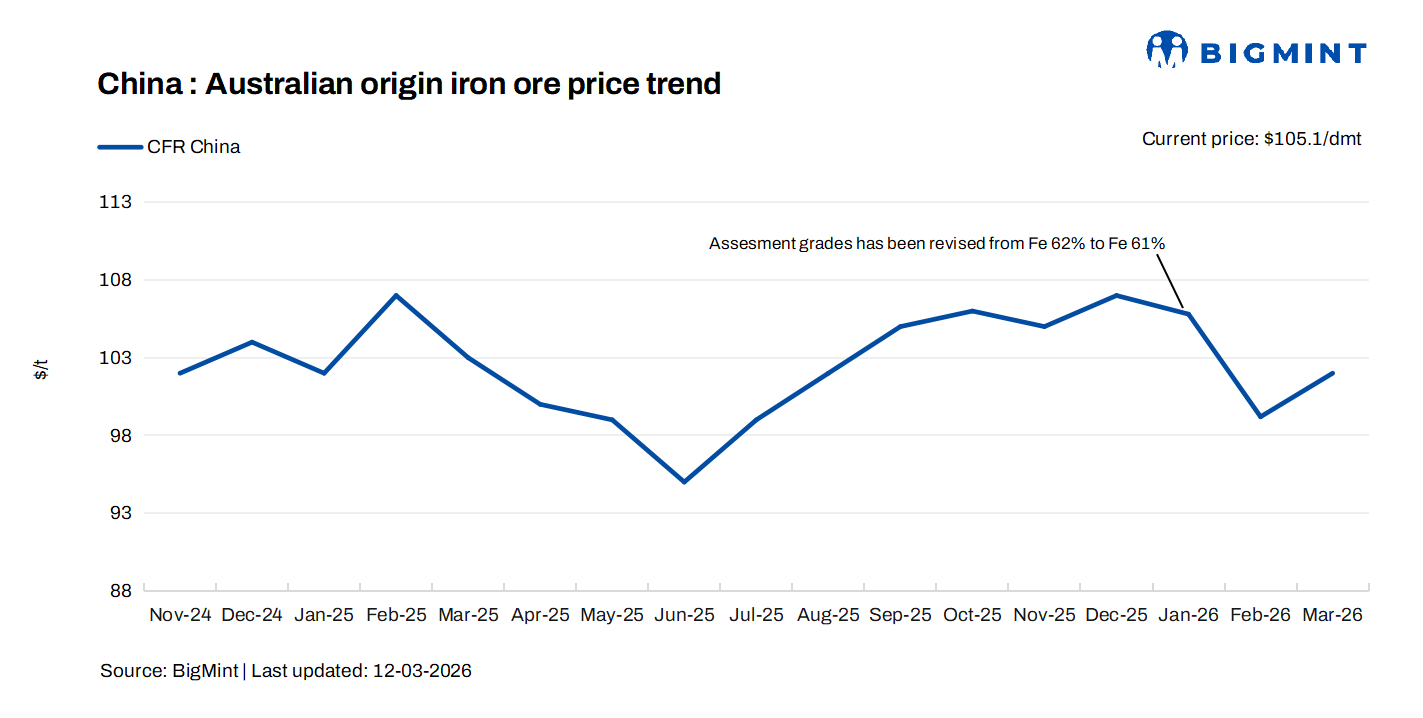
In contrast, supply of medium-grade ore tells a different story. After a brief disruption caused by cyclones off Western Australia in early February, shipments of Australian ore have recovered quickly. The pickup in arrivals of medium-grade materials at Chinese ports over recent months has resulted in ample supply, exerting downward pressure on prices.
Looking ahead, the high- medium-grade spread may hold firm for a short period, but potential for further gains is limited, with a pullback likely in the medium term, the report warns.
Production restrictions on steelmakers in northern China are expected to be lifted in coming days, paving the way for more blast furnace restarts and higher hot metal production. This should keep consumption of Carajas ore firm in the near term, along with prices. Nevertheless, steelmakers remain highly sensitive to raw material costs. As the premium for high-grade ore expands, it becomes less economical to blend these ores with low-grade equivalents. Several mills in East China’s Shandong told Mysteel that if the spread remains wide, they would seek to increase the ratio of medium-grade fines in their blends and scale back the use of Carajas fines.
“We will definitely cut back on purchasing Carajas fines if the (high-medium grade) spread reaches Yuan 140/dmt,” one mill source said. Meanwhile, imported or domestic concentrates could also serve as alternatives to Carajas fines if mills find the latter less cost effective, the report adds.
Should demand for Carajas fines soften, prices may come under pressure, particularly as arrivals of the ore are expected to recover gradually from April onward, following the end of Brazil’s rainy season. Under such conditions, the spread between high-and medium-grade ores would likely retreat from the recent highs, the report concludes.
Note: This article has been written in accordance with a content exchange agreement between Mysteel Global and BigMint.
Leave a Reply